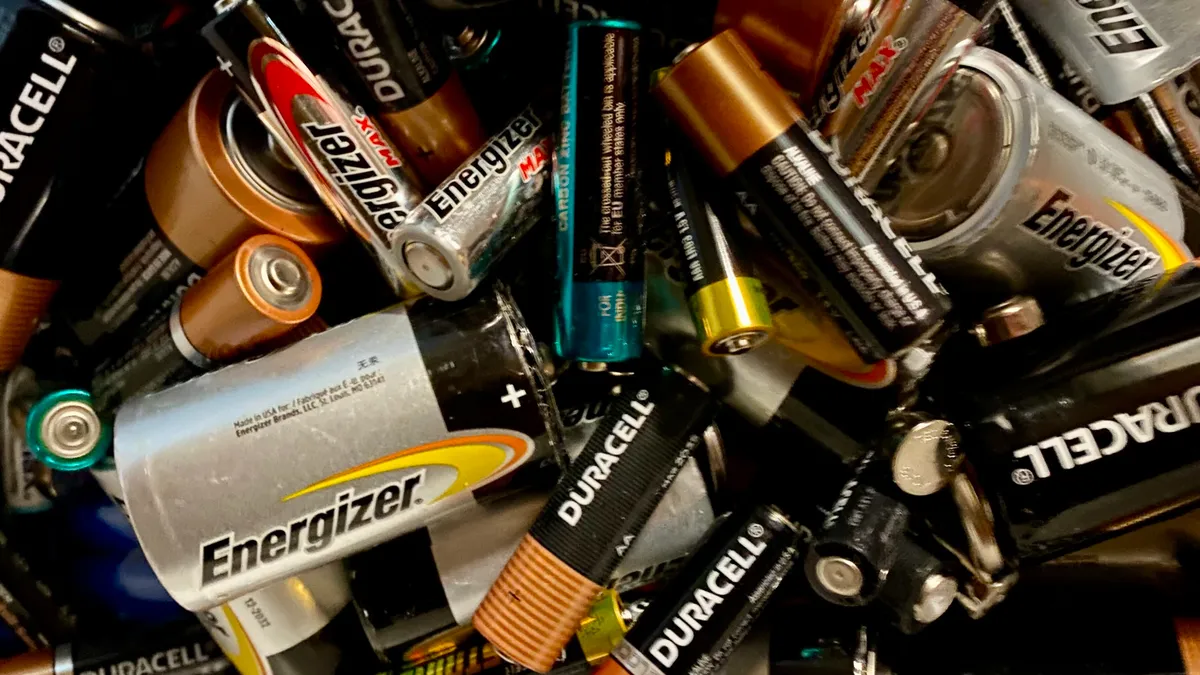
As the volume of portable lithium batteries from consumer devices grows, so does demand for systems to efficiently and safely collect them from consumers at their end-of-life and transport them to recyclers.
Redwood Materials, a Nevada-based battery recycler, recently introduced a first-of-its-kind in-store collection bin in San Francisco that accepts used batteries, even if they’re embedded inside devices. The Battery Network, the battery collection and logistics services company formerly called Call2Recycle, also recently introduced a time-saving system for preparing and shipping used batteries.
End-of-life lithium-ion battery management is a growing concern even outside the growing number of U.S. states that have passed battery extended producer responsibility laws, because they pose significant safety risks for local governments, collection vehicles and waste and recycling facilities.
When tossed into curbside recycling or garbage bins, they can spark fires after being crushed or struck. That’s evident in the steady rise in reported waste and recycling facility fires. Last year, the North American waste and recycling industry saw at least 448 fires, according to Ryan Fogelman, a fire safety consultant at Fire Rover. Fogelman said this was a record since he started tracking such fires in 2016.
But for recyclers and manufacturers looking to meet demand for domestically sourced critical minerals, those batteries, as well as some of the metals used in electronics, are resources to be mined.
Redwood’s collection strategy
Redwood, one of the largest battery recyclers in the United States, launched a system in mid-December that it hopes will both provide a steady supply of critical minerals and a means for reducing battery-sparked fires.
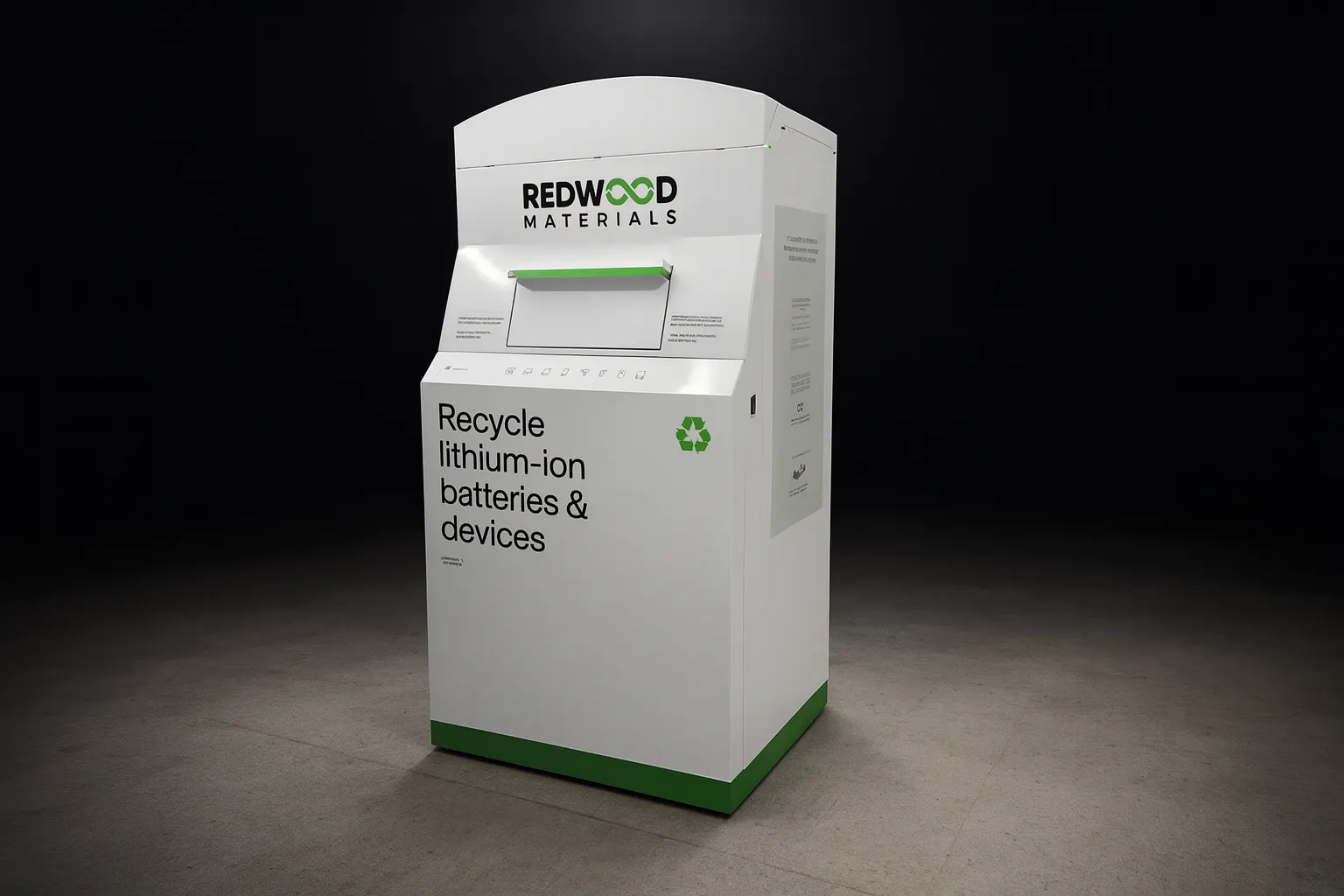
The company has installed the Redwood Battery Bin, a large, standalone metal container, in eight San Francisco retail stores. Inside sits a 55-gallon, vented drum — made by CellBlock, which sells fire containment systems for hazardous materials — as well as a reservoir holding fire suppressant granulate.
To drop off used batteries or battery-embedded products — whether that’s loose batteries, cellphones, battery-powered toys, toothbrushes, etc. — the user opens a slotted drawer and places the devices inside. As they close the drawer, the devices slide in. This trips an ultrasonic sensor which locks the drawer and triggers the reservoir to spread suppressant over the newly-placed items in the barrel.
When the barrel is full, the bin locks, flashes a red light and Redwood Materials gets an alert sent via an integrated transponder that transmits over the host location’s Wi-Fi network. This triggers a collection order to the Redwood logistics team to come swap the full barrel for an empty one.
That collection happens within 24 hours. "And often we do it within the hour,” said Haley Ketterer, who led the system’s design and is Redwood’s senior special projects manager. She said the company developed the system to provide an easy way for consumers to unload unwanted devices without having to decipher different battery chemistries. It also offers a place to send battery-embedded devices.
San Francisco’s waste hauler, Recology, does accept rechargeable, alkaline, or button batteries at the curbside — placed inside sealed plastic bags, on top of waste bins. Residents are directed to place tape over contact points on lithium batteries. But battery-embedded devices are not accepted curbside, except as part of scheduled bulky-item pickups.
Redwood does collect such items, both directly and through partners, depending on the location and volume. It then brings them to a Nevada processing plant. There, they are sorted by chemistry and processed into intermediate materials which can then be used to manufacture battery cells.
San Francisco promoted the bins through a social media campaign. “We’ve just had our third or fourth full load picked up,” said Zack Naour, general manager at one of three Sports Basement stores in San Francisco that is hosting a Redwood Battery Bin, said on Jan. 13. The bins have also been placed in four hardware stores across the city and in one mix-used commercial space downtown.
Naour said he expects demand among his customers will grow for recycling battery-embedded devices, because more and more of the camping and sports gear sold in the store is powered by integrated, rechargeable batteries. Items like headlamps, fitness sensors and bike lights, which used to be powered by removable batteries, now have integrated rechargeables.
Scaling awareness and collection
Last year, the National Waste & Recycling Foundation launched a public awareness campaign, aimed at reducing battery-sparked fires in waste and recycling infrastructure, that also hones in on outdoor gear.
President Michael E. Hoffman said the US Forest Service gave permission for the industry group to use Woodsy the Owl as part of its campaign, which it recently highlighted at the Consumer Electronics Shows in Las Vegas.
The NWRF booth featured a campsite motif and an Airstream trailer that contained a wide range of electronic devices. Nearly 2,000 CES attendees walked through the Airstream then took a quiz to guess which devices were battery-powered. Hoffman said many attendees — despite being “prolific users of technology” — were surprised by how ubiquitous batteries have become.
The campaign uses a carefully worded message: “Skip the Bin! Turn Your Batteries In!”
“We want to talk about battery recovery, because when I say ‘recycle’ you may easily default to throwing it into a recycling bin,” he explained.
Last fall, NWRF partnered with The Battery Network to launch the battery collection and awareness campaign, through collection events in Washington state, Washington D.C., and Illinois.
Founded in 1994 by a coalition of rechargeable nickel-cadmium manufactures, The Battery Network has offered collection bins for used batteries since 2010. But as the type and quantity of batteries that consumers brought to drop-off sites has increased, so has the time required for sorting and preparing the batteries for transport, said Todd Ellis, the nonprofit’s vice president of services and solutions. The network now covers more than 3,000 locations nationwide located within 15 miles of 80% of U.S. residents.
To address this, The Battery Network launched its OneDrum battery collection system in 2022. At the time, Ellis expected that most of the demand for the system would come from municipalities. But he was wrong — OneDrum is also being used by retailers and even MRF operators.
OneDrum comprises a 55-gallon metal drum from CellBlock and a large sack of granular fire suppressant. Whoever is assigned the role of battery sorter at the collection site, which at retail locations is usually a safety-trained employee, can place a layer of collected batteries, irrespective of battery chemistry, inside the drum. They then pour the fire suppressant on top, alternating batteries and the suppressant in layers that Ellis likens to building a parfait.
This saves time over shipping collected batteries in the cardboard collection boxes that The Battery Network offers, because no longer does someone need to tape the contact points on each battery before shipping.
While The Battery Network system is more manual than Redwood’s, it also has more scale. The nonprofit collected around 9 million pounds of batteries in 2025, according to Ellis. It has collected more than 160 million pounds of batteries since 1996. It also has partnerships with battery recyclers Ascend Elements and Cirba Solutions.
Transporting used batteries requires a special U.S. Department of Transportation permit. And moving high-energy batteries, with capacity at or exceeding 300 watt-hours, must be done under a separate DOT permit. These batteries, which power devices such as e-bikes and power tools, are not allowed in either the Redwood Battery Bin or the OneDrum. Both Redwood Materials and The Battery Network will take them separately, with contacts taped. The Battery Network also runs dedicated collection programs with makers of power tools and e-bikes.
Vapes and e-cigarettes are another troublesome category both in terms of fire safety and collection. The Battery Network does not accept them and Redwood Materials does not actively promote their collection. Vape waste collection programs, such as a pilot project in Missouri, are looking for large-scale solutions to safely process the devices.
With more EPR laws covering single-use and rechargeable batteries, Ellis said the volumes of material coming out of these states could grow up to five-fold.
“We need to be prepared for that not only with messaging but also with the convenient network aspect,” he said.
The OneDrum is designed to facilitate this, because neither consumers or collection sites need to worry about sorting batteries by chemistry.
As for Redwood, it plans to install 20 of its collection bins across Nevada this year as part of a statewide battery recycling initiative developed by a consortia of business, government, and academic partners.