Several publicly traded biogas companies reported strong results to end 2025, which executives said in March was a sign of continued demand for infrastructure development and renewable natural gas.
Among them, Canada-based Anaergia reported perhaps the biggest turnaround. The company recorded positive adjusted earnings before income, taxes, depreciation and amortization in the fourth quarter, with revenue more than doubling over Q4 2024. The company's full year 2025 revenue was 180.2 million Canadian dollars, up 61% over the prior year as well.
Executives attributed those results to the company’s pivot to a capital-light strategy. The company’s built, owned and operated assets now represent less than 10% of its total revenue.
CEO Assaf Onn also touted 257 million Canadian dollars in revenue backlog, meaning the value of payments under contract for the company's services, which was more than double the backlog at the end of 2024. He noted on the company’s earnings call that figure includes capital sales and operations and maintenance contracts.
Opal Fuels, another RNG infrastructure developer, reported strong growth both in the fourth quarter and for full-year 2025. Revenue was $349 million in 2025, up 16% year over year. The company also reported producing 4.9 million mmBtus of RNG in 2025, up 29% year over year, and it sold $42.9 million of investment tax credits associated with its facilities.
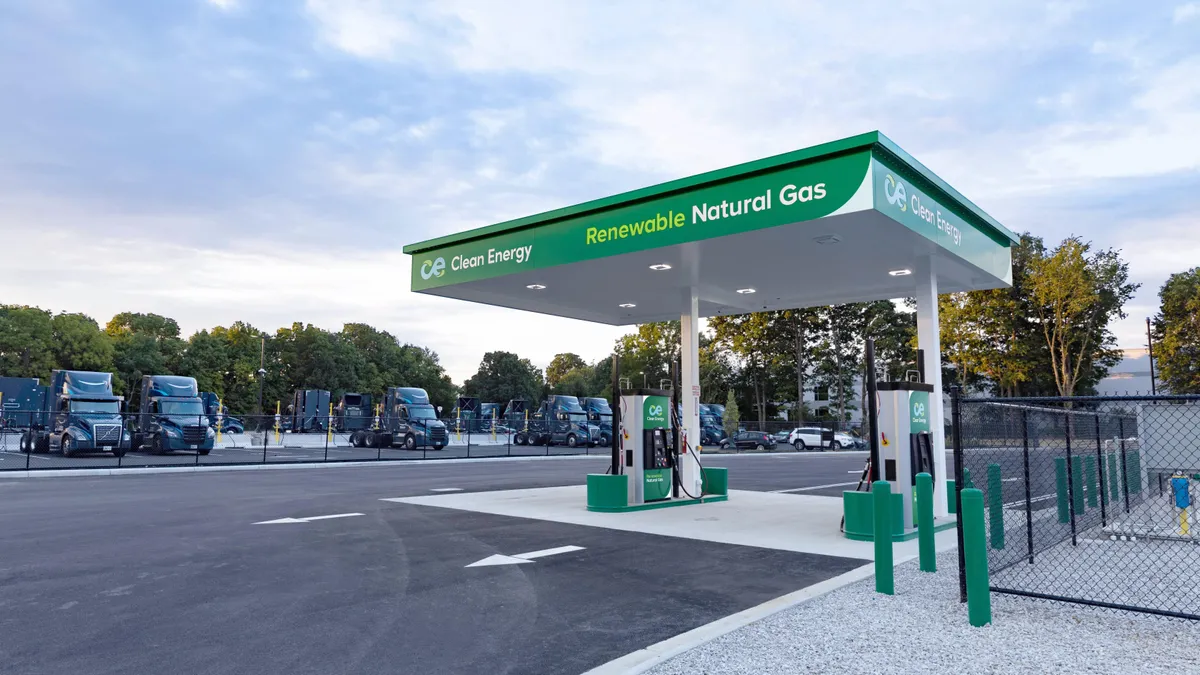
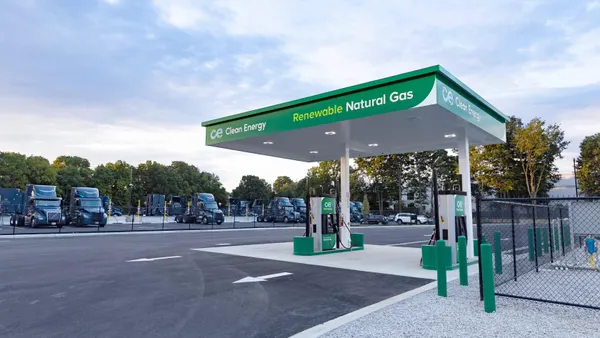
Meanwhile, Clean Energy Fuels reported selling a record amount of RNG last year. President and CEO Andrew Littlefair said despite broader fuel market volatility, the number of transit buses, refuse trucks and other heavy-duty trucks running on RNG all grew in 2025. The company reported improvements in its full year financials, with revenue up 2.1% to $425 million in 2025, though it recorded a net loss of $30.2 million.
Amid those tailwinds, Clean Energy Fuels is also expanding its upstream RNG production. The company recently began injecting gas from its East Valley dairy digester project in Idaho, part of a joint venture with BP. That project is expected to reach final completion in spring 2026. The company is also exploring an expansion of its South Fork Dairy project as the farmer there has grown his herd size.
Littlefair also projected confidence with California’s Low Carbon Fuel Standard credit market and the federal Renewable Fuel Standard credit market on the company’s earnings call, which occurred before the U.S. EPA finalized its rules for the RFS.
"It's never a dull moment in the RNG policy world, but 2026 has begun with encouraging signals across the major regulatory programs that affect our business," Littlefair said on the call.
Below is a selection of biogas industry highlights from March.
Waga Energy selected for New Jersey landfill project
The Cape May County Municipal Utilities Authority in New Jersey announced on March 10 that Waga Energy would build, own and operate a landfill-gas-to-RNG facility at the authority's Secure Sanitary Landfill. The facility is expected to produce 205,000 mmBtus of RNG annually, which it will inject into the local pipeline under a 20-year agreement.
The landfill serves 16 municipalities within the county and accepts about 180,000 tons of waste annually. Currently, the gas is used for power generation through a combined heat and power system.
This is Waga Energy's first project in New Jersey, but it has more than a dozen in the U.S. The company has continued to expand after private equity firm EQT Infrastructure acquired a majority stake in Waga in September.
Napa commissions anaerobic digestion facility
Zero Waste Energy, a subsidiary of equipment manufacturer Bulk Handling Systems, is set to build an anaerobic digestion facility for the Napa Recycling and Composting Facility in California, owned by the city of Napa, the project partners announced in March.
The facility will produce 500,000 diesel gallon equivalents of CNG annually, enough RNG to power 50 heavy-duty waste collection vehicles per year, which Napa Recycling's fleet will use. The project partners say the facility will also be designed to generate electricity from RNG in case the fleet makes a transition to electric vehicles in the future.
The project helps Napa meet its organic waste diversion requirements, and builds on an existing composting operation. The $30 million facility is expected to process between 32,000 and 44,000 tons of organic waste per year when it opens next year, The Press Democrat reported.
Nopetro Energy expands RNG fueling partnership
Nopetro Energy announced plans to develop its 15th Florida fueling station in partnership with the Central Florida Transportation Authority. The station will supply 100% RNG for Lynx, the authority’s bus service, as part of the company’s growing public-private partnership portfolio.
Nopetro integrates fueling infrastructure with landfill-gas-to-RNG development. It most recently announced a $50 million investment in a landfill gas facility in Manatee County.