This is the latest installment in Waste Dive’s Biogas Monthly series.
The annual international climate conference, COP30, ended this month without a new plan to curb fossil fuel emissions. But in side meetings, world leaders agreed to quadruple the use of "sustainable fuels" like biogas by 2035.
The Belém 4X Pledge on Sustainable Fuels was led by Brazil, Italy, Japan and India, and 23 additional countries endorsed the pledge during the climate conference. The Clean Energy Ministerial, an independent multilateral organization, is tasked with advancing the pledge.
The United States did not attend COP30, but it was a founding force behind CEM and remained active in the organization this year. The pledge is in line with major growth in biogas production in the U.S. in recent years.
The American Biogas Council estimates that the number of biogas systems turning food waste into renewable energy has increased 19% over the last five years, according to a news release. There are approximately 2,500 sites nationwide today producing biogas from all kinds of sources, according to the industry group.
Patrick Serfass, executive director of the group, said biogas, renewable natural gas and other sustainable fuels are “essential” for companies looking to quickly decarbonize, as they can be used as an immediate replacement for fossil fuels in transportation. He praised the Belém pledge in a statement.
“Scaling [sustainable fuels] up requires long-term, stable policies that grow demand and reflect their full lifecycle benefits. With better regulatory cooperation, aligned certification, and fair, transparent trade, we can unlock the full climate potential of sustainable fuels,” Serfass said.
The pledge also represents growing international interest in biofuels and their sources. The Global Methane Status Report, released ahead of COP30, found that the global waste sector is responsible for 20% of all anthropogenic methane emissions. At the climate conference, the Global Methane Hub unveiled a plan to cut 30% of methane emissions from organic waste by 2030.
The world remains far behind its target to limit global temperature rise to 1.5 degrees Celsius, a goal set in the Paris Agreement that emerged at COP21 nearly a decade ago. This year’s Belém pledge echoes an earlier agreement that nations should prioritize “transitioning away from fossil fuels in energy systems, in a just, orderly and equitable manner,” with an eye toward “technologically neutral” solutions like biogas-derived fuels.
Below is a selection of updates from the biogas industry.
WM highlights pair of RNG facility openings
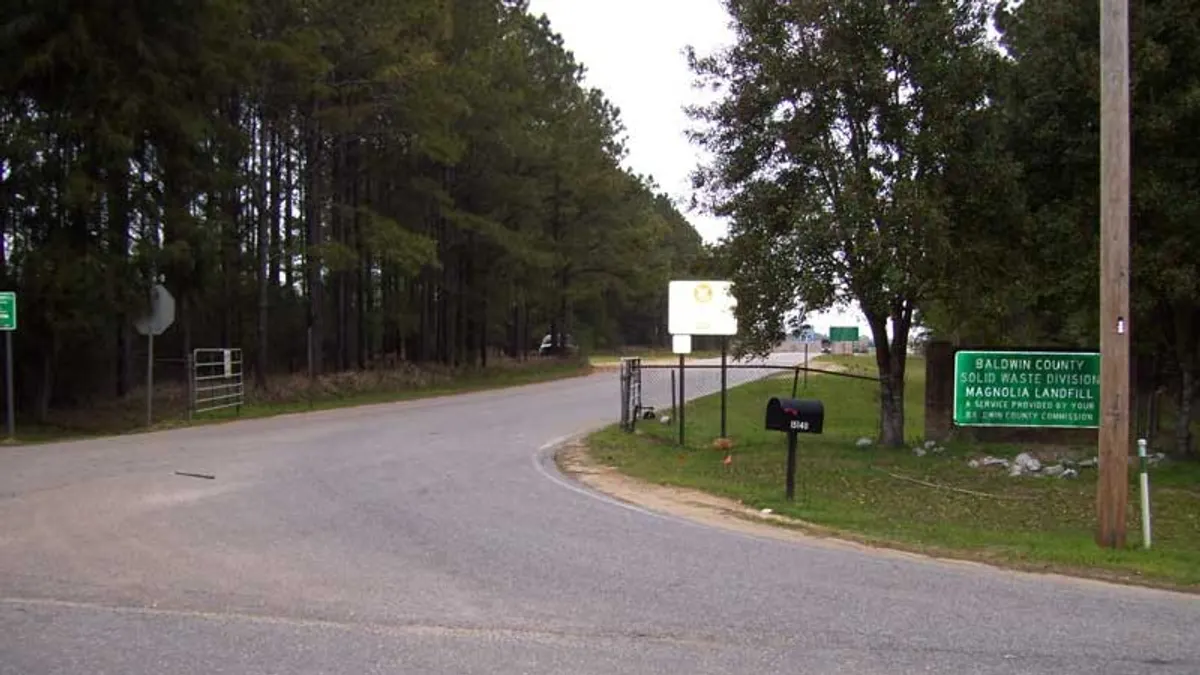
WM employees in Opelika, Alabama, celebrated the opening of the company’s $50 million Salem Renewable Natural Gas facility. The plant is expected to generate about 750,000 mmBtus of RNG annually and power a portion of WM's natural gas-fueled trucks.
The celebration followed the opening of a $78 million RNG facility in Okeechobee, Florida. The plant at WM's Okeechobee Landfill is expected to produce 1.5 million mmBtus of RNG annually, which will flow into the Florida Southeast Connection pipeline. WM also draws gas from that pipeline to power its fleet via a fueling station.
The two facilities are part of WM's company-wide goal to build 20 new RNG facilities from 2022 through 2026, a $1.6 billion investment. As of the opening of these two plants, the company already owns more than 20 RNG facilities across its portfolio.
Nopetro to build facility on Florida's Gulf Coast
Nopetro Energy is partnering with Johnson Controls to design, finance and build a $50 million landfill gas-to-RNG facility at the Lena Road Landfill in Manatee County, Florida. Construction on the project is expected to begin next year, with operations commencing in 2027, according to a news release.
The project will be owned and operated by Nopetro, and is the first on Florida's Gulf Coast. It is expected to generate an estimated 525,000 mmBtus of RNG annually once operational. Johnson Controls did preliminary design and engineering work for the RNG facility, as well as research into monetization and other development work, according to a spokesperson.
Nopetro also announced on Nov. 25 that Russ Boullion would become the company's vice president of commercial development in its RNG solutions division. In this role, Boullion will expand Nopetro's partnership with heavy-duty fleet operators. He previously held roles in the chemical logistics sector.
Founded in 2008, Nopetro operates 15 RNG fueling stations across Florida. It opened its first landfill gas-to-RNG facility in Vero Beach, Florida, in September.
Sparq Renewables' new RNG partnerships
Greenview Energy and Sparq Renewables, operating as the joint venture Meadowlark Renewables, are planning to build an RNG facility at the publicly owned Reno County Landfill in Kansas.
Meadowlark is planning to partner with Kansas Gas Service and Evergy for the project’s natural gas and electric utility service. Once permitting and right-of-way agreements are complete, the project will take about 18 months to build. It's expected to produce 210,000 mmBtus of RNG annually.
Sparq Renewables has launched several landfill-gas-to-RNG projects through partnerships. It previously partnered with NextEra Energy to develop a facility in Enid, Oklahoma.
Aemetis reports progress on dairy biogas
Renewable fuels company Aemetis reported $4 million in revenue from its 12 operating anaerobic digesters processing dairy manure in its third quarter earnings release published earlier this month. The company's digesters generated a combined 114,000 mmBtus of RNG in the quarter.
In September, the company completed its latest project extracting biogas from dairy cow manure. It plans to sell associated federal tax credits associated with the project for $20 million.