Dive Brief:
- The U.S. Department of Defense has published its updated 2026 interim guidance on the destruction and disposal of PFAS-containing materials, which explores options for cleaning up more than 700 DOD sites contaminated with per- and polyfluoroalkyl substances in water or soil.
- Hazardous waste landfills, incineration and some emerging technologies are on the list. Conversely, solid waste landfills and deep well injection options are less of a fit for DOD purposes due to either the risk of PFAS emissions or logistical constraints.
- The updated guidance also offers parameters the DOD must meet to consider whether the disposal and destruction methods safe and effective. Some environmental services companies say these details are important as they prepare to pitch their services amid the influx of PFAS-laden material.
Dive Insight:
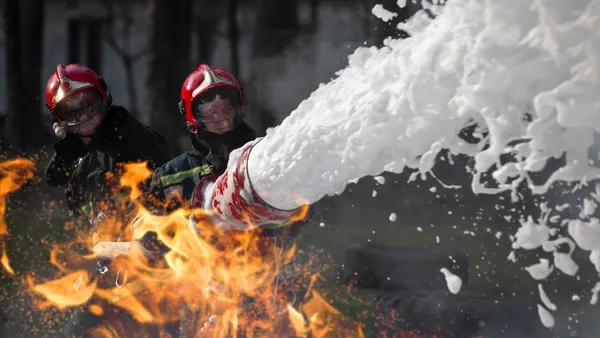
The agency is mulling options for managing more than 2 million gallons of legacy aqueous film-forming foam used to fight fires, along with about 1.5 million gallons of PFAS-contaminated equipment rinsate. The DOD’s drive to address PFAS in AFFF comes from a congressional mandate to phase out AFFF by October 2026, a deadline that was extended from a previous date of October 2023. The military has been working for a few years on strategies to safely offload a notable volume of PFAS-containing material, such as funding pilot programs and tech company demos.
The DOD has been using AFFF since the 1970s to suppress jet fuel fires and other petroleum-based fires. But the department has been prohibited from procuring new AFFF since 2023, and it’s in the process of replacing AFFF with new types of fluorine-free firefighting agents, known as F3, according to the document.
The DOD is also facing legal pressure related to thousands of AFFF-related lawsuits pending in federal court in South Carolina.
The DOD, which last published interim guidance in 2023, says its updated guidance document is meant to help it make informed decisions when evaluating available destruction and disposal options.
The DOD cites the U.S. EPA’s updated destruction and disposal guidance as an important influence in its own decision-making framework, because the EPA’s 2024 update offered more details on available technologies and encourages the use of destruction and disposal options that have a lower potential for releasing PFAS into the environment. This update came during the Biden administration, around the same time the EPA also determined certain PFAS as hazardous substances.
The resulting DOD guidance document covers some of the same options the EPA’s does. It notes that hazardous waste landfills offer a strong disposal option because of their high-level engineering controls that minimize the instances of PFAS release into the environment, such as double liner systems that offer leachate collection and leak detection. These facilities also keep extensive records, which adds accountability, the DOD says. This method was also listed as an option in DOD’s 2023 guidance.
However, the DOD has reevaluated its 2023 opinion on using solid waste landfills as a disposal option for concentrated AFFF or other liquid PFAS-containing materials. That’s partly in light of the EPA’s 2024 destruction and disposal guidance update, which noted these landfills may release more PFAS to the environment than previously thought, even with adequate composite liners and gas and leachate collection controls.
The DOD also mentions deep well injection options for liquid wastes, but said it “will rarely be an available option” for the DOD because it’s logistically difficult to transport the material, and the country currently has a limited number of wells that can accept offsite PFAS waste.
The DOD still lists hazardous waste incinerators as an option in its 2026 update, as long as key air quality regulations are met, it said. The department previously had a moratorium of PFAS incineration, which has since ended.
In the guidance document, the DOD noted that recent research continues to show improvement in this method, namely Clean Harbors’ recent work alongside the EPA and the Pentagon to test its high-temperature hazardous waste incinerator in Aragonite, Utah.
The most recent test found that Clean Harbors’ facility could destroy up to 99.9999% of PFAS chemicals in certain materials, an air emissions metric the researchers said is lower than the strictest ambient air quality standard.
The document also mentions Veolia North America’s 2025 study of PFAS destruction capabilities at its Port Arthur, Texas, incinerator, which “demonstrated high temperature incineration to be an efficient disposal solution for high concentrations of targeted PFAS.”
The DOD document also details other PFAS treatment methods it sees as viable because the technology is currently available on the market and is operating under an established permitting processes.
That includes carbon reactivation units, which use granular activated carbon to remove PFAS from water is one example of an established market, DOD said. There are about 17 commercial carbon reactivation units across the country, and four of those operate under the RCRA and air permits the DOD will need, it said.
Other emerging options the DOD will monitor include mechanochemical degradation, electrochemical oxidation, gasification and pyrolysis, and supercritical water oxidization, all methods “that show promise for PFAS destruction, production of few to no hazardous residuals or byproducts, commercial availability and cost effectiveness,” the DOD said.
The DOD notes that supercritical water oxidization is “one of the few non-incineration destruction technologies that have environmental permits or regulatory approval to operate at commercial locations.”
There are numerous PFAS destruction companies in the market today that are actively monitoring how state and federal guidance will influence tech adoption for destruction and disposal. These companies offer a range of methods mentioned in the guidance document.
The DOD’s openness to the method offers some business clarity for companies like Revive Environmental, which offers SCWO as one of its PFAS management methods. Companies that offer PFAS remediation services may use the DOD guidance document as a way to focus business pitches by matching services to government agency requirements, said CEO Rick Gillespie in a statement.
“Regulators and base commanders have consistently looked for the same thing, verified destruction at a permitted facility,” he said.
The DOD’s recent guidance update “will encourage organizations to select PFAS destruction solutions that not only work but also protect communities and the environment permanently,” the company said.