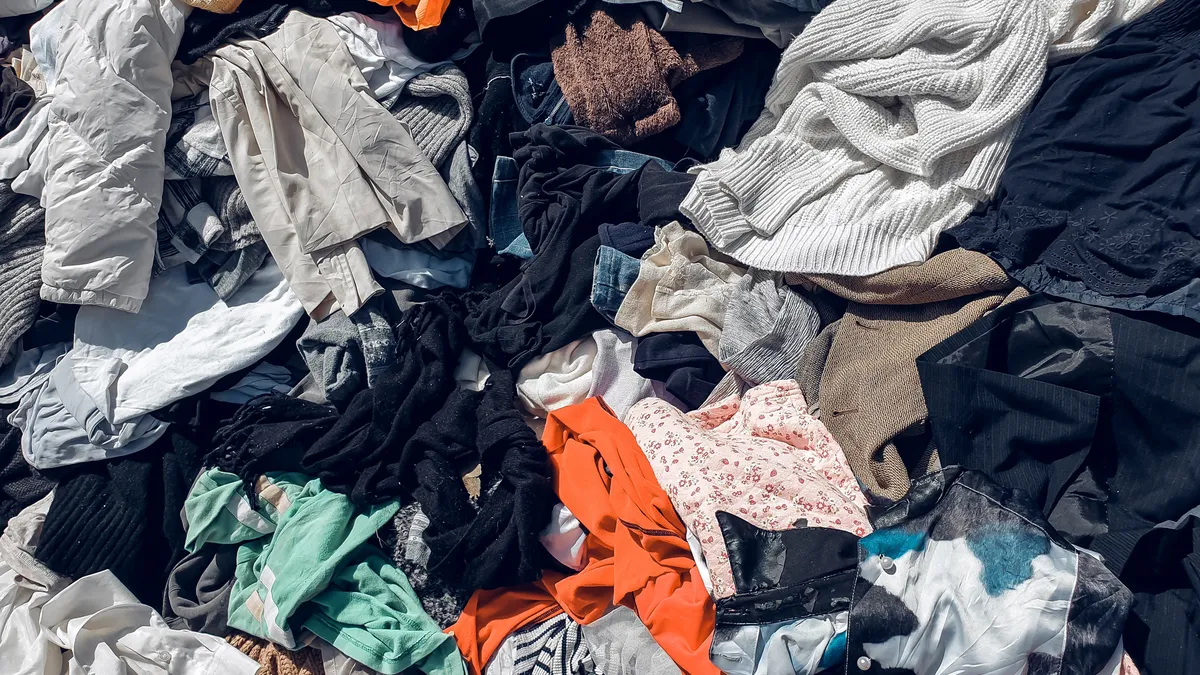
Textile recycling efforts are gaining interest across the country, partly as a response to the growing amount of textiles in waste and recycling streams. State legislatures in New York and Washington this year are mulling bills that could establish extended producer responsibility programs to divert clothing and other materials from disposal.
Meanwhile, California is moving forward with the implementation process of its textile EPR law that passed in 2024. It’s currently mulling producer responsibility organization proposals from three groups.
Here are some recent textile recycling policy updates. Where are textile recycling initiatives picking up steam in your area? Let us know at waste.dive.editors@industrydive.com.
Washington lawmakers again pursue EPR for textiles
Washington state lawmakers have reintroduced textile EPR bill HB 1420. The bill would require manufacturers of certain apparel and other textile products to establish a producer responsibility organization, which will fund statewide programs for reuse, repair and recycling.
By Jan. 1, 2027, producers of textiles and fashion apparel would be required to join a single PRO, though the state could allow for multiple PROs after Jan. 1, 2036, according to the bill. The program would be fully implemented by January 1, 2032, according to a bill analysis.
The bill exempts sellers of secondhand products and sellers with less than $1 million in aggregate turnover. Apparel producers with an annual worldwide income of over $100 million would be subject to additional requirements, such as sharing details of the company’s environmental impacts, recycled content use and working conditions of its direct suppliers.
It would require the PRO to prepare a needs assessment, manage collection sites for textiles, and provide for the transport, handling and management of such textiles.
The bill also calls for repair and reuse to be a major element of the law, similar to the law that passed in California in 2024. Supporters include Zero Waste Washington, which applauded the bill’s waste diversion efforts. The Washington Retail Association opposes the bill, saying the state’s infrastructure may not be ready for the program and that it may raise costs for producers and consumers.
New York’s textile EPR bill is back
New York lawmakers have also reintroduced its EPR for textiles bill, this time as S3217A. This bill would also require apparel and textile producers to form a PRO and fund reuse, repair and recycling programs for the materials. Lawmakers introduced a similar bill last year.
This bill would ban textile waste disposal three years after the law goes into effect. It also calls for the PRO to establish convenient and free textile collection points and organize outreach efforts to residents to educate them about their recycling or collection options.
New York’s bill also calls for a minimum 30% textile recycling rate for textiles within five years of the program’s start. Of that, 10% must be considered “closed loop” recycling. Within 10 years, that recycling rate would go up to 50%, with 20% of that closed loop. After 15 years, the recycling rate would be 75% with 40% of that considered closed loop, according to the bill.
The state would also establish a textile stewardship advisory board with members representing producers, retailers, recyclers, waste disposal associations, recycling associations and other stakeholders.
California mulls PRO proposals
California is mulling three proposals from organizations that want to become the producer responsibility organization for the state’s EPR for textiles program, CalRecycle announced last week. It will approve a PRO by March 1.
California’s EPR for textiles law aims to offer more options for recycling, repairing and reusing old clothing and textiles by 2030, and the PRO the state ultimately chooses will be in charge of implementing such statewide programs. The applicants are Landbell USA, the Textile Renewal Alliance and the Circular Textile Alliance.
Landbell USA is part of Germany-based Landbell Group, which operates 42 other PROs in 18 countries around the world, including for some textile EPR programs.
The Textile Renewal Alliance is made up of members from the California Retailers Association, the American Apparel & Footwear Association and the National Retail Federation. TRA established a working group to help provide input to the prospective PRO, with members including WM, the California Product Stewardship Council, the Secondary Materials and Recycled Textiles Association, the Salvation Army, Reju and Goodwill.
The Circular Textile Alliance is a nonprofit founded by fashion and textile industry professionals and has worked with apparel companies since 2008 on initiatives to make their products more sustainable, according to its application.