Dive Brief:
- Across the globe, annual waste production could increase by 50% by 2050 if countries continue with their “business as usual” approach to waste management, according to the World Bank’s new What a Waste 3.0 report.
- That’s from a 2022 baseline, when the world generated about 2.6 billion metric tons of municipal solid waste. That volume could increase to 3.9 billion metric tons by 2050. About 30% of waste generated worldwide is not managed properly and is instead dumped or left uncollected.
- Investments in waste management improvements, jobs and waste-specific policy could reduce that statistic, according to the report. Addressing disparities between how high-income and lower-income countries manage waste can also help close this gap.
Dive Insight:
The report reflects how nations are working on solid waste management issues “in the context of a transition toward circularity,” incorporating data from 217 countries and 262 cities. The 2026 report is an update to similar ones the World Bank published in 2012 and 2018. The 2018 report estimated that global waste generation would increase by 70% by 2050, but the new version puts that figure closer to 50%.
But the 2026 report also underscores the urgency for better waste management solutions in the face of rapid population growth and urbanization, along with increased consumption, which is accelerating waste generation around the world.
“Although solid waste is generated locally, its impacts—and opportunities—are global,” said Ming Zhang, World Bank’s global director for Urban, Subnational Finance, Tourism, and Disaster Management, in the report’s introduction.
Waste is an “underestimated threat to our shared future,” Zhang said, because of the impacts waste mismanagement can have on communities and the environment. For example, trash discarded along a street could blow into a waterway and be carried out to sea, while discarded food waste can contribute to methane emissions that in turn affect the whole planet.
Waste generation is growing most quickly in Sub-Saharan Africa and South Asia, according to the report. Waste generation there is expected to rise by 124% and 99% respectively by 2050.
Globally, food waste makes up the largest share of the municipal solid waste stream, accounting for about 38%. In low-income countries, this is closer to 52% and also includes garden waste.
The World Bank names composting and anaerobic digestion as the most sustainable options for managing this waste, but only 6% of waste is managed this way around the world. In low-income countries, it’s less than 1%.
Plastics make up about 12.5% of municipal solid waste globally. Plastic waste is a “significant concern” because almost 29% of it is mismanaged around the world, the World Bank states. That’s about 93 million metric tons that are not managed or “poorly managed” in uncontrolled facilities like dumpsites. About 16% is never collected.
Middle-income countries are the leading source of “unmanaged plastic waste” generating about 87% of the global total. Sub-Saharan Africa, South Asia, and East Asia and the Pacific produce the largest quantities, the report states.
Efforts to target plastic waste issues through government policies are one way to reduce such pollution, the report states. About 88% of countries have some kind of national policy targeting plastics through upstream measures such as taxes, bans, and fees on imports or production.
Meanwhile, extended producer responsibility is another option that’s gaining popularity, including in the U.S. “However, its practical implementation to date has largely been limited to high-income countries,” the report notes.
This is just one example of the ways economic disparities affect waste management practices around the world, the report states.
Waste collection rates show “stark disparities across income levels and regions,” the report says. High and upper-middle income regions such as North America have collection rates of “close to 100%,” in part because of access to controlled and regulated facilities like landfills and recycling facilities. Upper-middle-income countries have about an 89% collection rate.
Lower-middle-income countries collect 61%, while low-income countries have about a 28% collection rate, according to the report. Just 3% of low-income countries have access to controlled waste facilities, meaning most waste is not collected or is diverted to informal dump sites.
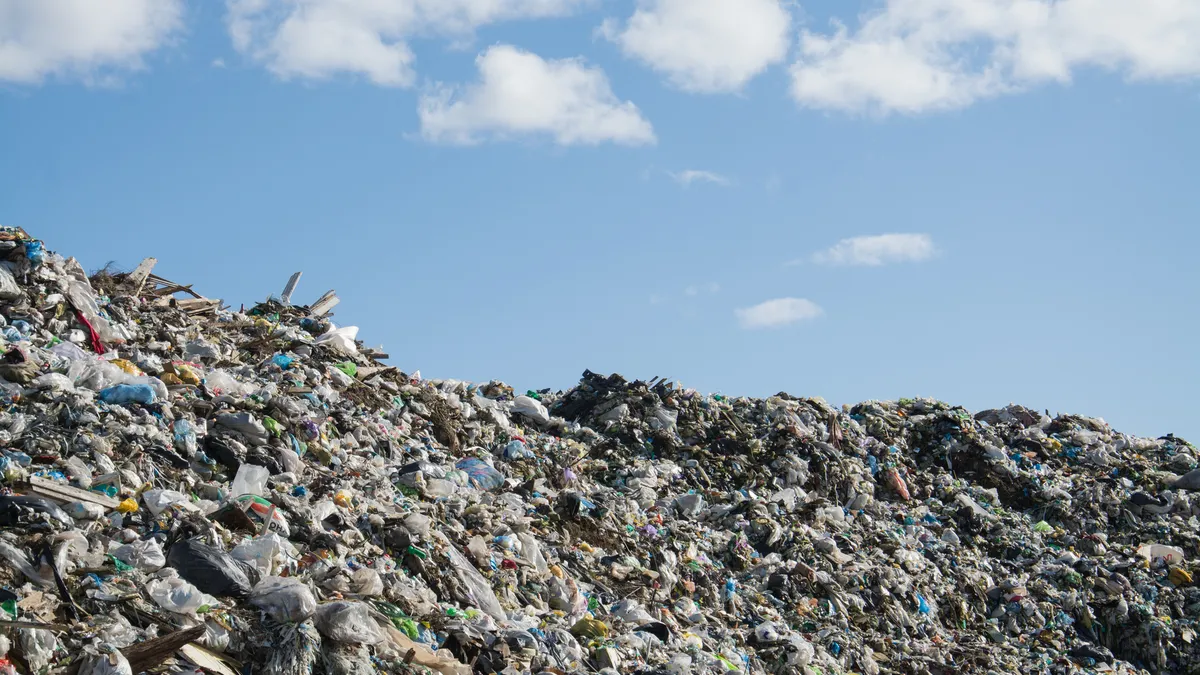
Globally, landfills are the most common method of waste management and take on about 29% of all waste. Facilities for recycling, composting, and anaerobic digestion take another 21%, and “incineration with energy recovery” takes another 20%
The challenge is how to improve these existing systems while also tackling the remaining 30% that is dumped or uncollected, the report states. The global cost of municipal waste management is already over $250 billion a year, and it’s projected to rise to $426 billion by 2050 if “existing practices” continue.
Improving waste management systems will require meaningful monetary investments to the tune of between 0.3% to 0.8% of GDP, the report estimates. And those investments must be “significant and sustained” to consistently address the growing waste problem, the report said.
“Economically, the case for effective waste management is compelling, as the costs of inaction considerably exceed costs required for sound waste systems,” the report states.
Long-term investments can also help boost job growth, the report said. “Waste services, resource recovery, and circular economy industries already employ millions of workers. With the right policies, investments, and support for small- and medium-sized enterprises and the informal workforce, they can create many more jobs.”
However, the reality is that many countries face financing hurdles and regulatory challenges. Plus, many significant waste management projects are often dependent on international monetary support, the report says.
Municipal waste management services can be expensive, placing pressure on public budgets. In the future, “additional financing from private sources is likely to play an increasingly important role, particularly for advanced treatment and recovery facilities,” the report states.
But the public sector’s appetite to invest in waste management will depend on “predictable revenue streams” supported by factors like favorable tariff policies, fee collection systems or other regulatory frameworks that “create conditions attractive to private operators.”
Without accelerating investments, existing gaps in service will continue to widen, and that in turn will make economic and health impacts worse, the World Bank says.
“The urgency is therefore twofold: to expand systems fast enough to keep pace with rising waste volumes, and to raise performance well above prevailing baselines to avoid compounding the broader economic costs of inaction and damages from unmanaged waste.”