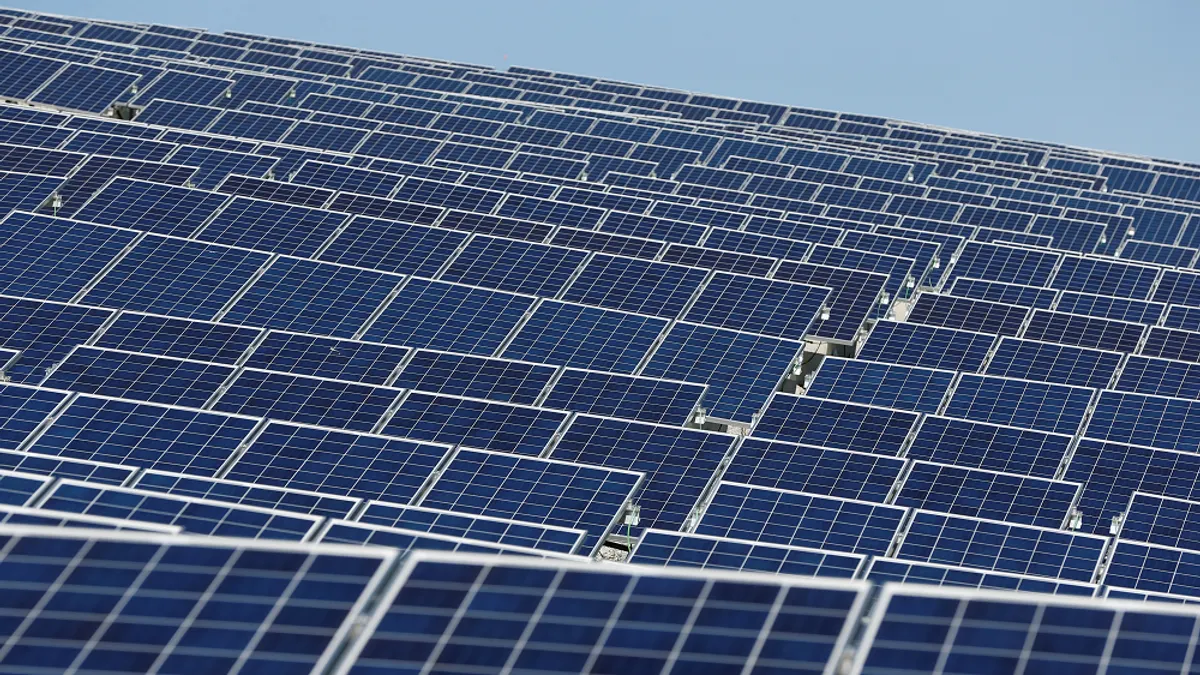
Nearly 13 years ago, just over a dozen landfills in the U.S. hosted solar panels. Since then, hundreds more installations have sprung up and continue to be green-lit, even if implementation has gotten trickier.
A Virginia county approved a two-megawatt project on a former landfill in December, for example, while a similarly-sized project on a closed site in New York is about to start the permitting process.
“There have always been compelling reasons for leveraging closed landfills for energy projects,” said Kelly Sarber, chief commercial officer and cofounder of renewable power developer Epic Star Energy.
For waste sites that have limited uses, generating power and offsetting maintenance costs may sound like a perfect solution. But ideals can come up against reality: Installing solar on landfills tends to be more complicated than on other types of property. These projects are more expensive to build per megawatt and can take an average of five or more years to develop.
In states with solar-friendly laws, closed landfills that are most suited to hosting solar are largely already home to panels, sources say. What’s left tends to be sites that need more remedial work or broader policy support. In either case, dependable aid for brownfield development and allowing community solar could shape landfills into the kind of project developers want to take on — particularly as pressure for affordable power starts building.
Big potential
Landfills support only a small percentage of all solar panels in the U.S. In 2024, about 330 landfills were home to renewable energy projects, including options like solar, wind and geothermal, according to a report from the U.S. EPA’s Re-Powering America’s Land Initiative. Along with other contaminated sites, the landfills hosted about 4.4 GW of power.
For comparison, over two-and-a-half times as many gigawatts of solar were added nationwide in just the third quarter of 2025, according to the Solar Energy Industries Association, which did not reply for comment. Total solar capacity around the country tallies up to about 280 GW.
Landfills might not post record numbers for single-site power generation, but communities and business alike find these kinds of projects appealing for energy, jobs and figuring out what to do with unoccupied land.
“If you sat everyone together, everyone would agree,” said Steven P. Gouin, a lawyer with Giordano, Halleran & Ciesla who has worked on multiple landfill solar installations.
In 2021, the Rocky Mountain Institute cited 10,000 closed and inactive landfills around the country. So why haven’t more of them become solar installations?
The answer often lies in practical considerations that impact the bottom line. Landfills are hilly and solar racks need flat spaces. Setback requirements or gas management infrastructure must also be navigated.
A 50-acre landfill could quickly become 15 acres of usable space, Sarber said. Liners and caps require solar racks that won’t damage them and contractors familiar with the conditions. Developers might also find that a site is capped and closed properly, but then slog through legal issues if land ownership isn’t clear.
The costs and limitations add up. Installing solar on landfills is more expensive than other types of land. Developers need a lot of money up front to put it together, Sarber said. It’s possible the math doesn’t always work.
Historically, the organizations calculating whether solar belongs on a former landfill have been local governments, since publicly-owned sites have been closing across the U.S. since the 1990s. Now that landfills are mostly privately-held, more corporations could begin looking at on-site solar.
Some already have: WM, for example, said that it hosted 57.9 MWh of solar on closed landfills in 2021, and confirmed that number remains accurate. Republic Service’s 2024 sustainability report noted the company had six sites with solar projects, though reports from the two previous years said there were eight. Republic declined to comment on the change.
Easy pickings
Despite the range of challenges, sites that are properly capped and closed with easily-identifiable owners have basically all become homes to solar panels in states with supportive policies.
That’s the case in New Jersey. The Solar Act of 2012 specifically encouraged development on brownfields and landfills by creating an energy certificate program. Today, the only landfills in the state that don’t have solar are either still in use or are in an in-between space of not being active but also not being properly closed, Gouin said.
In some cases, the sites have stopped being used but were never covered and still have soil contamination issues. Gouin said these locations also tend to be smaller, meaning less available surface area, and in remote locations far away from interconnection infrastructure, making them even less appealing to developers. Ultimately, solar developers wanting to work with these sites in New Jersey are faced with two infrastructure projects: Capping and closing landfills as well as installing panels.
There have been grants that made the double workload easier. The 2022 Inflation Reduction Act created a tax credit program for renewable power development on brownfields. When combined with other community solar initiatives created by the legislation, projects could be eligible for a 70% tax credit, said Angie Daoud, chief operating officer at the solar developer Onyx Renewables. “It was just the perfect combo.”
The pairing spurred development, including in New Jersey. Because the incentives were supposed to last a decade, developers and land owners felt emboldened to take on even the more burdensome remediation projects, added Onyx CEO Mary Beth Mandanas.
Projects relying on both tax credits will still be under construction for the next two or three years, Daoud said. But with the One Big Beautiful Bill stripping away certain federal incentives, development on these sites may slow again according to sources.
Alternative plans
States could step in with their own replacement programs. A model program could be found in New Jersey, which passed the Brownfields Redevelopment Incentive Program in 2024 and is still formulating its rules. Developers will be eligible for remediation-related tax credits under certain conditions, including proof that the project isn’t “economically feasible” without the money back.
Legislation allowing community solar programs could be useful too, Sarber said. The Ohio House of Representatives, for example, recently voted for a pilot program that would allow community energy installations for tech such as wind, solar and batteries. The bill has a cap on how much power can be added per site and per year, but landfill developments have their own, larger maximums. The bill has progressed to the state Senate.
Local governments could also aid landfill solar development by streamlining the permitting process.
“Every time you start with a city, it's like starting a brand new journey,” Sarber said.
Improved communication across city departments or even state permitting agencies could pick up the pace and effectively make the installations cheaper, Gouin added. The 2021 Rocky Mountain Institute report made similar recommendations. Waste, energy and sustainability teams could work together — particularly if municipal landfill closure plans include installing solar early on.
If municipalities don’t proactively look to facilitate solar on landfills, they might find themselves driven to build these sites as they search for ways to keep residential electric bills in check. U.S. energy demand could grow up to about 3.5% per year until 2040, according to McKinsey, while rising electricity prices are predicted to keep going up.
To provide cheaper power, the appeal of landfills will grow, Sarber said, particularly when it comes to city-owned land in areas where large, unoccupied parcels of solar-appropriate property are scarce.
“The underlying fundamentals of the business is going to drive an increasing demand for these locations.”