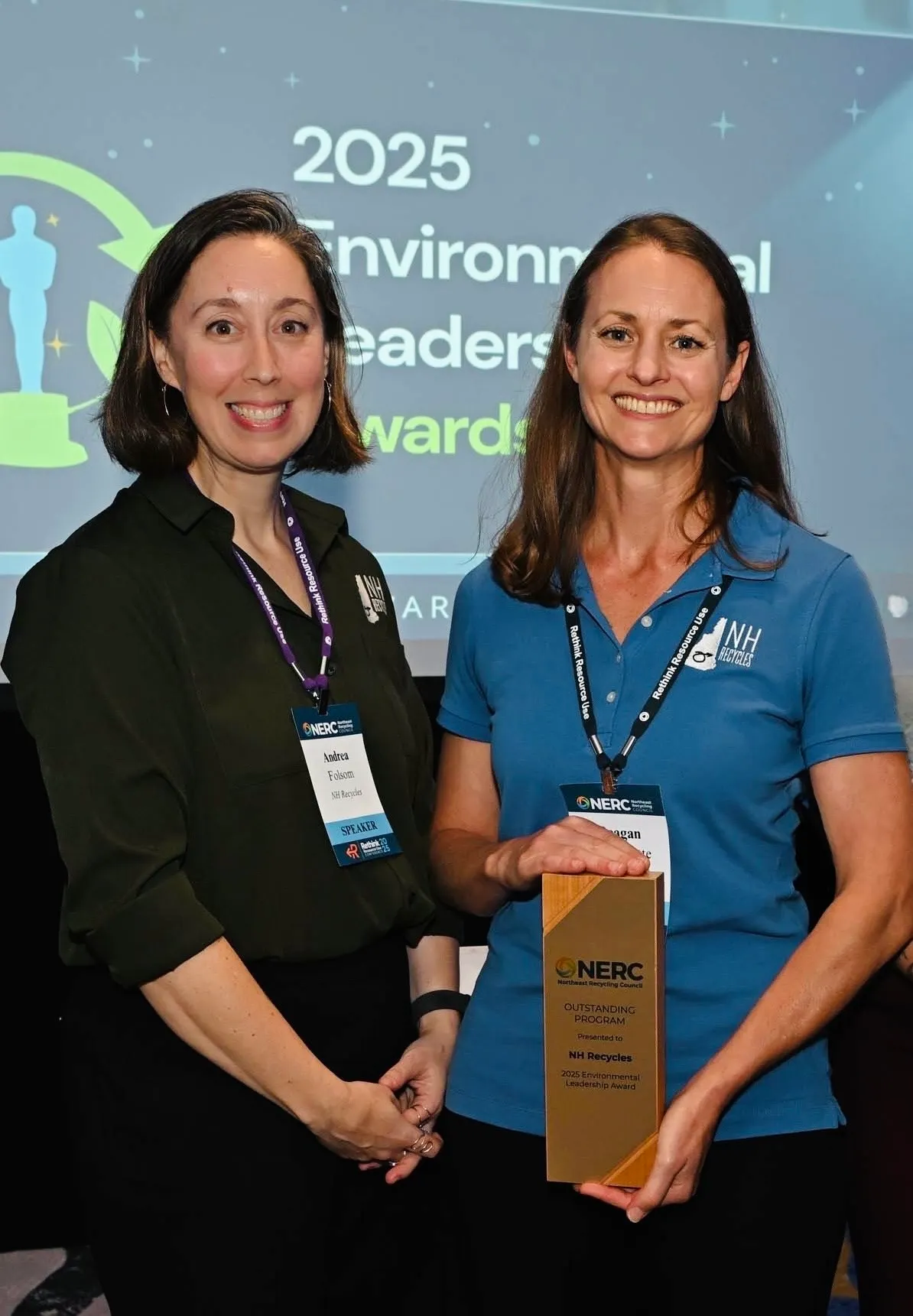
Since 2019, Reagan Bissonnette has shared her passion for recycling with communities across New Hampshire as the executive director of NH Recycles.
Now, she’s passing the torch to someone she’s worked shoulder to shoulder with for the last five years. Andrea Folsom, NH Recycles’ education and grants manager, will become executive director on May 18.
The leadership change comes as NH Recycles celebrates its 45th year. The organization, which describes itself as the “oldest and largest cooperative-model recycling nonprofit in the U.S.,” works with municipalities to manage recycling programs, connect recyclers with end markets for their recycled materials and provide technical and safety assistance. Previously known as the Northeast Resource Recovery Association, it changed its name last year.
In 2025, NH Recycles helped its members recycle and manage 76.9 million pounds of material, resulting in about $2.6 million in recyclable materials sales. NH Recycles continues to help connect recyclers with end markets amid challenging times for commodity markets, Bissonnette said.
Last year, the organization also launched Recycle Right North Country, an education effort that aims to to increase rural residential recycling rates and decrease contamination through a range of trainings and messaging. It’s funded as part of a three-year, $440,000 Recycling Education and Outreach grant from the U.S. EPA.
The organization is also offering ongoing safety training and resources, funded in part by a separate U.S. Department of Agriculture grant, to prevent facility fires caused by batteries and other hazards. These initiatives will continue when Folsom steps into the executive director role.
“When a challenge comes up, we want to make sure folks know we’re here for them,” Folsom said. “We have a really clear mission, and I’m very focused on continuing the good work and services we already provide and that our members rely on.”
Bissonnette is starting her own consulting and coaching business for nonprofits and nonprofit executive directors.
“I helped lead NH Recycles through a period of change and growth, so I'd really like to work with other organizations to help them do the same,” she said.
Waste Dive spoke with Folsom and Bissonnette about their visions for the organization and what makes New Hampshire a unique state for recycling and waste management initiatives.
This conversation has been edited for length and clarity.
How did the two of you approach the leadership transition in terms of how the role might look when that changeover happens in May? What will change, what will stay the same and what are the major priorities?
REAGAN BISSONNETTE: The past seven years have been a time of change and growth for the organization, and especially with our name change last year. We're in a really great opportunity to reintroduce ourselves to the New Hampshire community and to deepen our relationships with our members here in New Hampshire and the surrounding states.
I emphasized to the board that we would want to have someone who is an extremely strong communicator, someone who has experience working with a board of trustees and has financial management experience — and is, of course, really committed to our work.
And I'm just thrilled that the board selected Andrea for this role, because she has been on staff the past five years and has been a member of our leadership team. She has been very closely involved in all of our strategic initiatives and major projects. I anticipate it being a very seamless transition, and I'm also just really excited for the future of the organization under Andrea's leadership.
ANDREA FOLSOM: Reagan and I have had a really close working relationship over the past five years, so the transition will be a very good one. The focus won’t change much. We want to build on what is already working and continue to get our name out there.
We want to continue to let folks know — not only municipalities, but other partners, like regional planning commissions — that New Hampshire Recycles can provide things like cooperative marketing, like technical assistance and education. We are a strong resource here in New Hampshire and the region for recycling, education and information, and we want to be a place for folks to turn to.
How does your recycling cooperative model work, and what is it like to help New Hampshire recyclers market their material right now, especially as markets for some materials, like PET, are really challenging?
BISSONNETTE: We're one of only two nonprofits in the entire country that operates a recycling cooperative model, and what that means is we are actually helping municipalities get their recycling from their transfer station or recycling center to the actual companies that recycle that material. We have done that for our entire history.
We've seen markets go up, markets go down, and one of the services that we provide to our members is really helping them have that continuity of service, regardless of what's happening with the markets. We have a lot of very small rural communities in particular that we serve that would really have a difficult time recycling this material at scale without sort of being part of a cooperative model.
We work with dozens and dozens of vetted recycling vendors, and we specifically make sure that we have these trusted relationships so that even when markets go down, we can help our communities access markets that they wouldn't be able to access on their own. That's why we have such a long history as an organization.
Another thing we do is provide a lot of education and technical assistance to communities to help recyclers understand the big picture and the perspective of how markets can change over time.
We have some recycling and markets that we have worked with for over a decade, but there's always some type of change. There used to be an electronics recycling company, Universal Recycling Technologies, that closed their New Hampshire facility last year. Fortunately, we work with several other electronics recycling companies, and we were able to make sure that all the affected communities were able to then be serviced by another company.
Another thing NH Recycles offers is safety resources. Can you talk about how that’s developed over the years and what does the safety programming and outreach look like, particularly related to facility fire dangers from batteries?
FOLSOM: We've put a lot into our safety focus, especially as lithium-ion batteries continue to pop up everywhere. We’re continuing to help our transfer stations improve their safety practices with the help of a grant.
BISSONNETTE: Because of the unique model we have where we're working directly with the companies that are recycling materials for our municipal members, we were increasingly seeing challenges with not only rechargeable lithium-ion batteries, but other dangerous things that can make it into recycling, such as compressed gas cylinders like propane other gas-containing items.
For example, last year, one of the scrap metal vendors that we work with imposed fines for communities that had these types of materials in their loads. That’s costly for municipalities. So we worked closely with our towns to help them change their practices on the ground. Now, they are separating out material and carefully checking it after residents dropped it off. That gives them a greater sense of confidence that those harmful materials aren’t going on to scrapyards.
We took that background and applied for a grant with the U.S. Department of Agriculture to do an intensive solid waste safety project this year.
FOLSOM: On the technical assistance side of the grant, we have our municipal recycling advisor visiting transfer stations that have the most challenges, either with materials or just needing more support. Our advisor has years of experience as a transportation operator, so he can give very practical advice and information. We also offer signage and first aid kits and other on-the-ground information so they can make real change pretty much immediately.
We also host safety summits where we're bringing together not just transfer station operators, but interested residents, fire personnel and decision makers like town administrators for an overview on fire prevention and safety related to lithium ion batteries. We also partnered with the New Hampshire Department of Environmental Services as well as the state’s Fire Marshal office. The in-person [event] was well-attended, and we also had an online safety summit with more than 100 people registered.
There’s a final in-person summit this early in the summer, in June. So we really like to provide folks with a variety of tools and ways for them to access information, both now and in the future, because we know that this is not an issue that is not going to go away. Anything we can do to get ahead of it is great.