
Dive Brief:
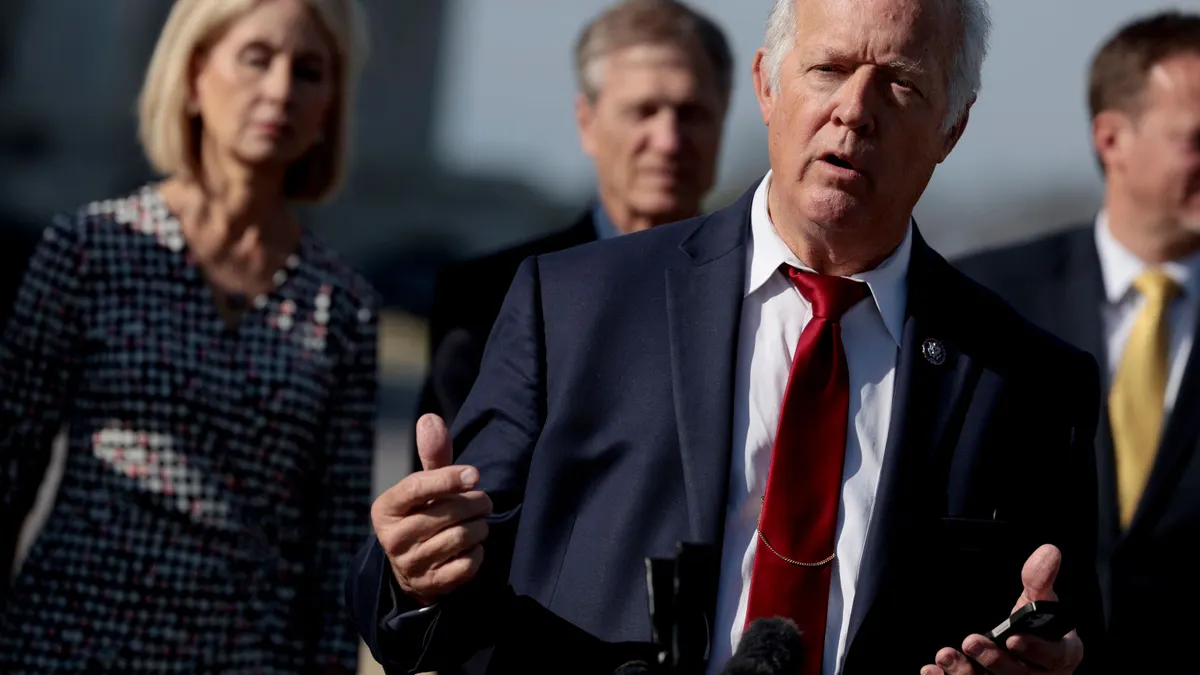
- U.S. Rep. Randy Weber, R-Texas, has introduced the Packaging and Claims Knowledge Act, a federal labeling harmonization bill that’s been championed by Ameripen for over a year.
- It would amend the Federal Trade Commission Act to include certain requirements for recyclable, compostable and reusable claims for consumer product packaging, including that they make qualifying claims and are backed by third-party certifications. Packaging that doesn’t meet stated parameters would be prohibited from bearing resin identification codes surrounded by chasing arrows.
- The bill also calls for state preemption. “This uniform structure will replace the confusing patchwork of state regulations, helping businesses provide accurate and transparent information across state lines,” Ameripen said in a news release Wednesday.
Dive Insight:
This federal push comes at a time when more packaging stakeholders are raising concerns about how differing state-level packaging regulations could inhibit interstate commerce. It’s also less than a year away from California’s planned implementation of SB 343, a landmark labeling law that will make it illegal for packaging to bear chasing arrows or other recycling indicators unless specific criteria are met.
All the while, unfinished efforts under the Biden administration to get clarity on best practices for sustainability claims by updating the non-binding FTC Green Guides have been quiet under the Trump administration.
“Americans want to do the right thing, but misleading labels make that harder,” Weber said in a statement. “The PACK Act cuts through that confusion. It’s pro-environment, pro-business, and rooted in common sense, all while holding companies accountable and giving consumers clear, honest information they can trust.”
The bills calls on the FTC to, within a year, establish an advisory council of experts and industry stakeholders to meet annually. Within two years, the FTC would have to issue guidance on third-party certification, including considering different types of packaging materials, colors, shapes and sizes.
The bill text shared by Weber notes various criteria for recyclable, compostable and reusable claims for consumer product packaging.
For example, a “recyclable” package must inform consumers about the availability of recycling programs and collection sites where the item is sold by noting the percentage of consumer or communities with access.
At the same time, a package can be exempt from that requirement if “a recycling program or facility is available to a substantial majority of consumers or communities in which the consumer product is sold.” A package cannot be deemed recyclable if it’s made from a recyclable material but due to its shape, size or other attributes is not accepted in recycling programs.
“Compostable” claims require “competent and reliable scientific evidence that the packaging is compostable.” And “reusable” claims require that a person provide means for reusing the packaging through a systems of collection and reuse, or offer a product for purchase to reuse the original packaging.
Ameripen says that the third-party certification requirement “allows businesses to utilize a variety of qualified independent parties to certify that packaging meets industry standards and follows the FTC’s ‘Green Guides’ to avoid deceptive claims.”
“This new framework will address concerns with the patchwork of state regulations and its negative effect on interstate commerce and consumer awareness regarding management of consumer packaging,” said Executive Director Lynn Dyer in Weber’s press release. “Ameripen will continue to support Congressman Weber as he moves this critical legislation through the House of Representatives.”
Peter DePasquale, vice president of government affairs at Keurig Dr Pepper, said in a statement the bill is a welcome step to establish “a single, national framework for packaging claims.”
“By setting clear, national standards and certifications through credible third parties, this legislation helps ensure consumers receive accurate information while giving companies the consistency they need to innovate and accelerate investment in sustainable packaging solutions nationwide,” DePasquale said.
The Pack Act’s dozens of of other supporters include major packaging companies and CPGs such as Amcor, Anchor Packaging and Dart, and Kraft Heinz, General Mills and Nestlé USA. The legislation is widely supported by different packaging trade groups, including the Plastics Industry Association, EPS Industry Alliance, Biodegradable Products Institute, Can Manufacturers Institute, Carton Council, Foodservice Packaging Institute and more.
Flexible Packaging Association CEO Dan Felton said the group is “thrilled” about the Pack Act’s introduction “and looks forward to fully supporting its passage into law.”
“We believe that a federal law for the labeling of packaging for compostability, recyclability, and reusability that supports existing national labeling programs makes far greater sense than a state-by-state approach of passing related laws and will lead to more — not less — consumers properly handling flexible packaging at its end of life,” Felton said in an emailed statement.
While no federal recycling legislation has been signed into law in 2025, multiple bills have advanced with bipartisan support:
- Steward Act: Introduced in January, the bipartisan Strategies To Eliminate Waste and Accelerate Recycling Development Act of 2025 passed the Senate and was sent to the House in November. The bill brings together the Recycling Infrastructure and Accessibility Act of 2023 (a 2025 version of which was introduced in March) and the Recycling and Composting Accountability Act, which each passed the Senate in 2024. The Steward Act would establish grants each worth between $500,000 and $15 million for certain recycling projects. It also calls for the U.S. EPA to collect and analyze more data on recycling programs and markets, as well as potential in the U.S. for more composting.
- Reuse Act: Introduced in June, the bipartisan Research for Environmental Uses and Sustainable Economies Act of 2025 passed the Senate and was sent to the House in November. The Reuse Act would direct the EPA to conduct a feasibility study on reuse and refill systems in different sectors, such as food service, food and beverage, and other consumer products, as well as shipping of wholesale and retail goods.
- Circle Act: Introduced in July, the bipartisan Cultivating Investment in Recycling and Circular Local Economies Act of 2025 calls for establishing a 30% investment tax credit on private investments in certain recycling infrastructure, phased out over 10 years. The tax credit would reduce a private entity’s tax liability on “qualified” investments on infrastructure designed to recycle paper, metals, glass, aluminum and other materials. Local municipalities that make similar investments would receive a direct rebate equal to the credit.