Dive Brief:
- A new report by The Pew Charitable Trust examines how key U.S. policies could reduce plastic waste in the United States by 2040 through an analysis of projected waste diversion, job and investment impacts.
- The report notes that policies like deposit return systems, extended producer responsibility laws and reuse systems all have a range of impacts depending on how widely they’re adopted. Each of these policy scenarios could reduce the amount of plastic packaging that is landfilled or incinerated by somewhere between 10% and 20% by 2040.
- The Pew report recommends several options for stacking these policies to optimize diversion rates, cautioning that a “business as usual” approach with no meaningful changes will result in the generation of about 1 billion tons of additional plastic waste through 2040.
Dive Insight:
Policy experts have long tried to move the needle on wavering U.S. recycling rates and uneven access to recycling systems and funding for infrastructure. The new Pew report aims to offer insight for policymakers and recycling industry stakeholders as they advocate for new or updated policies.
The report specifically highlights cost and recycling rate estimates for policies that include EPR, bottle bills, phase-outs of certain plastics, adoption of reuse programs and general improvements to recycling infrastructure and collection.
“Solutions to vastly reduce plastic waste and pollution already exist,” said Winnie Lau, a plastic pollution prevention project director for Pew and of one of the project leads, in a statement introducing the report. The key is to get policymakers, businesses and consumers to “all play their parts” in the effort to improve recycling systems and pollution prevention, she said.
Pew published the report with support from consulting firm ICF and sought input from partners including The Recycling Partnership, U.S. Plastics Pact and Upstream.
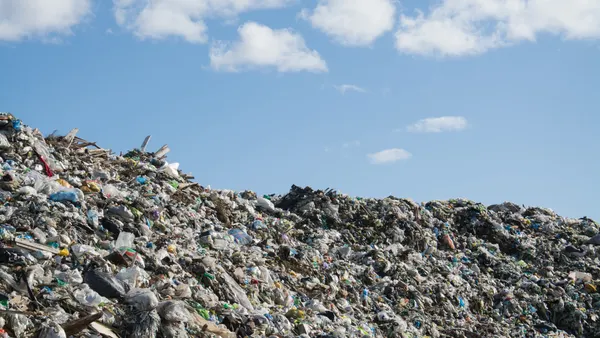
The data analysis comes as plastic pollution is increasing in the U.S., along with costs to manage the material, the report said.
“While plastic plays a vital role across many sectors, including packaging, construction, transportation, health care, textiles, agriculture, and consumer products, its proliferation is also putting substantial strain on waste management systems and budgets,” it said. According to the report, the United States spent about $2.3 billion on landfill disposal for plastic waste in 2019.
Pew estimates Americans generated about 56 million tons of plastic waste in 2025, with about 30 million tons coming from plastic packaging. By 2040, plastic packaging waste is projected to be closer to 39 million tons per year.
The costs for managing plastic waste, including capital and operating expenditures associated with collection and sorting, recycling, landfilling and incineration is about $40 billion annually, the report said. Currently, about $37 billion of that comes from taxpayers, it said.
About 60% of these costs are associated with collection and sorting, and 28% goes toward disposal methods such as incineration and landfilling. As of 2025, only 6.5% of waste management costs go toward recycling systems, including mechanical and chemical recycling strategies.
Using data from sources like Closed Loop Partners, Eunomia and Stina, the report calculates how different combinations of policy strategies could optimize plastic waste reductions, funnel more funding into recovery and recycling strategies, and help build better reuse systems in the U.S. The report compares each strategy to a “business as usual” baseline that assumes no new policy changes take place through 2040.
The report mentions how existing state policies, such as the 10 states that have a bottle bill and the seven states that have recently adopted EPR for packaging laws, are already working to reduce waste through investments in recycling systems. Yet “while there are many approaches to address plastic waste and pollution, they are not uniformly designed or implemented across states,” the report states.
In addition to pursuing more bottle bill and EPR changes in other states, the report also recommends pairing those with other policies, such as certain phaseouts for plastics like polystyrene and expanded polystyrene packaging. Such a scenario, when widely adopted, could reduce annual packaging waste by 20% while decreasing mass of plastic packaging that gets landfilled and incinerated by about 20%.
Some states have already banned or are phasing out certain types of PS, particularly for food service and packaging, the report said. States that have passed types of PS food packaging bans include California, Colorado, Delaware, Maine, Maryland, New York, New Jersey, Oregon, Rhode Island, Vermont, Virginia and Washington.
The report also discusses how reuse policies could make a dent in pollution while creating new jobs in the sector. “While reuse is widely recognized as an important solution to reducing plastic waste generation, it is not yet widely institutionalized,” the report said.
Several states have new EPR for packaging laws with reuse requirements including in California, Colorado, Minnesota, Oregon and Washington. California requires 4% of packaging and food ware to be reusable by 2032.
These systems can make meaningful change but represent higher upfront costs and other hurdles to implementation, the report states. “The reuse system represents a different business model than single-use systems, requiring initial investment to establish the necessary infrastructure and logistics.”
The report also offers several estimates for how recycling policies could impact job creation, but notes “expense and trade-offs of policy strategies” that would likely add jobs and investments in some sectors, such as reuse and recycling, while reducing investments and jobs in other sectors, such as landfilling and incineration.
Broadly speaking, the report estimates there are about 110,000 people currently working throughout the recycling and waste sector in the U.S., which includes jobs in collection, sorting, recycling, landfilling and incineration. By 2040, that could be closer to 140,000, assuming no policy changes take place.