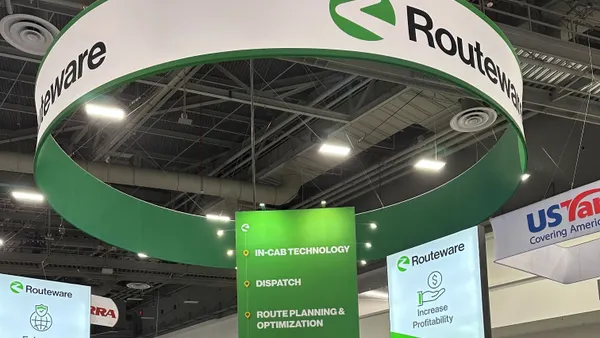
New Routeware CEO Jeremy Collins say he’s doubling down on the company’s approach to clients after he took the helm at the start of this year, refocusing on the individual customer’s experience.
Backed by California-based investor K1, Routeware is one of the country's longest-running fleet management and technology companies. It has about 1,500 customers today and has its technology inside 18,000 waste vehicles, Collins said.
The company has seen some change in recent years, including the succession of multiple chief revenue officers and its new executive chairman of the board, Ray Greer. Greer helped lead Routeware after former CEO Paul Rafalowski left in November and before Collins' appointment in January.
Collins said Routeware's ownership acknowledged a need to bring in "a new regime to move to the next phase of growth."
"Our strategy is sound, our people are sound. The connection, the tactical execution ... we could have improved and been better," Collins said. "We have to get back to the basics in some ways in execution and not live in pure strategy. This is not uncommon as you're going through growth stages."
Other businesses offering fleet technology and management services have stumbled in recent years. But Collins has experience with such services — he previously led fleet management firm Azuga, which served clients in a range of industries including waste management, to more than $100 million in annual revenue before a sale to Bridgestone.
He said the field can be tricky to navigate because clients’ needs are constantly growing while the technology rapidly advances, including through the adoption of artificial intelligence.
“The standard of technology in waste management is very different 15 years ago, 10 years ago, even five years ago,” Collins said. “As this market accelerates, so do their expectations.”
Routeware has expanded through acquisition. In 2024, the company acquired the former Rubicon Smart City route optimization business, which had served cities like Houston, Atlanta and Miami. Collins said Routeware's business today is split roughly 50-50 between private and municipal clients, thanks in part to that deal.
"It's incredibly important to the past success and continued success of the company," Collins said. "Smart City is powerful in and of itself, but Smart City plus everything else we do is now the real value that we're starting to see and recognize as we're starting to move forward."
Routeware is expanding its international reach, and today serves the United States, Canada, United Kingdom and Japan. The company recently launched its Smart City platform in the UK, and Collins predicts the country offers plenty of growth potential.
Looking ahead, Collins said that Routeware would continue to be opportunistic about acquisitions, including to expand its product suite or geographic reach. But he also noted that the company would remain focused on growth through internal mechanisms.
"We also are very focused on growing organically and controlling our own destiny and not buying our way to growth," he said.