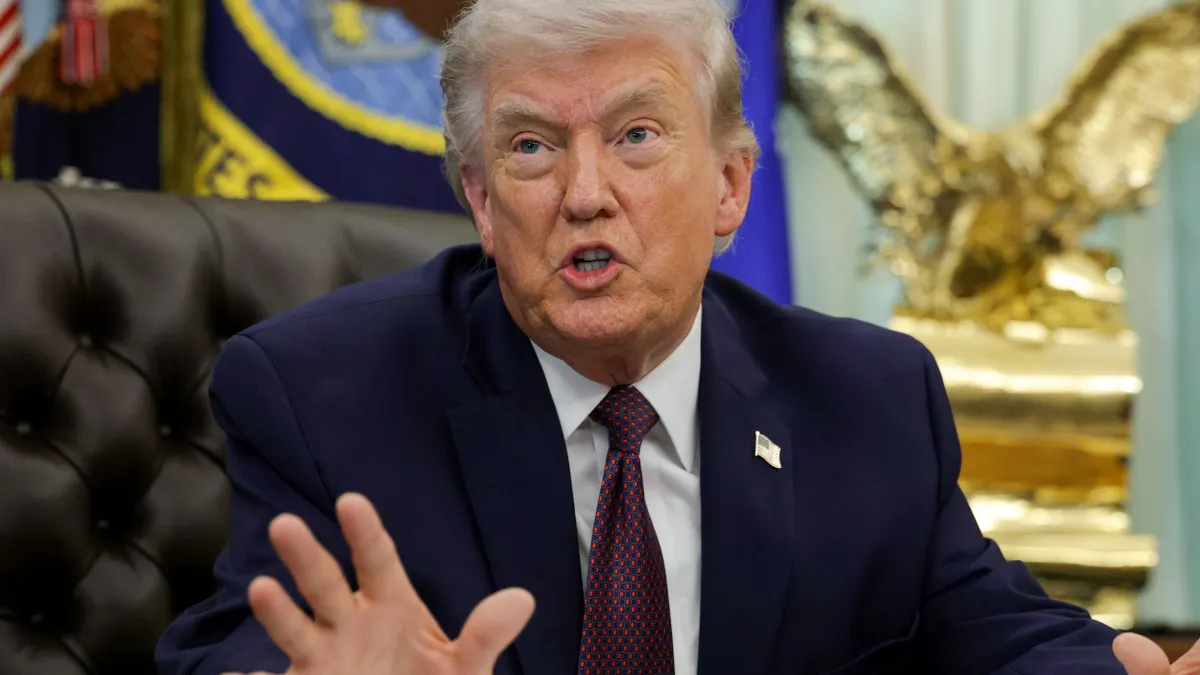
President Donald Trump published his initial budget proposal for fiscal year 2027 with deep cuts to social and environmental programs.
The 92-page proposal includes a roughly $1.5 trillion budget for the military amid the ongoing war with Iran, which would be a 44% year-over-year increase. To offset some of that steep rise, the budget proposes a 10% cut to non-defense spending, equal to roughly $73 billion.
In an introduction to the proposal, Office of Management and Budget Director Russell Vought said the administration began the work of winding down discretionary spending and closing agencies Trump wanted to shutter, including the U.S. Agency for International Development, in fiscal year 2026. He said that work would continue in 2027.
“Under President Trump’s bold leadership, every tool in the executive fiscal toolbox has been utilized to achieve real savings,” Vought wrote. “A historic paradigm shift in the budget process is occurring and is producing real results for the American public.”
The president's budget again proposes eliminating funding for environmental justice-related programming and work associated with the “Green New Scam,” the president and his allies’ term for climate and energy programs associated with the Green New Deal framework.
The budget envisions slashing the Environmental Protection Agency’s discretionary budget authority by 52%, to $4.2 billion. It anticipates a $7 million increase for certain drinking water programs and an additional $14 million for the web-based permitting tool NEPAssist, reflecting priorities under EPA Administrator Lee Zeldin.
But it also envisions several program cuts and eliminations. As part of Trump and Zeldin’s drastic reorganization of research activities within the organization, the proposal envisions “an end to unrestrained research grants, woke environmental justice work, radical climate research, and skewed, overly-precautionary modeling that influences regulations.” The proposal includes $277 million for “statutorily required research.”
The EPA’s budget in brief document, which includes a more detailed breakdown of the president's proposed spending levels, shows further cuts to waste-related activities. Funding for the Office of Resource Conservation and Recovery would be slashed nearly in half by the proposal, from a $113 million enacted budget in 2026 to roughly $68 million in 2027. That includes a 31% hit to corrective action funding, a 42% hit to waste management funding and a 56% hit to waste minimization and recycling funding.
The EPA’s Superfund program would continue to be funded mainly through tax receipts, following a transition for the 2026 fiscal year. The administration estimates $1.7 billion in tax proceeds that can fund the program in fiscal year 2027, as well as proceeds from litigation and $290 million in additional appropriations. The proposal also envisions spending $7.5 million on Superfund-related monitoring and enforcement, an increase from the 2026 proposal, with roughly the same number of employees.
An EPA spokesperson said the proposed budget would allow the agency to focus on its core statutory responsibilities and ensure a balance between the federal government and the states.
“The proposed budget advances President Trump’s bold vision to make America safer, healthier, and more prosperous for all Americans,” the spokesperson said in an emailed statement. “Importantly, the budget prioritizes direct environmental remediation like addressing hazardous contamination, restoring blighted lands, and reducing human health risks to deliver measurable results that improve the lives of American families.”
The president’s budget proposal also included examples of the kind of “woke” activities the Trump administration hopes to eliminate. It took aim at collecting, repackaging and distributing reused food and analyses of equity and environmental justice as they relate to greenhouse gas emissions, as well as workforce initiatives like Black and Hispanic engineer conventions sponsored under the Superfund program.
The proposal also anticipates a 19% decrease in the U.S. Department of Agriculture’s discretionary budget authority, to $20.8 billion. That includes slashing $659 million in funding for Community Facilities grants, such as a $1 million grant doled out last year to a food hub in Nantucket, Massachusetts.
This is the opening pitch in the budgeting process, which is largely controlled by Congress. The two chambers have been slow to enact funding bills for individual agencies, such as the farm bill used to set the USDA’s budget. But lawmakers did include far more funding than the Trump administration initially proposed in its fiscal year 2026 budget for agencies like the EPA.
Trump in January signed a funding bill package for fiscal year 2026 that included an $8.8 billion budget for the EPA. That total was $320 million less than the previous fiscal year, and was more than double what the Trump administration had previously proposed.