Dive Brief:
- Wisconsin and Kentucky are among the latest states to adopt battery stewardship programs. Their governors signed battery EPR bills into law this month.
- Wisconsin Gov. Tony Evers approved AB 713 on April 2. It creates a battery stewardship program for certain rechargeable batteries under 11 pounds, non-rechargeable batteries under 4.4 pounds, and medium-format batteries under 25 pounds, including certain lithium-ion batteries that fit the description. WM and other waste groups supported the bill.
- The Kentucky law, signed by Gov. Andy Beshear on April 10, also covers a similar range of portable and medium-format batteries, including some lithium-ion battery types, but the program differs from some other battery EPR laws because it is voluntary for producers to join.
Dive Insight:
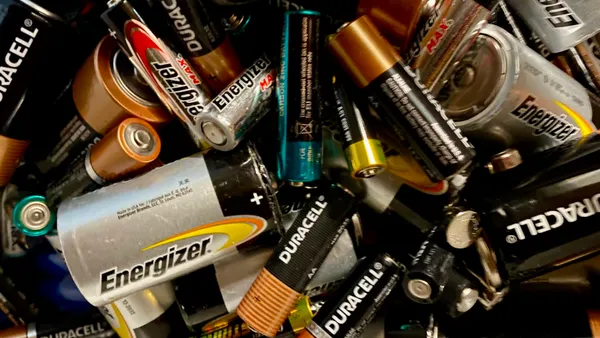
Adoption of battery stewardship laws has gained momentum in recent years, partly as a way to help prevent fires at waste and recycling facilities. Oregon’s governor signed a similar battery EPR bill on April 7.
The federal government also has an interest in battery EPR to help recover more critical minerals from domestic sources, which the Trump administration sees as a way to reduce reliance on imports and create U.S.-based jobs. The U.S. EPA is focusing on battery EPR by developing a voluntary battery EPR framework meant to guide states working on such programs. The agency expects to publish it sometime in the summer.
Wisconsin’s new law, which goes into effect in January 2027, calls for battery producers to join a stewardship organization and create a collection and management plan to be approved by the state’s Department of Natural Resources.
The stewardship organization will be responsible for collecting covered batteries “on a free, continuous, convenient, visible, and accessible basis” and use fees collected from battery producers to reimburse local governmental units for collection activities.
Certain medical device batteries and lead-acid batteries are not covered under the law.
The law also requires the organization to set up staffed collection points specifically for medium-format batteries, such as household hazardous waste facilities, and the program must also have a plan for how to safely collect and store damaged or defective batteries at designated locations.
The stewardship organization will also need to conduct education and outreach efforts to the public, such as launching a website, distributing info at collection sites and providing collection site operators and retailers with safety training, according to the law. The law also calls for the program to achieve recycling rate targets of at least 60% for rechargeable batteries and 70% for primary batteries.
In Wisconsin, supporters including WM’s local division and several state solid waste departments helped push the bill forward.
In written testimony, WM officials noted that battery-related fires are “putting our workers at risk and destroying millions of dollars in investments that we’ve made to collect and process waste and recyclable materials.” Such fires are also leading to an uptick in insurance rates, WM said.
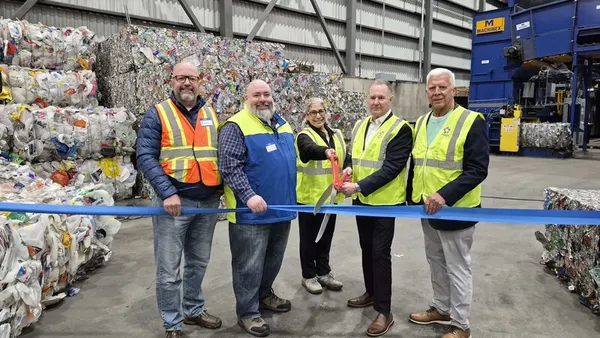
WM spent $39 million to upgrade its MRF in Germantown, Wisconsin, in 2024, including a $250,000 fire detection system. Battery stewardship is necessary to help divert more batteries from facilities like this one, the company said. “If the Germantown MRF were to burn to the ground, 25% of the state’s recyclable material would have to be processed at other facilities, most likely out of state,” the company said.
Meanwhile, Marathon County Solid Waste Department said it has faced several facility fires caused by batteries, and advocated for a producer-funded collection program that would ease the financial burden for local community waste departments struggling with limited budgets.
“Every day that passes without this legislation is another day our workers face unnecessary dangers. We have been fortunate so far that no worker has lost their life in a battery fire at our facilities, but our luck will not hold indefinitely without action,” wrote the department and county waste board in joint testimony during a bill hearing in December.
A previous version of the bill would have exempted alkaline batteries, but the Rechargeable Battery Association voiced concerns about that proposal, saying it would be out of step with other states’ programs and would lead to producers having to collect the batteries under the program even if they’re not explicitly accepted, and “the cost to manage them will be borne by producers of the batteries covered in the bill,” the organization said.
The Battery Network, formerly called Call2Recycle, does not advocate for or against legislation but sometimes offers best practice guidance. It noted in written testimony that consumers generally cannot tell the difference between different battery chemistries, and that alkaline batteries would have ended up in collection systems anyway, even if they were not included in the stewardship program.
In Kentucky, the new law will establish a voluntary Covered Battery Stewardship program by March 31, 2027. Like Wisconsin’s program, it will cover certain rechargeable batteries under 11 pounds, non-rechargeable batteries under 4.4 pounds, and medium format batteries under 25 pounds.
The bill also prohibits residents from disposing of covered batteries in curbside collection bins or commercial front-load or rolloff containers.
The new voluntary stewardship organization will operate similarly to other battery EPR organizations around the country. It will submit a plan to the state for approval that includes a strategy for collecting covered batteries and providing consumer education and collection site training, according to the law. It will also oversee a voluntary take-back program for recovery of rechargeable covered batteries “in an efficient and safe manner” and investigate the feasibility of creating a voluntary program for embedded batteries, according to the bill.
The plan will also need to offer details on how to fund the voluntary program “without adding a point-of-sale cost or fee to the consumer,” the bill states.
Other states are considering similar battery stewardship programs this year. New Hampshire’s HB 1602 is expected to go through a hearing process on April 15. Iowa is also considering a bill, SF 2477 that would update its battery EPR program.