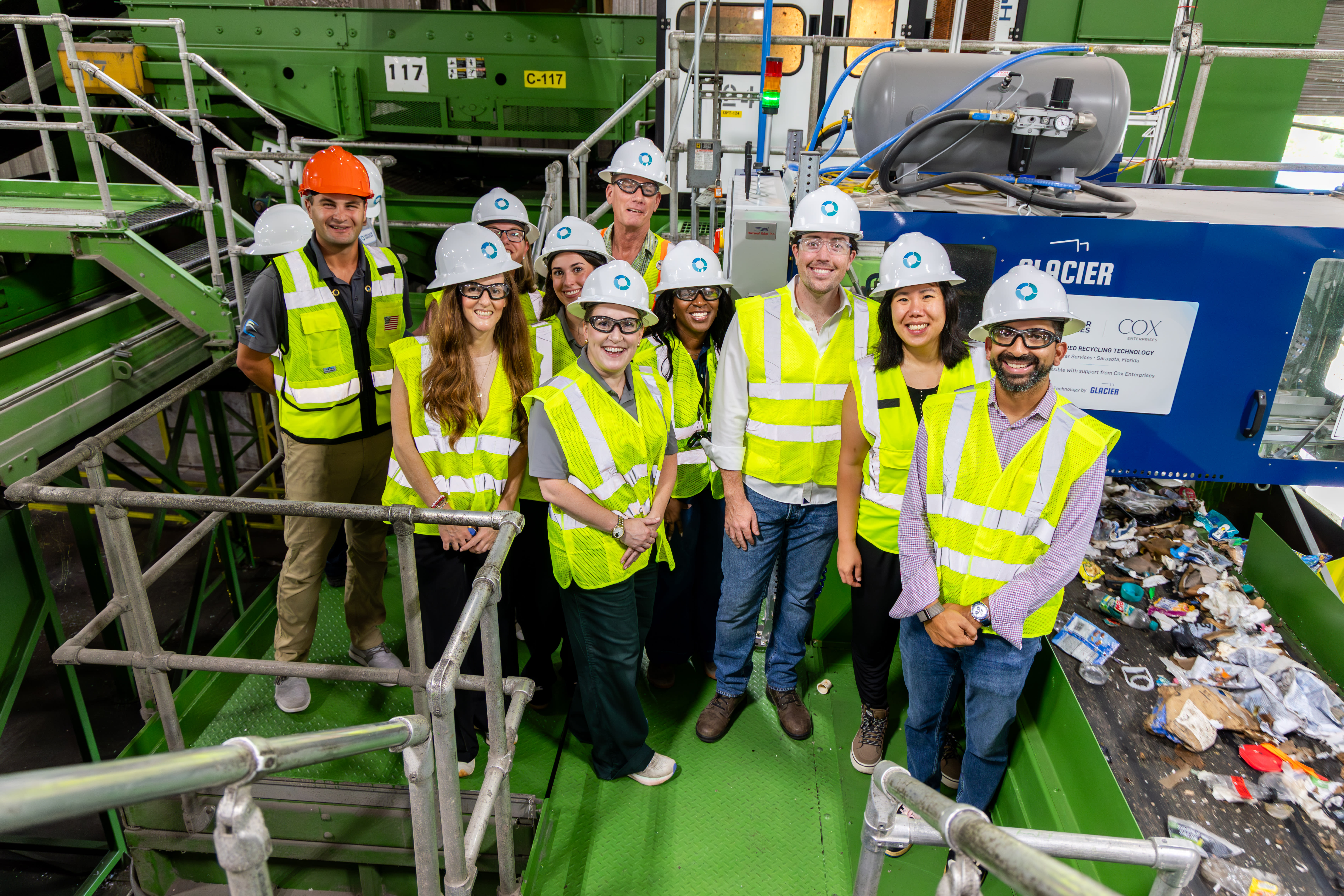


SARASOTA, Fla. — 8 October 2026 — Glacier today announced the deployment of its AI-powered recycling technology at Circular Services’ Sarasota Materials Recovery Facility (MRF), expanding the facility’s use of advanced automation to improve recycling recovery, productivity, and operational performance.
Circular Services’ Sarasota MRF is already one of the country’s most advanced recycling operations. Opened in 2019 as Florida’s first AI-powered recycling facility, the 50-ton-per-hour facility processes residential and commercial single-stream material from Sarasota County, Manatee County, and other surrounding municipalities. The facility combines robotics, optical sorters, and other advanced equipment to maximize material recovery and bale quality.
For Circular Services, the installation reflects how recycling automation continues to evolve: from early robotics that proved the technology could work in a MRF environment to systems built to deliver consistent, measurable gains in material recovery
"We've been utilizing AI and robotics in Sarasota since 2019, so we've seen firsthand what this technology can do and what it takes to deliver real value in a working MRF," said Jamie Lowrey, Vice President of the East Region. "We're focused on technology that performs consistently, improves productivity, and gives our operators better visibility into the facility, shift after shift. We're always looking for innovation partners that offer novel, reliable solutions.”
Glacier’s system at the Sarasota MRF combines robotic sorting with AI-powered vision to improve recovery on the facility’s residue line. The Glacier robot will target valuable containers, including aluminum cans and HDPE, that might otherwise be sent to landfill.
An AI scanner positioned upstream will also measure recyclable materials remaining in the residue stream, giving Circular Services better data on what is being lost. Together, the robot and scanner can help the facility recover more valuable material while identifying additional opportunities to improve capture.
“Circular Services is an especially exciting partner because they already understand automation and they are holding it to a very high bar,” said Rebecca Hu-Thrams, co-founder and CEO of Glacier. “They needed a system that can show up every shift, perform in the realities of a MRF and help the facility recover more value. That focus on uptime, productivity, and ROI is exactly what we prioritize at Glacier.”
This project also builds on an ongoing partnership between Glacier and Cox Enterprises to invest directly in recycling infrastructure.
Through Cox Conserves, the company has established environmental goals spanning carbon and climate, water, circularity and waste, and habitat and species. Its strategy looks beyond Cox’s own operational footprint to partnerships and infrastructure investments that create measurable environmental impact in the communities where its employees and businesses operate.
In 2025, Cox also supported the deployment of Glacier technology at Waste Connections’ Penn Waste facility in York County, Pennsylvania. The Sarasota installation represents the next step in that effort.
By 2034, Cox aims to divert 1 billion pounds of waste into the circular economy, alongside broader targets for carbon reduction, water stewardship and habitat protection.
“Meaningful circularity requires investment not only in our own operations, but also in the infrastructure communities rely on every day,” said Amit Vyas, vice president of Environmental Sustainability at Cox Enterprises. “Our partnership with Glacier illustrates how technology and collaboration can improve recycling outcomes and create lasting value.”
For Glacier, the partnership also demonstrates an important evolution in the recycling robotics market: as more facilities gain experience with AI and automation, technology providers increasingly will be judged not on whether their systems can operate in a MRF, but on how reliably and economically they perform over time.
“The recycling industry needs automation, but operators also need to be able to trust it,” Hu-Thrams added. “Every successful installation builds that confidence. We’re proud to work with Circular Services and Cox to show what recycling robotics can look like when performance comes first.”
###
About Circular Services
Circular Services is a leading developer and operator of circular economy infrastructure and services in the United States. With 40 recycling, composting, and reuse operations, Circular Services provides holistic materials management services to municipalities and businesses across the country that keep valuable materials in circulation and minimize the cost and environmental impact of landfills.
Learn more at www.circularservices.com
About Cox Enterprises
Cox Enterprises is a global privately-held company that owns, operates and invests in businesses across multiple industries, including automotive, greenhouse agriculture, cleantech, software, outdoor recreation and journalism. Guided by its purpose to build a better future for this generation and the next, Cox’s diverse family of businesses deliver solutions to address some of the world’s most pressing challenges. Since its founding in 1898, Cox Enterprises has been fueled by a relentless focus on innovation and a deep commitment to people, the planet and progress.
To learn more about Cox’s history and how it’s shaping what’s next, visit CoxEnterprises.com.
About Glacier
Glacier builds AI-powered robotics and data intelligence for the recycling industry. Its technology combines computer vision, real-time material insights and robots engineered specifically for the demanding conditions of materials recovery facilities. Glacier works with recycling operators across the country to recover more valuable materials, better understand their waste streams, improve operational performance and make recycling more efficient, profitable and circular.
Learn more at endwaste.io.