
Dive Brief:
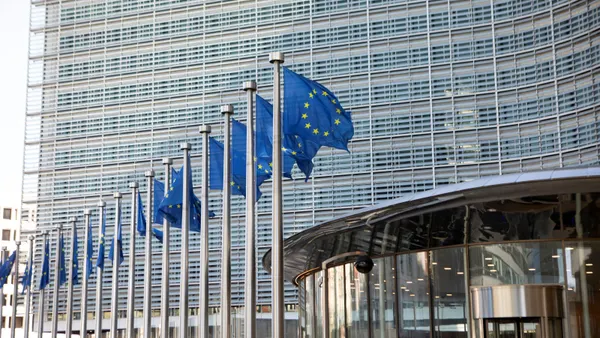
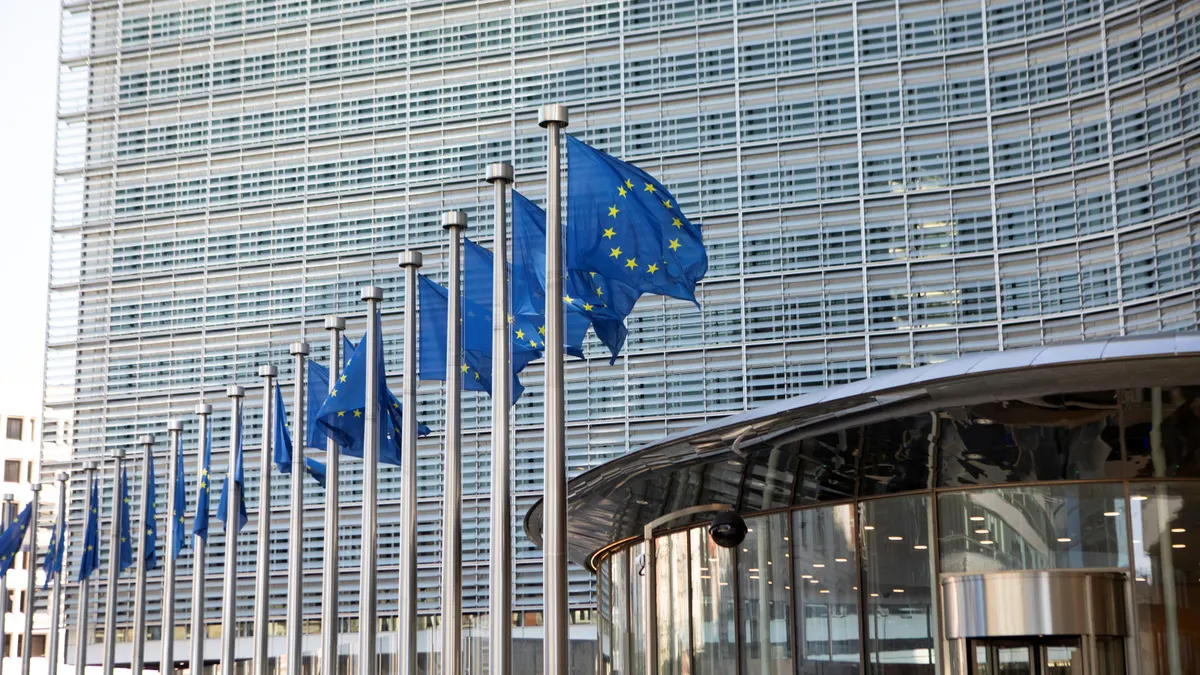
- The European Commission on Monday released new guidance for implementation of the Packaging and Packaging Waste Regulation, which is slated to take force on Aug. 12.
- The new guidance aims to clarify definitions for covered producers, importers and packaging, as well as restrictions on single-use items and PFAS. The EC also shared a frequently asked questions document — spanning questions around compostability, environmental claims, empty space, plastic carrier bags and more — which it says addresses issues raised by stakeholders.
- Packaging trade group Europen responded to the guidance release, saying it “still falls short of providing the legal certainty and operational clarity businesses urgently require,” which has resulted in stagnant investment decisions and compliance planning.
Dive Insight:
The Packaging and Packaging Waste Regulation replaces the Packaging and Packaging Waste Directive, circa 1994, and interplays with the Single-Use Plastics Directive. The regulation was in the works for multiple years before being finalized last year.
PPWR’s targets include banning per- and polyfluoroalkyl substances in food-contact packaging as of Aug. 12, 2026; reducing waste 5% by 2030, 10% by 2035 and 15% by 2040, from a 2018 baseline; making all packaging recyclable “in an economically viable way” by 2030; allowing a maximum of 50% extra space for grouped, transport, and e-commerce packaging; and harmonizing sorting labels for packaging.
The EC, member states and other stakeholders are still working to prepare delegated and implementing acts in the coming years related to labeling, extended producer responsibility, recycled content, recyclability criteria and more.
Europen says that with less than five months before PPWR enters into force, “uncertainty across the packaging value chain has reached a critical level.”
“Industry must be put in a position to act, which requires practical, coherent legal guidance and critical secondary legislation delivered in time for implementation,” Europen wrote.
These are a few of the items among the many clarifications included in the guidance document:
- No PFAS transition period: Packaging containing PFAS in excess of PPWR’s limits that was produced prior to Aug. 12 won’t be allowed to be placed on the market after that date: “the PPWR does not foresee a transitional period for the exhaustion of stocks.”
- Recycled content exemptions: The EC will assess by Jan. 1, 2028, the need for granting further exemptions from recycled content requirements for plastic packaging, or revising existing exemptions.
- Interplay between PPWR and SUPD: SUPD is due to be evaluated in 2027, and the EC will need to ensure coherence and consistency with PPWR, according to the guidance.
- National provisions: Member states can set their own additional or higher targets for reuse or recyclability, for example, but must ensure that they “do not create disproportionate and unjustified barriers to trade in the internal market or competitive distortions.”