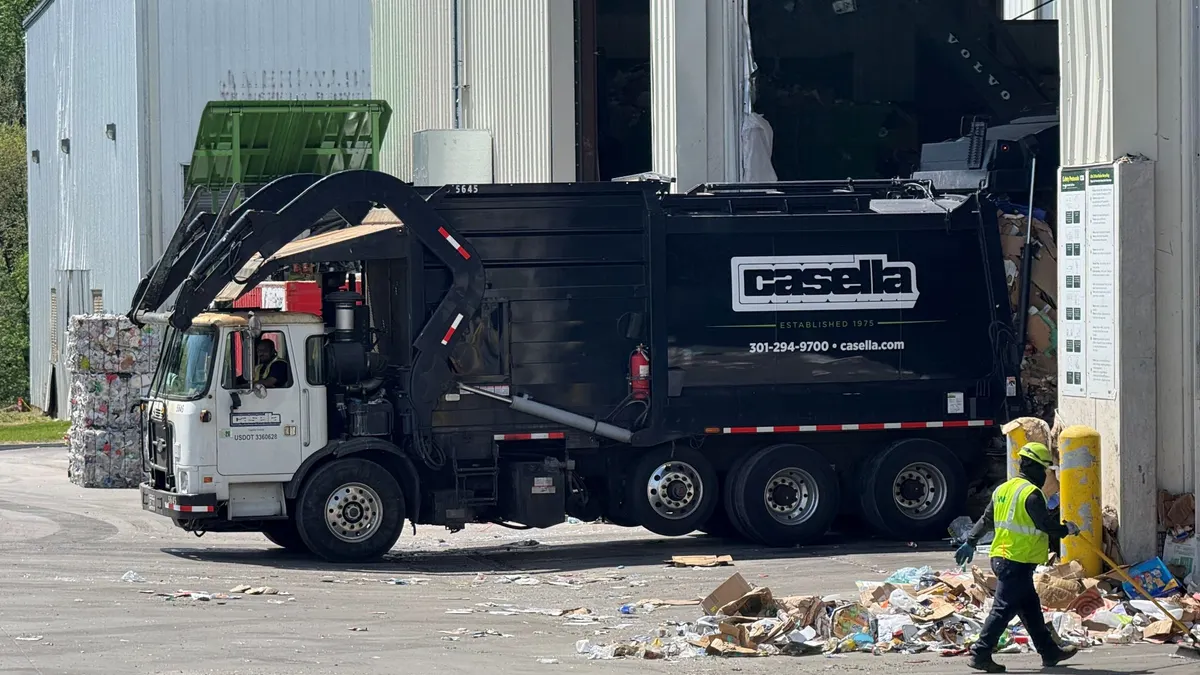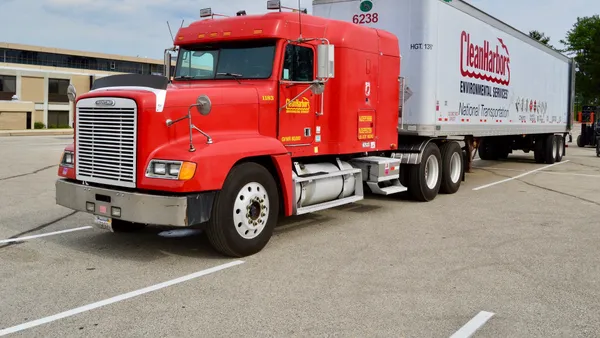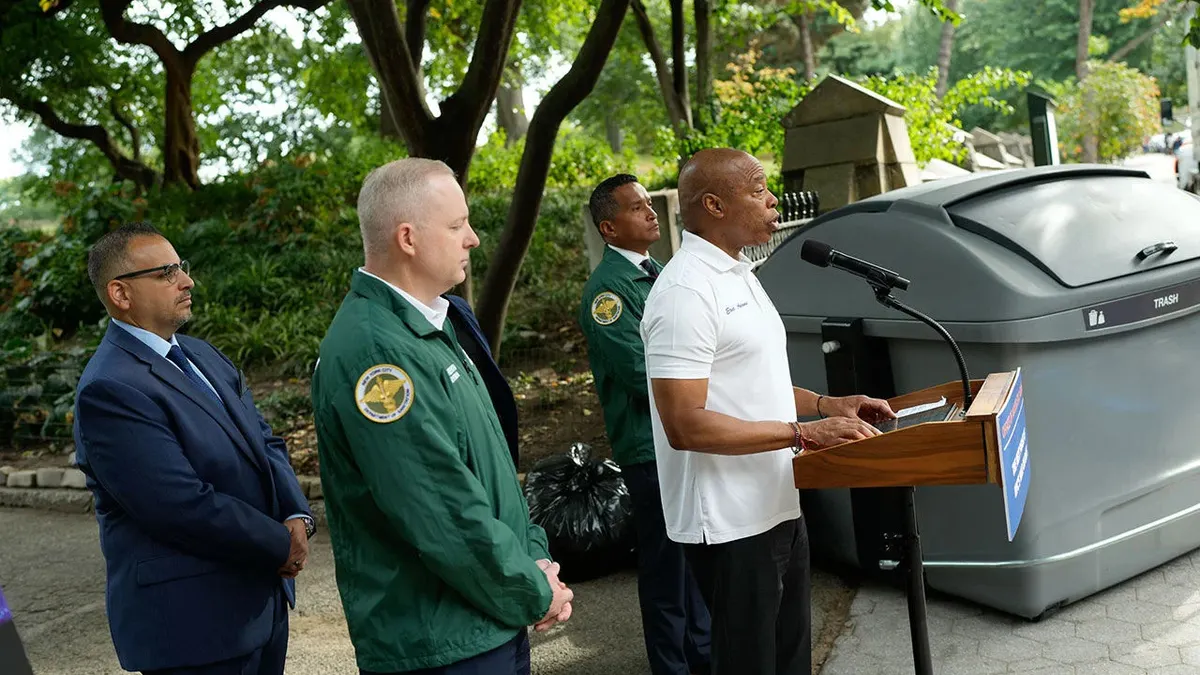
New York City's “trash revolution” began on an October day in Manhattan in 2022. Standing at a podium in front of a Department of Sanitation collection truck, then-Mayor Eric Adams and Sanitation Commissioner Jessica Tisch laid out a policy shift that would lead to a transformation of the city's sidewalks. Starting April 1, 2023, many businesses would have to pile their bags of trash on the sidewalk at 8 p.m. instead of 4 p.m. But they could set it out two hours earlier if they used bins.
That day, the officials delivered several zingers targeting the rats of New York City, including Tisch's contention that "The rats don't run this city, we do." The press conference marked the true start of containerization in New York City, the centerpiece of what Adams would come to call a “trash revolution.”
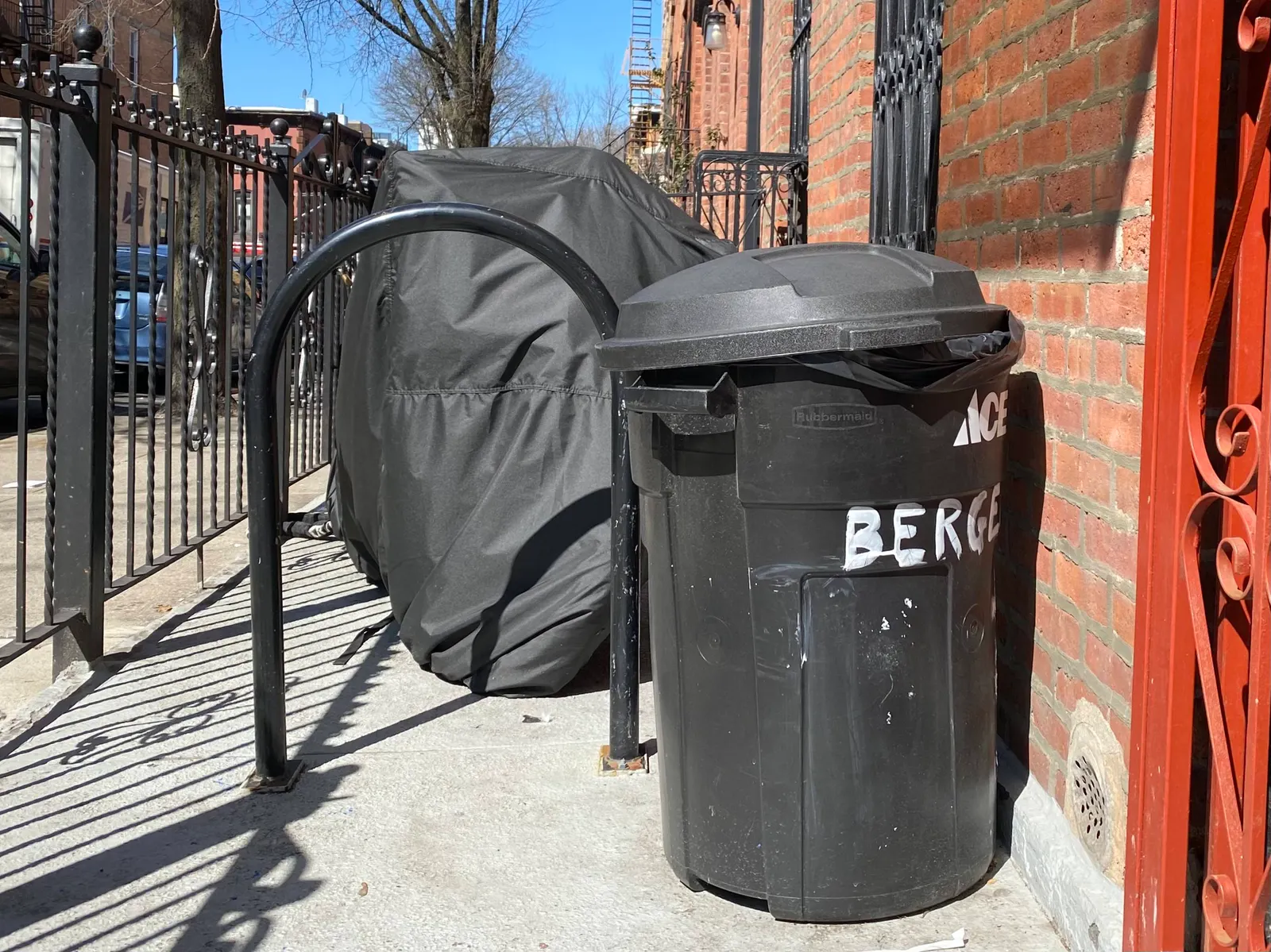
Containerization rules were extended to all commercial businesses, and buildings with one to nine residential units are also now required to put their trash in bins for collection. Experiments with larger bins continue to deliver results as well, as the department's recent announcement of a Brooklyn pilot demonstrates.
In areas where containerization has been implemented, 311 calls over rat sightings have steadily decreased, leading local officials to agree that Adams and his deputies led a solid campaign against the invasive pest. But his legacy on other key sanitation priorities, including organics diversion policy and commercial waste zones, is more mixed, officials say.
“This administration is not necessarily a sanitation administration, it’s more like an anti-rat administration,” Brooklyn Borough President Antonio Reynoso, who has advocated for expanded composting in the city and other major changes, told Waste Dive in November.
Adams did not provide comment before he left office. In the final months of his tenure, much of his top brass in the revolution moved on. Tisch, who led DSNY at the start of Adams' administration, became New York City Police Commissioner last year and remains in that position today. Kathleen Corradi, who was appointed Adams' "rat czar" in 2023, departed for a role in the city's housing department in September, according to The City.
Javier Lojan has led DSNY on an interim basis since Tisch departed in November 2024. A 25-year veteran of the agency, he's earned praise for his steady hand and willingness to walk the streets with city council members to understand residents' concerns.
In a December interview, Lojan defended Adams’ approach to key policies around containerization, curbside organic waste collection and commercial waste zone implementation.
“He's given the department some really great resources to get to these goals and these initiatives that we've been able to do. So my tenure, working under him has been great,” Lojan said.
The city is now in transition. Zohran Mamdani was sworn in as New York City mayor on Jan. 1. While he drew sharp contrasts between himself and Adams on the campaign trail, he has appeared relatively positive on the sanitation policies of his predecessor, some of which are now enshrined in city law. In December, Mamdani said he would keep Lojan in the commissioner role on an interim basis.
But Mamdani will inherit several initiatives from Adams that remain unfinished. And stakeholders are hoping Mamdani can succeed in areas where his predecessor has struggled.
An inorganic rollout
Under Adams, containerization was the first line of defense against rats, which have an easier time feasting on food scraps stuffed in piles of trash bags on the street. But the city has higher aspirations for its organic material.
In 2016, New York City set a goal to achieve zero waste by 2030. The mayor’s office of sustainability, then controlled by Mayor Bill de Blasio, found that organics diversion represented a significant reduction opportunity, as the material represented about 35% of commercial waste.
But zero waste took a backseat during the Adams administration. In 2024, the New Yorker reported that Tisch didn’t see it as her job to reduce garbage, just get it out of sight, prompting criticism from advocates.
By that time, some in the city council had already become skeptical that Adams and his deputies would take zero waste seriously on their own. Council members passed the Zero Waste Act in 2023, a package that required the rollout of citywide curbside organics collection for residential buildings by Oct. 6, 2024. The bill package became law without Adams’ signature; he would later say he would have followed through with the policy even without being compelled by law.
Rollout of the curbside organics collection was also met with frustration from residents and building owners. In April 2025, DSNY stopped issuing fines for residents that failed to separate organic waste from trash a little over a week after enforcement began.
The move was criticized by composters as well as City Council Member Shaun Abreu, chair of the city council's sanitation committee. He said in a letter at the time that “this administration has been asleep at the wheel, fumbling a citywide rollout of a program that had already been successfully piloted in multiple boroughs.”
Lojan insists that the pause was meant to give more time for outreach efforts. As a measure of success, he pointed to a period in November where residents separated out about 6 million pounds of food scraps per week, a high water mark for the curbside collection program. In New York City’s 2025 fiscal year, which ended June 30, DSNY collected more than 163,000 tons of organic material, more than double what it collected in fiscal year 2022, according to the mayor’s management report.
"Everybody hates getting a fine, so we felt like it would be better to just go out, speak to the property owners and just remind them that this is now the law," Lojan said.
But others think the city could have achieved better diversion rates by combining an earlier outreach campaign with firm enforcement expectations for residents from the start.
“The message that went out is, 'Relax. We're not doing anything for the rest of the year.' When you send these mixed messages, it confuses the public,” said Eric Goldstein, a senior attorney with the Natural Resources Defense Council.
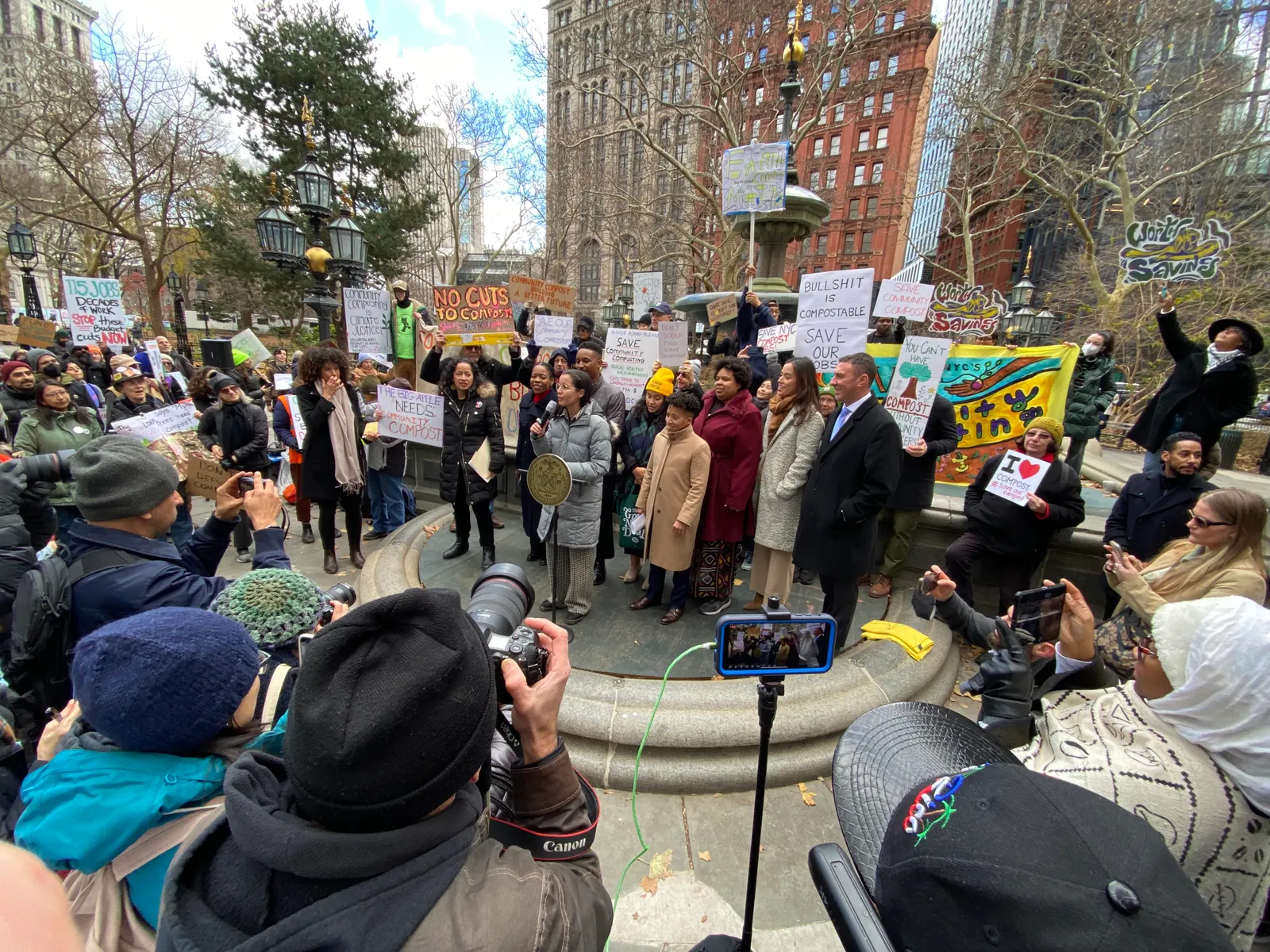
Adams dealt a critical blow to composters late in 2023, when he cut funds meant for the curbside organics program and zeroed out the funding for the city’s longstanding Community Composting Program amid broader budget cuts. The move led one organization, GrowNYC, to lay off dozens of staff members that it never hired back, though funding for the program was restored by the city council the following year.
Participants in the program, who were some of the most visible proponents of composting in the city, say the budget cuts pulled them away from their educational role right as the city needed to get residents invested in diverting their organic waste.
When funding for community composters was eliminated, Lena Frey was a compost coordinator with GrowNYC, staffing a booth at a farmers' market in McCarren Park that accepted food scraps and taught Brooklyn residents about composting. The cuts effectively nixed funding for her position, forcing her to find another job.
Frey said the saga made it clear to her that Adams did not care about the community composting program, and she believes the cuts had a lasting impact on New Yorkers' understanding of composting. If GrowNYC’s robust presence at farmers’ markets and other educational programs had continued to receive funding, Frey believes they could have assisted with education and outreach efforts prior to the rollout of the curbside program.
“If you don't have someone to ask that question to, a lot of people don't necessarily take the initiative to look this up or seek it out on their own,” Frey said.
GrowNYC said in a statement that the funding it has received from the city council for the last two fiscal years constituted about 10% of what it received annually in its previous composting contract, and it’s earmarked for outreach regarding the curbside organics collection program. Partner organizations still operate a handful of drop-off sites today, according to the nonprofit.
Adams has been criticized for a similarly halting approach to the rollout of commercial waste zones. The policy, which moves the city from an open hauler market to zone-based contracts, was mandated by law in 2019 and was delayed by the pandemic. But more than six years later, just five out of 20 zones are either implemented or in progress today. DSNY has previously said it would roll the program out completely by the end of 2027.
Abreu, who is a supporter of the commercial waste zone system, said the administration was “very, very, very terrible” at getting commercial waste zones implemented on a timely basis.
“There was a lack of political will in actually getting it done. But once they started with the rollout, we have seen for the most part that it's been pretty seamless,” he said.
Josh Haraf, vice president of the New York City market for hauler Interstate Waste Services, has a more positive view of DSNY’s approach so far. He said the amount of time it’s taken to reach out to customers in the Bronx, one of the zones where IWS serves, has shown that a measured pace is the best way to proceed.
“After living through the transition just in the Bronx recently, I think it is an aggressive pace, candidly, for what we want to accomplish. But I think it's probably as measured as possible to ensure the highest likelihood of success,” he said.
Mamdani’s sanitation to-do list
Many of the signature sanitation policies of the Adams years remain incomplete, and it will be up to the Mamdani administration to see them through.
Clare Miflin, executive director of the Center for Zero Waste Design, has spent several years lobbying successive mayoral administrations to develop a suite of potential solutions to waste containerization. She was recently a member of Mamdani’s transition team, alongside more than a dozen other professionals advising the mayor’s environmental policy.
She gives Adams credit for kicking off containerization in the city, but has several criticisms she’d like to see taken up by the new mayor. In particular, she said residential buildings should be able to share use of large stationary containers placed on the street, called Empire bins, lowering the number of small wheeled bins stationed just outside of a building’s ground floor. Other solutions, like larger four-wheeled bins that can be stored inside but rolled out at collection time, should also be explored, Miflin said.
Moreover, Miflin decried what she described as “trash-centric infrastructure,” especially when Empire bins are permitted for trash but not used for recyclables or organics.
“If you incentivize trash, you'll get less diversion,” Miflin said.
She also thinks these tweaks to containerization could serve Mamdani’s affordability agenda by lowering building staff costs for residential building owners. A report released by the Center for Zero Waste Design found that buildings with 30 units or fewer pay $75 per unit per month to handle their residents’ waste, but that cost could be eliminated with a switch to large shared waste, recycling and organics bins on the street.
What leadership role the new mayor takes is unclear. Goldstein said Adams and his sanitation commissioners deserve credit for jump-starting containerization, but believes the city council was also the driving force behind many other changes, including curbside organics and commercial waste zones.
“[Adams] called this a trash revolution. It's more accurate to say it's a trash evolution, and it's certainly a work in progress,” Goldstein said.
Mamdani's transition team did not respond to questions about his approach to organic waste, containerization or commercial waste zones. They also did not say when Mamdani would announce a permanent sanitation commissioner, though it’s unusual in New York City to change commissioners during snow season.
Lojan said he would like to remain at DSNY in some form even if he is not tapped by Mamdani to lead the agency. He highlighted his experience turning lofty sanitation goals into reality; Lojan held a leadership role in western Queens during an early pilot of the curbside organics collection program, and helped come up with a hybrid route schedule that minimized the need for additional vehicles or personnel. He said his ability to operationalize those programs remains a strength.
New deadlines will continue to pop up for the city’s evolving sanitation policies. This year, the city will develop its first solid waste management plan in 20 years, guiding policy for at least the next decade.
Enforcement of curbside organics is expected to resume, and haulers are currently enrolling businesses in the next commercial waste zones, Brooklyn South and Queens Northeast, which will go into effect at the end of February. Meanwhile, the city council has begun placing guardrails on the containerization program, which may take until 2032 to roll out completely, according to city documents.
As for the rats, Lojan says they no longer run New York City. But he believes the trash revolution is still underway.
Editor's note: This story has been updated to clarify the Center for Zero Waste Design’s recommendations for containerization and include comment from GrowNYC.