The past five years have been good for the waste and recycling investment market. Consolidation has continued at a strong pace, and investors fearing macroeconomic uncertainty have increasingly parked their money in the industry to lock in relatively safe returns, driving up valuations in the process.
But times may be changing. In the third quarter of 2025, advisory firm Houlihan Lokey recorded a slight underperformance in the environmental services peer group compared to the broader market as investors signaled a willingness to rally to riskier investments. That reinforced the industry's counter-cyclical status, the firm reported.
"In times when there is more macro volatility, this sector performs very well. And then when there's a little bit more stability, a little bit more risk-on mentality, it may underperform," Jordan Mendel, managing director at Houlihan Lokey, said in an interview.
After a series of economic shocks throughout 2025, including the inauguration of President Donald Trump and his announcement of tariffs, markets began to settle through the end of the year. Interest rates have ticked down slightly as inflation has cooled, and experts predict those trends to continue in 2026, showing signs of a normalizing market.
That could lead some bullish investors to look beyond the stable but less exciting waste and recycling industry this year.
Over the last ten years, infrastructure assets broadly and the waste and recycling industry specifically have been “discovered” by investors, said Elazar Guttman, a partner specializing in M&A and private equity at Sidley Austin.
"There are these industries that come in and out of being attractive or sexy or the cool industry that everybody wants to get into," Guttman said.
But there are still plenty of attractive aspects to the waste and recycling industry that will keep investment flowing, including the cash large publicly traded waste companies spend on dividends, Mendel added. "It's still a very safe place to invest," he said.
Deal volume spiked in 2020, and has remained above 2019 levels ever since. The industry’s continued maturation means that the dynamics of dealmaking will shift this year, but Guttman doesn't think investors will go away as that initial sheen wears off.
"Once you become aware of an industry that does provide safe returns, I would expect people to stay," Guttman said.
Today’s buyers and sellers
2026 is expected to be another healthy year for M&A, though the characteristics of typical buyers and sellers are changing.
The industry’s M&A boom kicked off in the immediate aftermath of the COVID-19 pandemic. Owners of some small- to mid-sized companies "were exhausted after COVID and decided to sell," said Joe Ursuy, an executive vice president specializing in energy, renewables and waste at Comerica Bank, via email. Buyers were more than happy to strike deals during that time due to low interest rates.
China's National Sword policy, which cut off a major destination for America's mixed plastics beginning in 2018, also created a multiyear reconfiguration of the market as companies worked to reduce their exposure to resulting commodity price headwinds.
But the owners heavily impacted by those external forces have since sold. Recyclers have restructured their contracts to move commodity risk to their contractors or suppliers, relying instead on more stable processing fees. And many haulers have been able to absorb elevated inflation through new pricing contracts.
Sellers today are larger and more knowledgeable than they were in the past, said David Stahl, partner at financial advisory firm Plante Moran Wealth Management. He said the growing sophistication of the M&A market for waste companies has given business owners a better understanding of how to grow and structure their business ahead of a sale.
There are also still market pressures unique to the last five years, like labor challenges, supply chain disruptions and regulatory changes, that make those owners eager to find a buyer.
"Many have watched peers and competitors complete significant exits and make noticeable lifestyle shifts," Stahl said in an email. "The combination of operational fatigue and the psychological pull of those 'greener pastures' is contributing to more owners exploring a sale."
The waste majors “almost always” snap up traditional waste and recycling assets, especially those companies that serve a competitive market and are below a certain size, said Houlihan Lokey’s Mendel. But he said the larger a hauler or recycler is, the more publicly traded companies may shy away for fear of antitrust scrutiny, leaving the door open to competitive offers from infrastructure funds or other private investors.
At the same time, the number of private funds looking to invest in the industry for the first time continues to grow.
“There should be continued increased competition from sponsors for new deals,” Mendel said.
Some of the biggest winners of the M&A market today are environmental services businesses — those that provide services beyond traditional municipal solid waste. The rise of deals for such companies will likely continue this year.
Public companies, like private investors, have pursued M&A in such waste niches to diversify their own businesses. Veolia North America most recently announced a deal to acquire Enviri’s Clean Earth business, which is expected to complete later this year. Other public companies have staked their own claim to unique waste streams, such as WM’s acquisition of medical waste company Stericycle, Republic Services’ acquisition of industrial waste company U.S. Ecology and Waste Connections’ focus on energy waste.
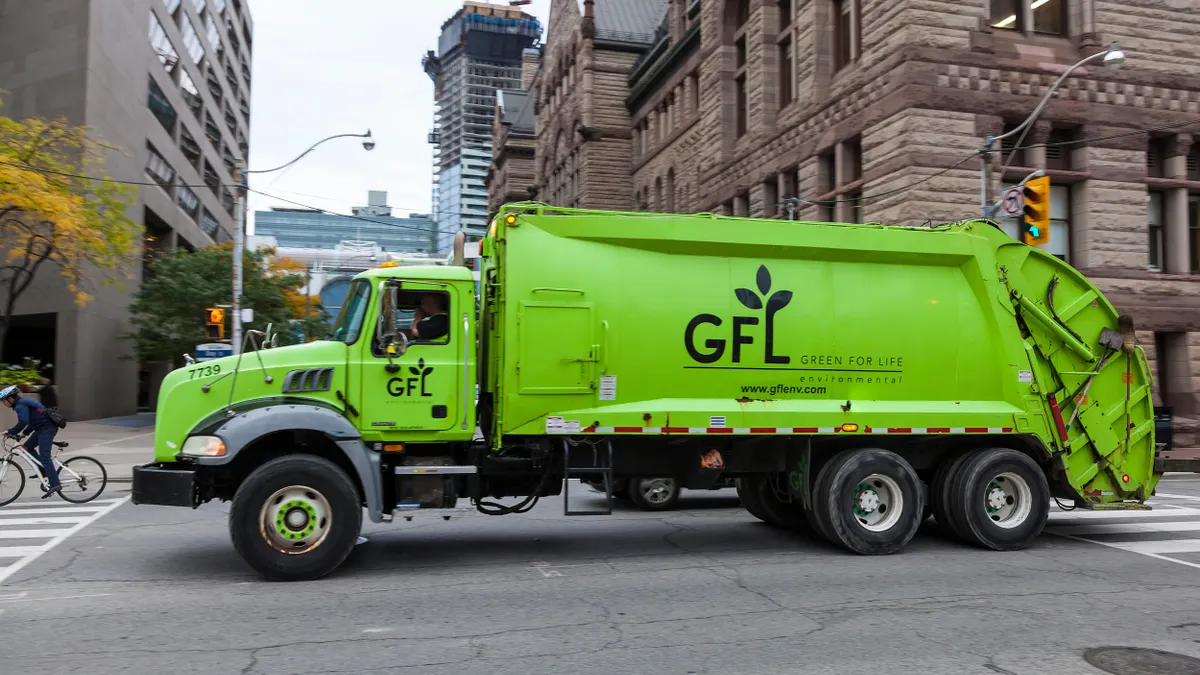
Since those blockbuster deals, transaction volume around environmental services has remained steady. Republic picked up several companies in recent years, including industrial waste and wastewater services platform Shamrock Environmental. Meanwhile, GFL Environmental spun off a majority stake in its environmental services division last year, with plans to accelerate acquisitions.
But landing spots for specialty waste companies can be heavily dependent on the particulars of each company. Mendel noted that Liberty Tire, a large tire recycling company, was acquired by infrastructure investor I Squared Capital from another private investor in a deal that closed in December. That business got more competitive offers from infrastructure funds in part because the kinds of synergies it could offer didn’t align with some major traded public companies.
“It very much depends on what specific waste streams the business is serving,” Mendel said. “It's a bit more nuanced on the specialty waste side.”
Experts also see plenty of room for consolidation in the environmental services space. Effram Kaplan, co-CEO of Brown Gibbons Lang & Co., said he has seen a wide range of such companies getting attractive deal offers.
He also noted that a stabilized market in 2026 combined with falling interest rates may unlock additional transaction opportunities for businesses, especially those below $2.5 billion in enterprise value.
“What we would expect to see in 2026 … is a broadening of or more volume than we've seen in the past,” Kaplan said.
Continued holds
While assets are expected to continue to change hands at a high rate, experts are also seeing a growing number of deals where companies don’t change hands at all.
There has been a rise in continuation vehicles — deals where companies remain under private equity ownership but get a fresh infusion of capital from investors. Kinderhook Industries kicked off the new year with a $1 billion continuation transaction backed by funds managed by Goldman Sachs Alternatives and Apollo S3. That transaction involved merging together existing portfolio companies Cards Recycling, Live Oak Environmental and EcoSouth Services into the new Ecowaste Solutions platform. Last year, Heartwood Partners also executed a continuation vehicle of its own with The Amlon Group.
More deals like that could be on the way, said Kaplan. Private owners may see a clear path to continue growing their waste companies over a longer period of time, but their investment partners may have shorter term liquidity needs and would prefer to cash out.
Continuation vehicles are one solution to meet this need by bringing in new limited partners to those looking to sell their stake, all while allowing the general partner on the deal to continue to own the business over a longer period of time.
"They'd rather have something they know how to fix or know how to grow, rather than finding something new," Kaplan said. "Why not hold on to the asset that you have and continue to build it and grow it and produce dividends to your shareholders, rather than just sell?"
That attitude could lead to larger privately held companies. Trevor Romeo, a research analyst with William Blair, said he expects some of those companies to continue to consolidate, particularly regional players. But they “could become targets themselves” in the coming years, he noted.
It’s also been some time since the waste industry has seen a splashy initial public offering — GFL Environmental's initial public offering in 2020 was the last time a North American waste company debuted to the public market with long-term success. Mendel said that’s due in part to a broader hollowing out of mid-sized public companies. Those companies are instead now growing under private ownership, often by increasing their debt to equity ratio to levels beyond what the public markets would tolerate. If such companies went public, they’d have to invest in paying down that debt, an unattractive prospect for private equity funds eager to see cash from their assets.
But as private equity-backed businesses get even larger and look for a landing spot, there are fewer realistic options.
“Certain companies have gotten to the size and scale where the buyer universe is just very limited,” said Mendel. “There's going to be some companies that their only option is to exit through the IPO market.”