Massachusetts recycling professionals are pushing ahead with new programs and funding opportunities, even as policy momentum remains limited in the state legislature.
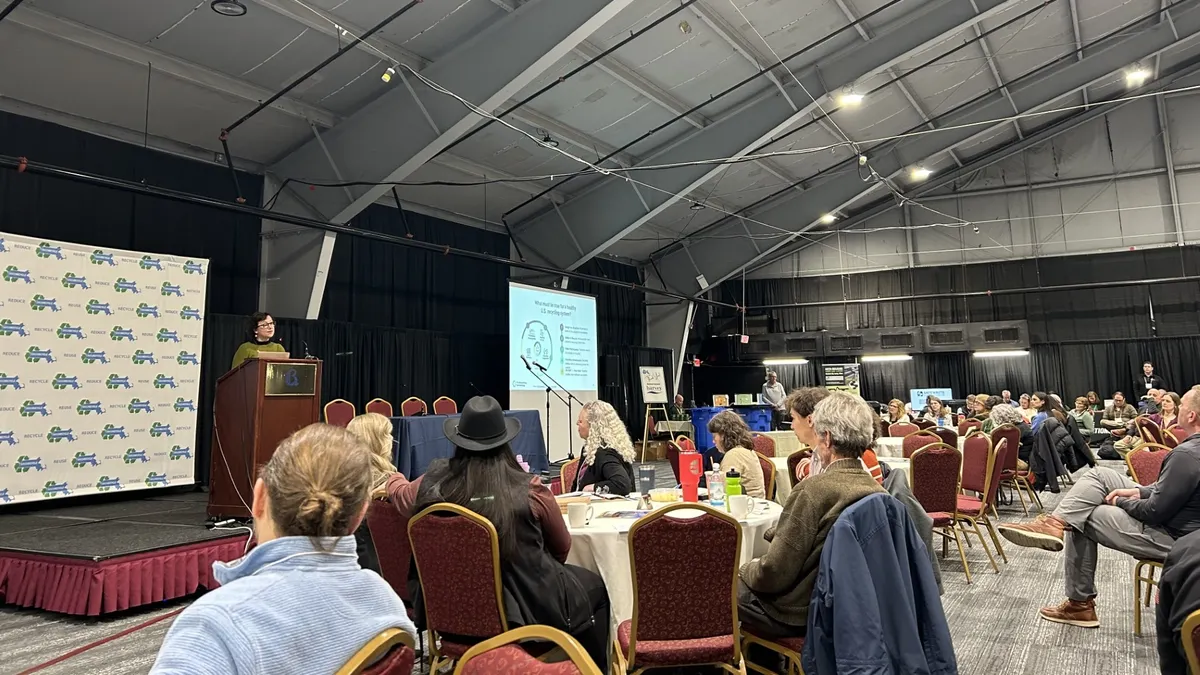
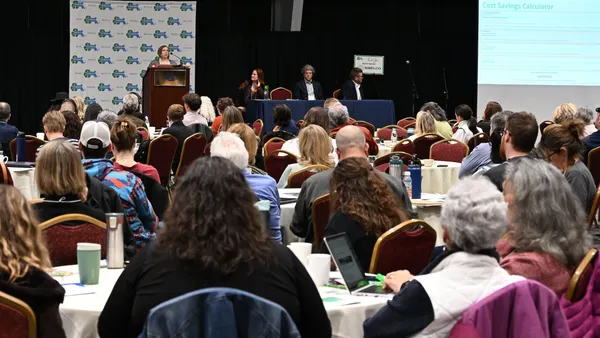
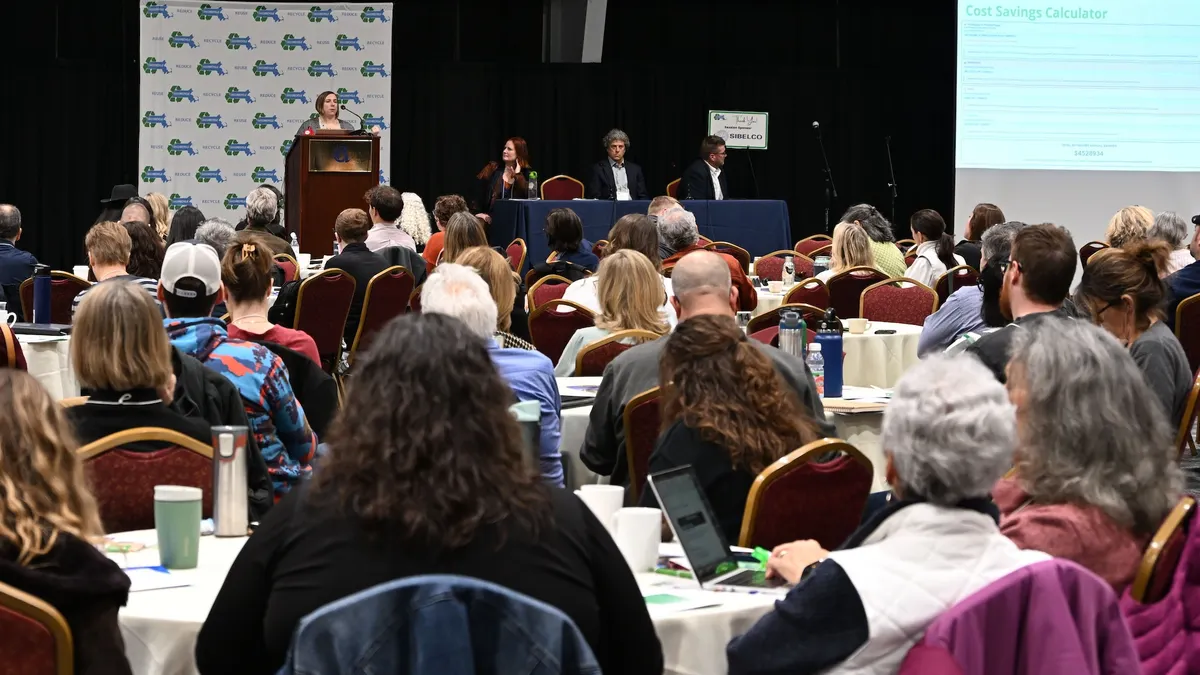
MassRecycle, a nonprofit, hosted an estimated 350 people at its annual conference in Boxborough on March 24. Attendees gathered to discuss the outlook for extended producer responsibility policies, the growth of organics diversion programs and more.
The group’s membership — which includes local recycling coordinators, private sector staff and others — had grown to at least 185 people as of the event, according to Executive Director Abbey Massaro.
This engagement comes at a time of financial strain for certain recyclable commodities, as discussed in a keynote from Keefe Harrison, The Recycling Partnership’s CEO, and efforts to make progress on a statewide waste reduction goal.
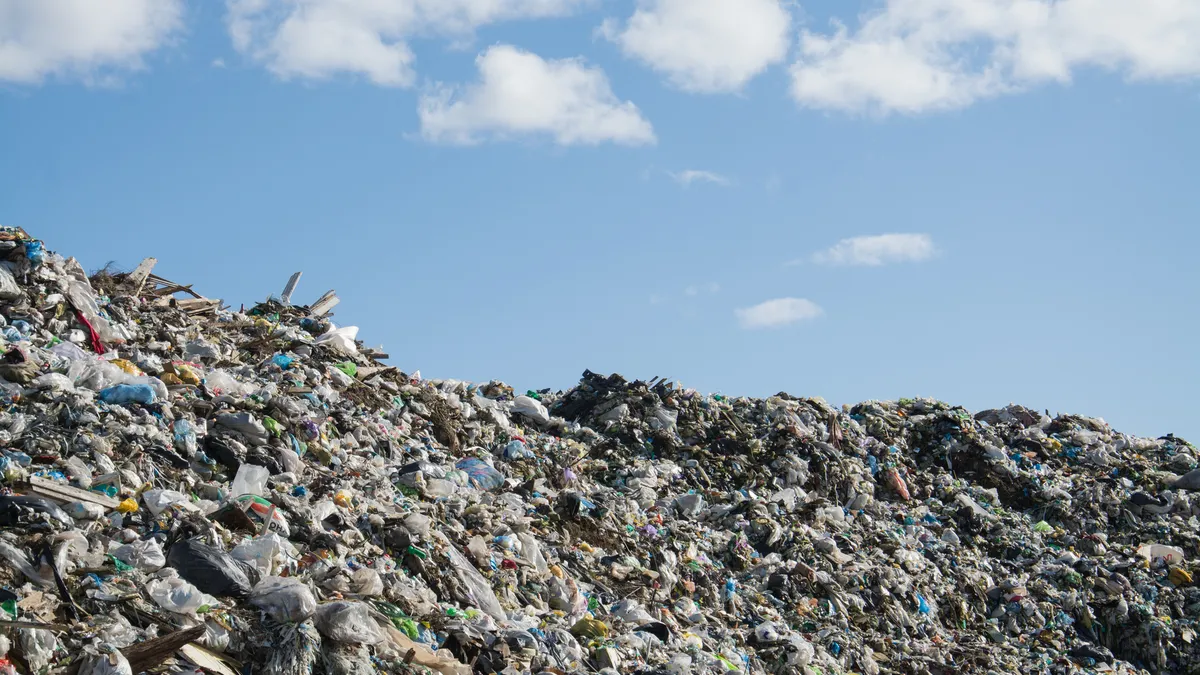
The Massachusetts Department of Environment recently reported that overall solid waste volumes continue to grow, and that material is increasingly getting exported out of the state. The agency has a goal to reduce waste volumes 30% by 2030, from a 2018 baseline.
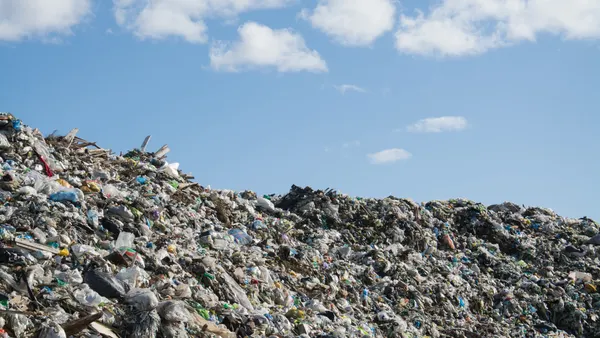
An estimated 6.22 million tons of solid waste were disposed of in Massachusetts during 2024, up 10% from 2018. MSW volumes largely remained flat, but other waste — primarily C&D — has increased by 50%.
The agency said this was largely due to an increase in gross domestic product, which can affect building activity. It noted ongoing efforts to promote building deconstruction and material reuse. It also plans to increase the minimum performance standard for C&D recycling facilities to 25% by 2030 and further support end market development.
While the agency’s recent program and policy assessment noted positive results from its waste disposal bans on mattresses, textiles and certain amounts of organics, plenty of work remains to drive further waste reduction and help local governments manage costs.
EPR efforts
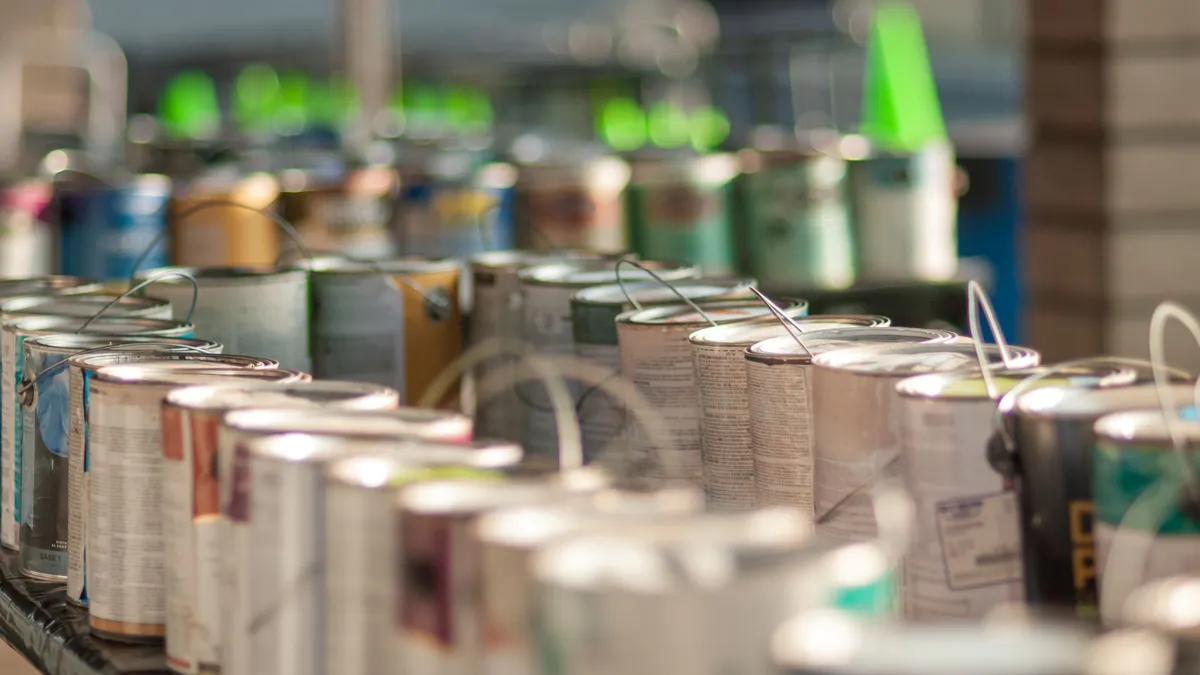
Earlier this year, a legislatively established commission recommended that lawmakers pursue EPR policies for batteries, electronics, mattresses and paint. The commission punted on the more complex issue of packaging to allow for further study.
Now, the question is whether lawmakers will act on any of the recommendations before their formal session ends in July.
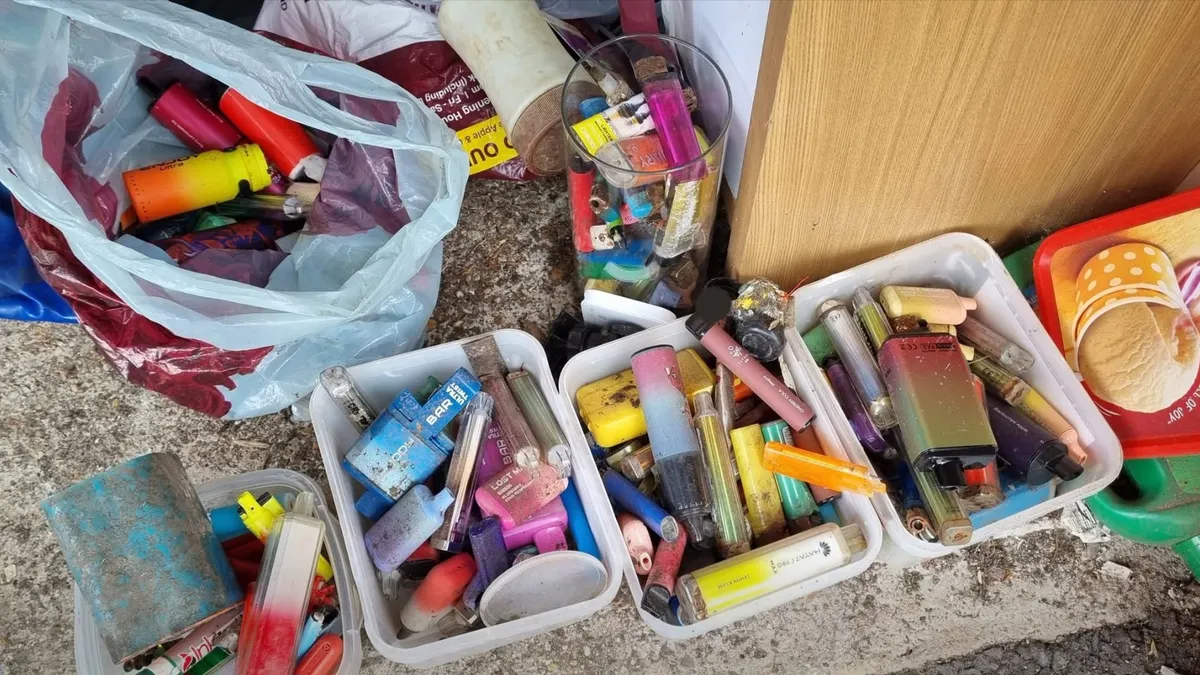
Bills remain active for all categories of EPR, as well as a potential packaging needs assessment, but the Massachusetts Product Stewardship Council — an offshoot of MassRecycle — is narrowing its focus. The group made a push for paint in the last session, but faced opposition from certain retailers. This time it’s focused squarely on batteries.
MassPSC Chair Waneta Trabert said the group’s preferred battery bill is modeled after one that recently took effect in Illinois. Advocates emphasize the fire hazard issue, as well as municipal costs to manage batteries. So far the bill has garnered support from the National Waste & Recycling Association’s local chapter, WM, Casella Waste Systems, the Fire Chiefs Association of Massachusetts, the Massachusetts Municipal Association and multiple local governments, including Boston.
Trabert also presented survey research about potential EPR cost savings that she conducted in her capacity as director of sustainable materials management for the city of Newton, in partnership with the Product Stewardship Institute. The work was funded by a MassDEP grant.
Based on the available responses, the surveyors estimated local governments in Massachusetts spend at least $187.6 million per year to manage material from the five categories that were studied by the EPR commission. Packaging and printed paper was by far the largest category at $163 million, with the next-closest category, mattresses, coming in at $16.6 million.
The survey collected waste and recycling cost data from 47 local governments, representing about 38% of the state’s population. Respondents ranged from small towns to six of the state’s 10 largest municipalities, including Boston. Trabert cautioned that the data wasn’t fully representative due to challenges getting local governments to respond, differences among municipalities’ data collection and incomplete responses on certain questions.
Scaling organics programs
MassDEP reported that 370,000 tons of food waste were diverted from disposal in 2024, which is still less than half of the state’s goal for annual reduction by 2030.
The state reported positive momentum on commercial organics diversion, following a reduced disposal ban threshold of half a ton per week that took effect in 2022. The agency also noted steps it had taken to educate businesses potentially covered by the updated policy. In some cases, this prompted businesses to establish programs before enforcement began.
Residential organics are the next focus area, and the agency is considering a statewide disposal ban by 2030. An estimated 160 of the state’s 351 municipalities now have some form of organics program.
A presentation from Debra Darby, a manager of organics sustainability solutions at consulting firm Tetra Tech, showed a wide range of local approaches. While backyard compost bins and drop-off sites are the most common offering, several local governments also have some version of curbside service. This may include preferred vendor models, direct city contracts or other methods.
Darby also noted the potential for local governments to team up for regional programs and emphasized the importance of designing cost-effective programs that can be sustained over the long term.
No final decisions will be made about a statewide disposal ban without further research said John Fischer, deputy division director for solid waste materials management at MassDEP.
The agency’s latest program and policy assessment previewed upcoming stakeholder meetings this year to discuss “infrastructure and capacity development, as well as guidance and assistance to municipalities and major food business sectors.”
State funding
The state is also still focused on maintaining a range of existing grant programs for waste reduction and recycling, as well as launching new ones.
This includes microgrants of up to $10,000 for donation, reuse or repair projects — not recycling or composting — which have a May 15 application deadline.
The agency is also expected to finalize awards for waste reduction innovation grants of up to $2 million, focused on supporting new technology to scale recycling and reuse. MassDEP previewed plans to “initiate development of an incubator and accelerator program to help early stage and innovative waste reduction business ventures grow successfully.”
The agency could also see additional funding from Gov. Maura Healey’s proposed environmental bond bill, the Mass Ready Act.
The proposed bill contains $28.1 million in funding for solid waste issues. The bill text says funding could be used to manage pollution from existing or closed solid waste facilities, as well as for “capital expenditures associated with composting, recycling and waste reduction programs consistent with the comprehensive statewide solid waste master plan.”