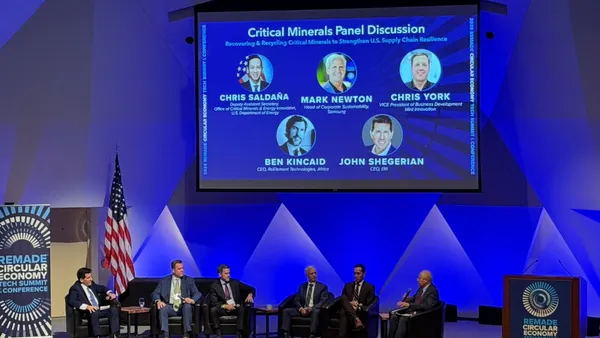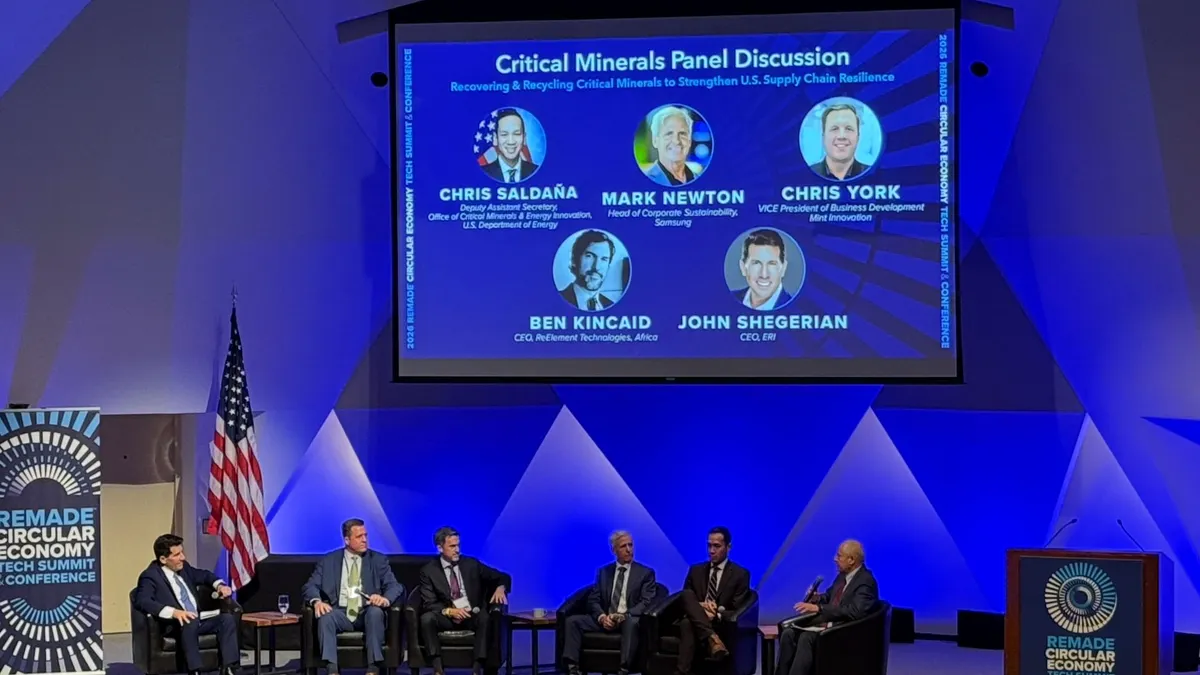
To boost domestic supply chains for critical minerals, players in the recovery and recycling value chain will need to foster stronger relationships and think more creatively as geopolitical and global trade pressures mount, said speakers at the Remade Institute’s annual conference on Wednesday in Washington, D.C.
There’s an estimated $67 billion in value locked inside “hibernating devices” such as forgotten laptops or old phones tossed into junk drawers globally, said Danielle Holly, executive lead, North America, for the Ellen MacArthur Foundation.
But to take advantage of the critical minerals inside — and keep them in the U.S. — more investments and innovations need to take place in collection infrastructure, recycling capacity and supply chains, and the space would benefit from policy drivers to make recycling a priority and an attractive value proposition, speakers said.
Paired with other strategies like reuse and remanufacturing investments, the U.S. can turn this waste into an “economic powerhouse,” Holly said. Electronics are already the “largest growing, the most valuable waste stream that we have.”
Supply chain pressures driving urgency
In recent years, efforts to boost U.S. domestic supply chains for critical minerals used in electronics, batteries and magnets has become a federal economic and manufacturing priority. That’s because other countries currently corner the market on certain minerals commonly used for those items, including China.
The subject of boosting the economy through recycling and reuse is a familiar theme at Remade conferences. The national institute, established by the U.S. Department of Energy, partners with academia, trade groups and national laboratories with the goal of creating circular economy jobs and increasing supplies of recycled materials.
But this year, speakers noted a greater sense of urgency to pursue domestic supply chain initiatives, due to the conflict between the United States and Iran, which has disrupted numerous industries.
“The world has woken up to the dire need to decentralize our supply chains,” said Ben Kincaid, CEO of ReElement Technologies’ Africa subsidiary. The company is a refiner that sources recycled magnet material as one of its feedstocks and is based in Indiana. The ability to control such feedstocks domestically can “not only drive success for investors, but show there’s clearly a national security interest here.”
At the same time, the DOE, as well as some private companies, is investing heavily to recover critical minerals such as rare earths, lithium and cobalt.
The agency last summer announced it would offer nearly $1 billion in funding for projects that advance critical mineral mining, processing and manufacturing technologies.
In December, it announced another $134 million in funding for projects that collect rare earth metals from discarded electronics.
“We’re not just focused on recycling but on the full value chain,” said Chris Saldaña, deputy assistant secretary in the DOE’s Office of Critical Minerals, Materials and Manufacturing. “If we pursue this without a systems approach, we won’t be able to solve the problem.”
Some of the funding windows for these programs have accelerated opening and closing dates compared with past grant programs, he said, because “it conveys the urgency of solutions needed to address the problem. There's going to be more opportunities as we dig further into this.”
Electronics companies are also seeing the benefit of examining their own supply chains for how to extract more recycled materials instead of relying on global supply chains, said Mark Newton, head of corporate sustainability for Samsung Electronics. Samsung collects an average of 100 million pounds of electronics every month, and it recovers about 20% of materials for recycling.
“A success story for us, is that we’ve figured out how to get quite a bit of value from lithium and cobalt from lithium-ion batteries,” he said, noting that 80% of the cobalt the world sources comes from the Democratic Republic of the Congo, making resources finite and reliant mainly on one country’s export.
But despite Samsung’s resources, “we can’t get past that 20% recovery rate,” he said. “We still have to get materials out.”
Plenty of material, yet not enough material
Collection challenges remain a frustration for recyclers and manufacturers who know disused electronics are everywhere but can’t source enough of it.
“We're not collecting the material we need. It's out there. We know it's out there. It's just a matter of establishing the collection infrastructure,” said Chris York, vice president of business development for Mint Innovation, a company that extracts critical materials from items like circuit boards and lithium-ion batteries.
Holly of EMF said another problem is that the general public either “doesn’t know how to get rid of [these electronics], or we're worried about getting rid of them, because they have our data and our private information on them,” Holly said. “But this is an example of a place where technology and innovation exist.”
John Shegerian, CEO of electronics recycler ERI, said he’s built his business on collecting and recycling electronics, returning about 98% of the material inside back into circular economy applications. But the industry is also contending with an estimated 137 billion pounds of end-of-life electronics entering the waste stream globally every year. Between 12% and 22% actually gets responsibly recycled or reused, according to U.S. EPA and UN data, he said.
“OEMs create these wonderful tools that make our personal lives and our business lives more connected, more interesting. But at the end of the day, they've got to go somewhere, and they've got to go somewhere responsible,” he said. “The opportunity is for all of us to do better.”
The scope of the problem — coupled with the urgency to improve supply chains from directives from the federal government — has prompted companies like Mint to work more closely with other members of the supply chain in the last year, York said. “We have been trying to attack this individually, but now we know we need to work together and approach the government with a full solution.”
An additional avenue is identifying waste streams for “hibernating” electronics beyond those found in consumers’ homes, such as disused laptops or electronics gathering dust in government buildings, said Kincaid of ReElement.
Industrial scrap is another type of material that companies could capitalize on, something ReElement is already sourcing from some customers. “China is doing a magnificent job of controlling the market. For us, we do have lots of feedstock that we could take advantage of, Kincaid said.
Communicating existing solutions
Speakers were also optimistic that their strategies will help move the needle, as long as they can simultaneously look for more ways to innovate.
One reason for optimism is that the Trump administration is focused on offering funding incentives and signaling its interest in working with the private sector to solve the problem, which Shegerian said has helped shift the industry in the right direction. “The time is now and the more collaboration, the better,” he said.
From the DOE’s perspective, the critical minerals conversation has a longer horizon, Saldaña said. “Yes, we do want to solve this problem in the short term by addressing capacity, and I think the opportunity with recycled feedstocks is significant for short term impact. We also want to obviously make sure that we’re sustainable in the long term.”
Longer-term policies should be coupled with advancements in recycling and refining technologies, Newton said. That’s something he says he is excited about because these innovations are already happening.
York would also like to see other long-term infrastructure and business improvements. “Once I capture the precious metals, what do I do next?... There’s a lack of infrastructure for it to go back into manufacturing because it generally has to leave the U.S. to become a circuitboard. Some of that infrastructure needs to be brought to the U.S.”
And Shegerian sees more opportunities for the industry to better communicate what is already working, he said. “We now have to show it to be able to close the gap in education, to make sure that the policymakers, legislators understands the solutions exist, and we're here now.”