Dive Brief:
- Supporters of a recently introduced bill in Congress want to make it easier for chemical recyclers to regulate their processes as manufacturing rather than waste management.
- The Recycling Technology Innovation Act seeks to amend the Clean Air Act to allow certain chemical recyclers to petition for their operations to be “excluded from the definition of solid waste incineration unit.” Reps. Dan Crenshaw, R-Texas, and Gary Palmer, R-Ala., vice chair and chair of the House Energy and Commerce Committee’s environment subcommittee, sponsor the bill.
- The American Chemistry Council, which backs the bill, has long said this reclassification would make chemical recycling facility permitting and regulatory processes more consistent across the country. It would also align federal policy with ACC-backed policies in 25 states that recognize chemical recycling as manufacturing.
Dive Insight:
The legislation continues an ongoing discussion at the federal level over the role of chemical recycling in advancing U.S. domestic supply chains and creating jobs. ACC and other groups say more federal policies and investments are needed to help recyclers collect, sort and recycle more plastic.
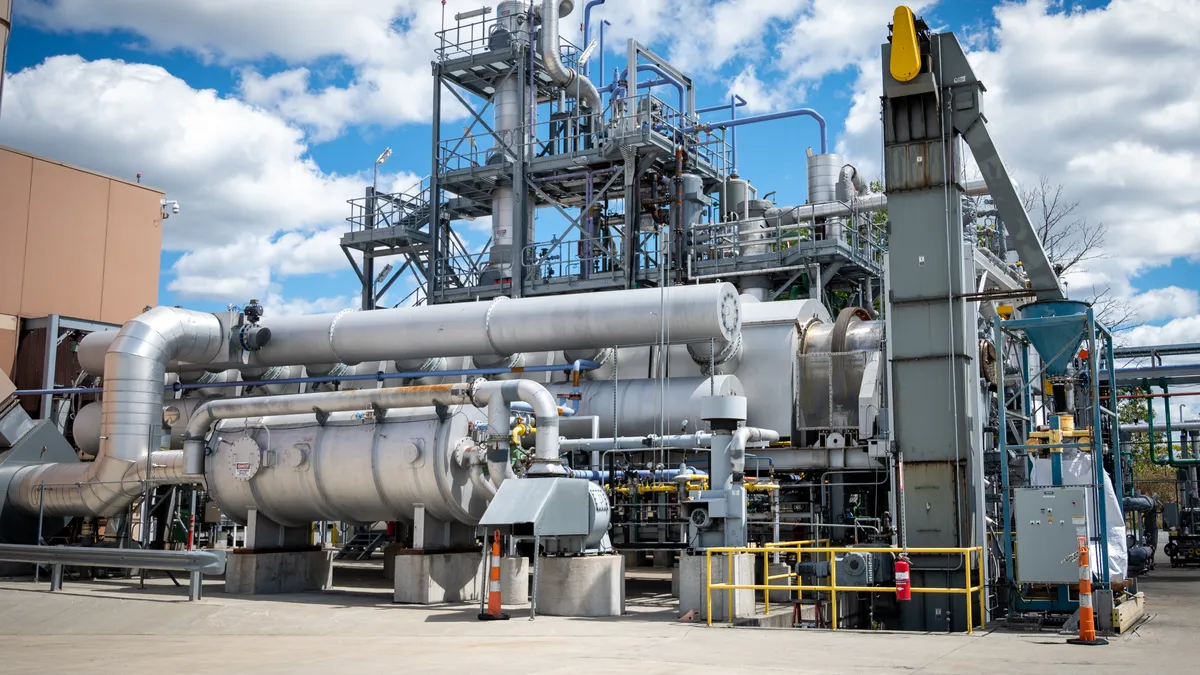
Chemical recycling, which the plastics industry calls advanced or molecular recycling, is a suite of technologies meant to break down plastics to their molecular building blocks to be made into new plastics, or in some cases fuel. The techniques have drawn both enthusiasm from groups who see it as a possible economic driver and criticisms from environmental groups that say the processes can create pollution and overpromise on recycling results.
Crenshaw is among those who see chemical recycling as a key economic driver, particularly for his state of Texas, a major U.S. hub for plastics and chemical manufacturing. ExxonMobil has chemical recycling operations in the state in Baytown and Beaumont.
“Currently, vague and inconsistent interpretations of the Clean Air Act have left companies guessing about how advanced recycling will be regulated — a barrier to long-term planning and large-scale investment,” he said in a statement.
According to the bill, certain chemical recyclers, defined as “an owner or operator of a unit that converts or transforms plastic or post-use polymers,” would be able to petition the U.S. EPA administrator to request their operations be “excluded from the definition of solid waste incineration unit.”
That petition process would need to be posted publicly and go through a public comment period, according to the bill.
The bill further specifies the law would apply to certain units that make “products” through processes such as “pyrolysis, gasification, depolymerization, catalytic cracking, solvolysis, or chemolysis.” Processes that create electricity, heat or steam, as well as ash, soot or char, would not be eligible, according to the bill.
“These modern technologies should be regulated like manufacturing because they take an input — in this case, used plastics — and turn it into new products,” said Ross Eisenberg, president of ACC’s plastics division, in a statement.
The U.S. EPA last year declined to consider a reclassification for pyrolysis, a type of chemical recycling, in recent air quality standards.
ACC had previously urged Congress to support similar federal reclassification legislation in July during a meeting of the House Committee on Energy and Commerce’s environment subcommittee. During that meeting, the Flexible Packaging Association also voiced support for chemical recycling as a tool to increase recycling rates for some films and flexible packaging.
Yet some Democrats on that subcommittee have voiced concerns that reclassifying chemical recycling as a manufacturing process could potentially allow facilities to avoid stronger environmental protections under laws like the Clean Air Act.
Environmental groups such as Greenpeace have long criticized ACC and other plastic groups for the ongoing work to advance chemical recycling technologies. In a recent report, Greenpeace reiterated its position that the technologies create harmful pollution and are not economically viable.
In the meantime, ACC has also called on the federal government to recognize that plastics made from chemical recycling processes would count as “recycled plastic,” a designation that could be notable for states that have laws requiring some products to contain a certain amount of recycled content.