Dive Brief:
- The Can Manufacturers Institute and the Household & Commercial Products Association published a guide aimed at increasing MRF acceptance of aerosol cans to boost recycling rates.
- The trade groups are working with Circular Action Alliance to expand aerosol can recycling in Oregon as part of an extended producer responsibility for packaging program that began in July. CAA determined that “collecting and processing empty aerosols can be done safely and efficiently, distinguishing it from the challenges posed by non-empty containers that still hold residual content.”
- Aerosol cans are often considered a hazard by some MRF operators, and aren’t accepted in all curbside programs. Last year, How2Recycle downgraded the cans from “widely recyclable” to “check locally.”
Dive Insight:
The new playbook from the Aerosol Recycling Intiative, a joint effort between the trade groups, seeks to address common MRF concerns around worker safety, fires and uncertain end markets.
“Yes We Can! A Practical Guide to Aerosol Recycling at MRFs” is based on interviews with 13 MRF operators in 11 states, some of which explicitly accept aerosol cans, some of which do not, and some of which accept aerosols without advertising it.
It suggested implementing procedures for inspection and safe handling to reduce fire risk, such as having staff manually sort non-empty aerosol cans and adding fire suppression systems. Consumer education is another critical piece of the solution, the playbook notes.
The playbook also included case studies, such as the example of a MRF in Utah that unofficially accepts aerosols and chose to install a Fire Rover detection and suppression system as a safety measure. It also notes efforts by CAA and industry trade groups to work with recyclers and officials in the Portland, Oregon, region to gather better data about aerosol cans in the recycling stream and test educational messaging.
Roxanne Sharif, director of sustainability at CMI, said in a press release that the hope is the playbook “equips MRF operators with resources, including from their peers, to confidently assess and advance their operations while helping create meaningful, industry-wide impact.”
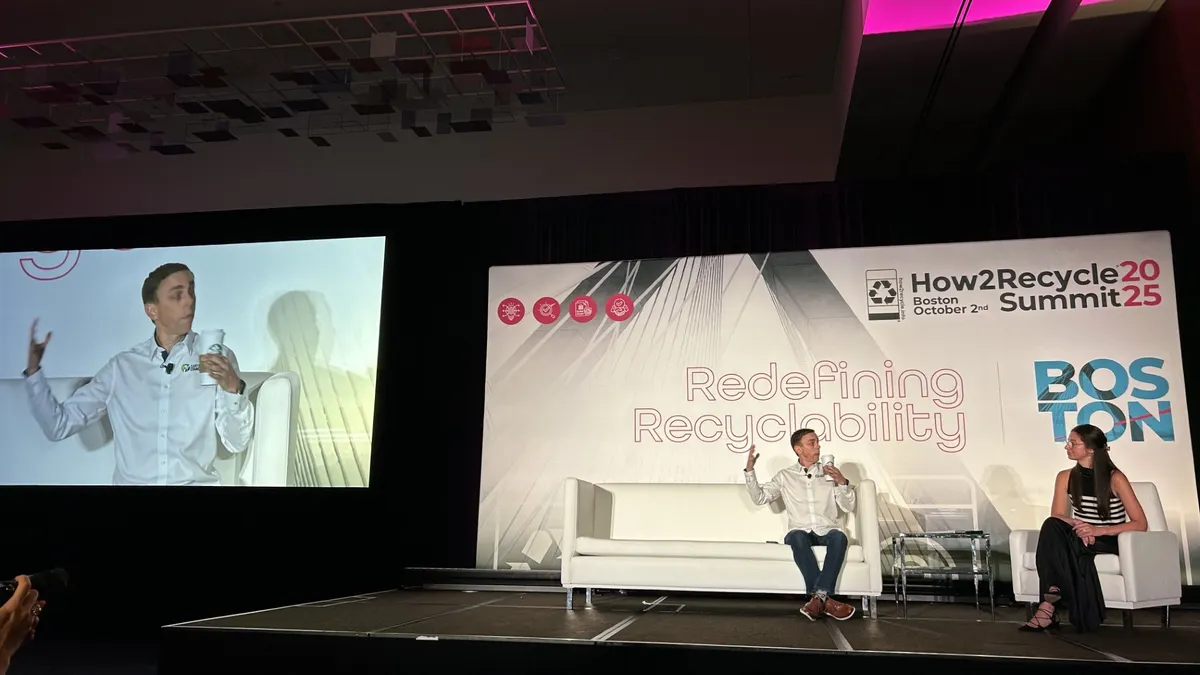
Miriam Holsinger, co-president of Eureka Recycling in Minnesota, said her facility accepts aerosol cans, but “when people say they don't I completely understand.”
“For us, it was kind of a legacy thing,” she said. “We've just accepted them for a long time, so we've already had to manage them. I tell people all the time, it's so much easier to put something on the ‘yes’ list than take it off. If we said they’re not accepted anymore, we’d probably still get the same amount.”
Eureka has had several thermal events “that we’re pretty sure were caused by aerosol cans, so the safety concerns are 100% real,” Holsinger said, adding that the facility has protocols around keeping the area around the baler clear of flammable material and staff, in case of fireballs.
The Aerosol Recycling Initiative formed in 2022 with a goal of an 85% recycling access rate for aerosol cans by 2030. The rate is under debate as How2Recycle’s downgrade means the group determined that less than 60% of Americans can recycle aerosol cans through curbside or drop-off programs. That’s based on data from The Recycling Partnership, which found a 39% acceptance rate for aluminum aerosol containers in the U.S. in 2025.
However, the Aerosol Recycling Initiative found that 62% of U.S. residents have access to a recycling program that accepts aluminum aerosol containers, and 61% have access for steel aerosol containers. The discrepancy is because some facilities don’t advertise that they accept the cans, the initiative said, and it planned to work with The Recycling Partnership to clarify the rates.
The playbook stated that “while there are inherent risks to accepting empty aerosol cans, potential economic and future-proofing benefits may outweigh or even address some of the risks.”
The benefits include increased revenue, alignment with consumer expectations, higher diversion rates, reduced residuals and non-accepted items and preparedness for EPR programs.
Previous research commissioned by the initiative found that U.S. MRFs could see an additional $39 million in annual revenue, or about $77,000 in per MRF, plus $8.5 million in avoided disposal costs, assuming a 50% recycling rate.
In 2024, the group published a white paper that found that of nearly 900 aerosols from two MRFs, just under 80% had less than 3% residue. The paper said aerosols should be included on recyclability lists in EPR programs.
The playbook’s authors argue that “end markets do exist, and when the cans are properly sorted and emptied, they can be a valuable source of aluminum and steel.” Steel aerosol cans could be incorporated into bulk ferrous metal scrap, and aluminum aerosol cans, while rejected by sheet mills, can go to scrap dealers, deox producers and intermediary processors.
Holsinger said Eureka puts nonferrous aerosol cans into a lower-grade aluminum bale, and ferrous cans in with steel and tin bales.
“We have a really high-quality product, so we haven't had any issue moving it, but we only make a load every two months and we’re not a tiny MRF,” she said, noting the economics might not make sense for all MRFs.
EPR programs, such as the one active in Oregon, could help by taking aerosol cans in drop-off locations. This could make the process safer and increase volumes, Holsinger said, though only time will tell.
This story first appeared in the Waste Dive: Recycling newsletter. Sign up for the weekly emails here.