This is the latest installment in Waste Dive’s Biogas Monthly series.
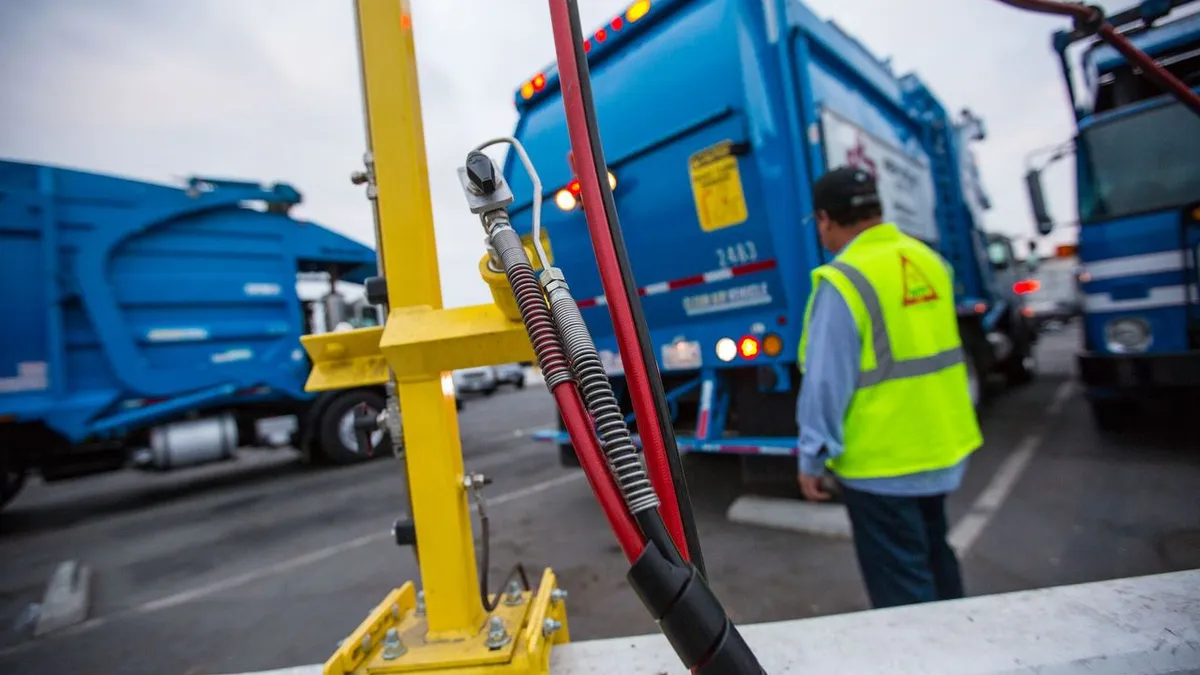
Renewable natural gas has become a success story in the world of sustainable fleets and appears poised for additional growth, according to a report from TRC Companies. The annual State of Sustainable Fleets report showed adoption of compressed natural gas-fueled trucks continued in 2025, and a growing share of those vehicles are being powered through RNG.
“Natural gas is having a good year, and RNG ... has really been an example for other drivetrains, other technologies,” Nate Springer, vice president of market development at TRC, said on an April 28 webinar discussing the report.
Other studies have shown similar positive signs for RNG adoption. The Transport Project, an industry group, reported that 94% of all natural gas fuel used in transportation was RNG in 2025, representing 13% growth over the prior year.
The sustainable fleets report found that 65% of CNG truck users reported using RNG, which accounted for about 78% of their total fuel volume. Total new natural gas-powered vehicle registrations declined by about 15% year over year, which was reflective of a recession in the freight market. Orders of refuse vehicles fueled by natural gas fueled the segment, however, as registrations of “straight trucks” like those used by waste haulers increased 27%.
The Cummins X15N engine, which entered full-scale production in late 2024 and saw its first full year of commercial availability in 2025, may drive additional growth in the market. The engine is lighter and more efficient than other natural gas engines, offering expanded use cases for fleet operators, per the report.
The report found that 71% of fleets using the engine reported cost savings relative to diesel, and 59% reported fuel cost savings relative to other kinds of CNG-powered engines. More than one-third of fleets that have deployed the X15N reported they plan to increase their use of the engine.
Springer said that RNG supply entered a boom period three or four years ago as new incentives and a growing desire for alternatives to diesel fueled demand. He said that growth has cooled slightly as the market matures, but he expects the supply base will continue to grow.
Below is a selection of biogas industry highlights from April.
Vanguard Renewables reports significant portfolio progress
Blackrock-backed Vanguard Renewables announced this month that three new facilities producing RNG from food waste opened in the last month. The facilities are the first completed through a partnership with utility TotalEnergies. They also are part of an offtake agreement with AstraZeneca that was signed in 2023.
The three facilities are located in River Falls, Wisconsin; Eden, Wisconsin; and Amelia Court House, Virginia. Combined, they can produce nearly 870,000 mmBtus of RNG annually, according to Vanguard.
All three of the projects also use technology developed by Anaergia, which has hitched its own growth to an asset-light model where it designs and operates its proprietary biogas technology for project partners. On April 22, Vanguard announced a contract with Anaergia worth 8 million Canadian dollars for a fourth project in Minnesota. CenterPoint Eenrgy has agreed to purchase the RNG from that facility.
The new facilities are a different design and reflect Vanguard’s “next generation of assets,” compared to its portfolio of New England facilities, according to a company spokesperson.
The agreement between Vanguard and AstraZeneca remains one of the largest open-market deals for RNG signed in the United States. Last year, Vanguard said it supplied the equivalent of 33 gigawatt-hours of energy through RNG to AstraZeneca.
The company continues to evaluate new projects in its development pipeline with TotalEnergies, per the spokesperson.
Clean Energy Fuels names new CEO
Publicly traded RNG fuel supplier Clean Energy Fuels’ board of directors appointed Clay Corbus as president and CEO on April 23. Corbus succeeds Andrew Littlefair, who co-founded the company. Littlefair will remain on the board and serve as a government relations consultant.
Corbus has held various roles at Clean Energy for about 19 years, including senior vice president of strategic development and head of renewable fuels. He was also previously co-CEO of the investment bank WR Hambrecht + Co.
Board Chairman Stephen Scully praised Corbus’ “ability to craft strategies for the future,” which he said will allow him to bring a fresh approach to the company.
“I’m honored to step into the role of CEO and am grateful to the board for its confidence in me,” Corbus said in a statement.
In 2025, Clean Energy Fuels reported growth in its RNG business and revenue up 2.1% overall, though it also reported a net loss of $30.2 million. The company continues to invest in new RNG production.
Hydron Energy launches Chilliwack RNG plant
British Columbia-based Hydron Energy announced it would build a landfill-gas-to-RNG project at the Baily Landfill in Chilliwack, British Columbia. The company plans to deploy its proprietary gas upgrading platform at the plant, which it says can reduce capital and operating costs by up to 50% compared to similar technologies in the biogas space.
Founded in 2020, Hydron has received investment from several entities, including the multi-trade contractor Modern Niagara Group. In July, it also announced the first commercial sale of its system to an unnamed private party in eastern Ontario.
The Chilliwack facility is backed by several entities, including the utility FortisBC and the city of Chilliwack. The National Research Council of Canada Industrial Research Assistance Program is also providing up to $2.3 million in funding through its Clean Technology Initiative.
“This project represents a pivotal step toward transforming the economics of RNG production from landfill sites,” said Soheil Khiavi, CEO at Hydron Energy. “By combining N₂ and CO₂ removal into one streamlined process, we are enabling producers to achieve market-acceptable RNG quality at a materially lower cost. This opens the door for all sizes of landfill projects to become financially viable.”
Opal Fuels announces tax credit sale for New Jersey site
Opal Fuels announced it completed the sale of tax credits associated with a facility it helped develop in Egg Harbor Township, New Jersey. The facility, which entered commercial operation last fall, was built in collaboration with South Jersey Industries at the Atlantic County Utilities Authority's landfill.
This is Opal's fifth tax credit sale. Co-CEO Jonathan Maurer said in a statement it reflects "expanding opportunity in the renewable natural gas market."
“RNG remains an important tool for lowering emissions, enhancing U.S. energy dominance, and provides tangible benefits to local communities," he said.
Opal Fuels has taken an aggressive approach to tax credit sales to earn additional proceeds from its RNG portfolio. It's also sold tax credits at facilities in Virginia, North Carolina and Michigan.