Early results from a new wave of U.S. Department of Defense-funded demonstration projects to remediate PFAS contamination on military bases show promise for destroying the chemicals at scale and could pave the way for the commercialization of the technologies, according to program participants.
More than 700 DOD sites either contain or are likely to have elevated levels of per- and polyfluoroalkyl substances in water or soil. The military is under mounting pressure from nearby communities to clean up the chemicals, which have been linked to certain cancers, infertility and other serious health problems.
Congress has required the agency to phase out the use of PFAS in aqueous film forming foam, or AFFF, which is responsible for much of the contamination at military sites. Multistate litigation combining thousands of AFFF cases is also pending in a federal court in South Carolina, adding further incentive to clean up the sites. DOJ was granted a stay on 22 of those cases last month after citing delays from the government shutdown.
But fully eliminating PFAS from contaminated sites has proven difficult. The same chemical properties that make these “forever chemicals” so effective as repellents or firefighting agents also make them challenging to break down.
In recent years, DOD has funded a series of demonstration projects aimed at determining which technologies are most effective and efficient at ridding surface water, groundwater and soil of PFAS and standardizing sampling methods across the military’s contaminated sites.
The tests, overseen in part by the agency’s Defense Innovation Unit and Environmental Security Technology Certification Program, are also a way for companies to show their methods are ready for commercial use.
Under the agreements, each company that successfully proves its technology will receive a “success memo” from DoD, which can fast-track the process to secure government contracts and help attract customers in the private sector. The military also promises to connect the companies with potential buyers.
Initial results for a group of 10 projects launched in 2023 at sites around the country will be presented at a symposium in early March after being postponed due to the shutdown. Earlier this year, the agency described these demos as the first time PFAS treatment technologies have been tested and compared at a large scale.
In a February statement, Kimberly Spangler, who was ESTCP’s executive director at the time and also headed DoD’s Strategic Environmental Research and Development Program, said the demos mark the first time PFAS treatment technologies have been tested and compared at a large scale.
“These testbed demonstrations are strategically designed to conduct a side-by-side cost and performance evaluation among the various prototype technologies and represent a novel contribution to the industry for PFAS remediation,” said Spangler.
Several waste tech companies have participated in the demo programs, which in some cases provide an opportunity to test other uses for treatment technologies that already show promise for removing PFAS from waste streams such as landfill leachate.
DOD did not respond to requests for comment about the status of success memos for these projects, but multiple companies say they’ve yet to receive one.
Encouraging results
While DOD hasn’t shared further information about the demos, several of the participating companies said they were encouraged by preliminary results.
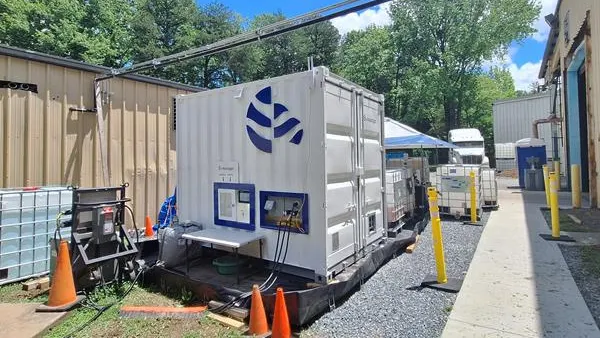
A project by Aquagga completed in May — one of four selected to test destruction technology — successfully demonstrated that a method called hydrothermal alkaline treatment, or Halt, can eliminate the chemicals, says cofounder and CTO Brian Pinkard.
Aquagga’s test involved processing about 3,000 gallons of PFAS-laced material — including two PFAS-containing liquids and one AFFF mixture — over three weeks at a North Carolina facility. The substances were subjected to high temperatures at a high Ph in water to which sodium hydroxide was added.
“It turns out that PFAS are very susceptible to those high Ph conditions, and they’ll just start to fall apart,” Pinkard said. What’s left are harmless end products — sodium fluoride, sodium carbonate and sodium sulfate — which he said can be safely handled by wastewater treatment plants.
The team is still crunching the data from the demo, but Pinkard said information gathered so far, along with results from previous DOD demonstrations, shows that Aquagga’s technology effectively eliminated the 47 target PFAS identified by the U.S. EPA, as well as a class of “ultra short-chain” PFAS, which are notoriously difficult to treat.
The success of the project will boost the company’s bid to commercialize its technology.
“DOD wants to make sure that the technology works, that it works well in a lot of different environments, and that it’s going to save money,” he said. “So it’s a lot of work to do it well and do it convincingly. But at the end of the day, that gives us a rock solid case for our technology."
Aquagga is now in the process of negotiating an agreement with a private party that would move its technology closer to commercialization. The company has also tested its technology on leachate from a landfill in Vermont.
Another key lesson from the DOD demo is that on-site treatment is more efficient and cost-effective than existing off-site disposal options, said Pinkard, because of the logistical and permitting challenges of moving waste from one place to another.
Another company encouraged by preliminary results is Revive Environmental, which treated AFFF in Detroit. The company, launched by Battelle and Viking Global Investors in 2023 to provide PFAS remediation services using Battelle-developed technologies, uses supercritical water oxidation, which combines high pressure and heat, to destroy PFAS.
In this extreme environment, the fluid takes on properties of both a gas and a liquid, which makes it easier to create a chemical reaction that destroys PFAS. What’s left is “an innocuous amount” of carbon dioxide and salt-based fluorine, said Revive CEO David Trueba, a chemist by training.
Trueba said he couldn’t provide data on the “Annihilator” system’s destruction efficiency because the project is still in the reporting phase. But “it did the job we were expecting it to,” he said. “Our technology works at scale.”
A 2023 study published in the American Chemical Society journal ES&T Water, conducted by researchers at Battelle, found that the supercritical water oxidation method destroyed 99.999% percent of PFAS in AFFF.
The company can adjust the heat, pressure and how long the material sits in the reactor according to the type of AFFF being treated. “That’s one of our competitive advantages,” said Trueba, noting the cost is competitive with incineration and other current disposal methods.
“PFAS has been named ‘forever chemicals’ because they’re very hard to break down,” he said. “They’re hard, but now not impossible. I can confidently say that PFAS can be destroyed. It’s no longer forever.”
Other companies participating in the recent DOD demo projects include Allonnia, Arcadis US (partnering with 374Water and Enviri’s Clean Earth), ASRC Consulting & Environmental Services (known as ACES), Cyclopure, ECT2, General Atomics, Savron and TRS Group.
ACES, which demonstrated a thermal soil treatment method at the Joint Base Elmendorf-Richardson in Anchorage, found that the test provided further validation that the company’s mobile remediation system is effective at destroying PFAS onsite.
“We consider the project a huge success, which really advanced the state of the art in PFAS remediation,” said Liam Zsolt, senior director of innovation and new business development for ACES' parent, ASRC Energy Services, in an email. “The treated soil has no detectable PFAS remaining.”
ACES and ASRC Energy Services are subsidiaries of Arctic Slope Regional Corp., Alaska’s largest native corporation.
The JBER project involved a two-step process. First, soil was sent through a rotary drum, heated by electric induction. The soil was heated at temperatures high enough to desorb, or separate out, the PFAS. The removed contaminants were then piped into an oxidizer heated to about 1100 degrees Celsius by a thermal plasma torch, which can break the fluorine carbon bonds in PFAS. At the end of the process, he said, clean vapor is released.
Zsolt added that using renewable energy to power the system allows it to reach the high temperatures needed to peel off PFAS while reducing emissions.
While the company has conducted several previous tests and received a permit from the Alaska Department of Environmental Conservation in 2021, Zsolt said the new demo allowed the company to improve upon the technology by adding the plasma torch. It also offered a chance to show the technology destroys both long and short-chain PFAS using the EPA’s new OTM-50 and OTM-55 emissions testing methods.
The biggest challenges, Zsolt added, are getting costs down and detangling regulatory compliance across different states or jurisdictions.
“Treating the soil properly takes a lot of equipment, energy and resources. Everyone in the industry is trying to work down the cost curve as quickly as possible, but the reality is we have set the bar really high, and cleaning up PFAS to such low levels is a big lift,” Zoldt said.
Some of the latest round of DOD tests were designed for removal and concentration of PFAS, a key step before destruction or disposal.
ECT2, a subsidiary of Montrose Environmental Group, said its demo at Willow Grove Naval Air Station Joint Reserve Base in Pennsylvania, showed that its resin-based PFAS treatment technology could effectively concentrate PFAS.
Cullen Flanders, emerging contaminants market leader at Montrose, said ECT2’s regenerable ion exchange resin system passes PFAS-contaminated water through a resin bed, which absorbs the PFAS. Once the resin is saturated, a solvent is applied to it that captures the PFAS, moving it into a smaller waste stream. The resin can then be reused.
The demo “confirms that the technology works effectively under real-world conditions,” Flanders said in an email. “The system consistently reduced PFAS to non-detectable levels and maintained performance over multiple regeneration cycles.” The test also helped the team figure out how often the resins need to be regenerated and how to minimize operating costs.
“By keeping the regeneration loop closed and the waste stream small, the system’s life-cycle footprint is much lower compared to single-use media systems, which generate large volumes of spent resin or activated carbon waste that must be disposed of or incinerated,” he said.
The Willow Grove demo also showed that the same design can work in different types of sites, including industrial wastewater systems, municipal systems and DOD bases, Flanders added.
Federal PFAS work to continue
While the Trump administration has recently scaled back PFAS rules adopted by the Biden administration, such as certain PFAS limits in water, the DOD work is continuing as planned according to the companies involved in the demos.
In September, EPA also said it would defend its 2024 rule designating PFOA and PFOS as hazardous waste under the Comprehensive Environmental Response, Compensation and Liability Act, which was challenged by the National Waste & Recycling Association and other groups.
The House version of the 2026 defense authorization bill that passed in September includes a provision to appoint a PFAS coordinator tasked with accelerating the clean-up of contaminated military sites and responding to community concerns. The Senate has now passed its version, which calls on DOD to update its PFAS destruction and disposal guidance.
Negotiators from the two chambers are now hammering out a compromise, with the final bill currently expected to reach the House floor by the second week of December.
Editor’s note: This story has been updated to clarify the coroporate structure of the Arctic Slope Regional Corp. and its subsidiaries.