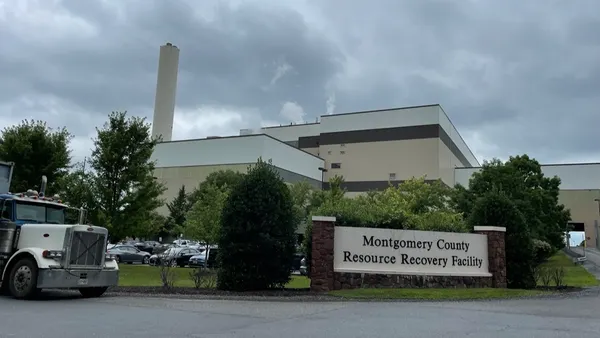
Montgomery County, Maryland, officials are facing renewed pressure to come up with alternatives to incineration after the county's longtime Resource Recovery Facility has reported major dioxin leaks from two of its three boiler units in the last few months. The issue has put a spotlight on zero waste policies that the county has explored but struggled to bring to fruition.
County leaders have been debating waste diversion proposals for several years, urged on by groups like the citizens association that have long been skeptical of the incinerator. County Executive Marc Elrich, who is in the final year of his second term, campaigned on the issue in 2018.
A report submitted to leaders in 2020 outlined a range of actions that could reduce disposal needs, including enhanced recycling collections, residential organics diversion and a pay-as-you-throw disposal system for residents. The report also noted that the county's MRF had not been updated in two decades, and upgrading it would be a "critical priority... foundational to making any significant progress."
Those recommendations were made ahead of the expiration of the county's last contract with Reworld, which operates the Resource Recovery Facility for the Northeast Maryland Waste Disposal Authority. In 2024, the county chose to renew its contract with Reworld as it continued to deliberate alternatives. The contract now includes a provision allowing the county to end material shipments after giving Reworld 180 days' notice.
In December, the company discovered that one of the facility's units was emitting dioxin and furan emissions more than three times the state limits, and they took the unit offline. The discovery came three months after Reworld discovered an emissions leak at another of the facility's three units.
The company proactively reported the situation to the Maryland Department of the Envrionment and began repairs, said Linda Ribakusky, Reworld's director of communications, in an emailed statement. She said compliance testing for the first unit was completed in January and showed results consistent with historical emissions levels, and compliance testing for the second unit is scheduled for mid-March.
That hasn’t assuaged concerns of some county residents, however.
“I am horrified,” said Lauren Greenberger, vice president of the Sugarloaf Citizens’ Association and a board member of Zero Waste Montgomery County. “Even before these leaks, I was completely convinced by the data that it’s safer [to landfill]. We want to do the least harm.”
The issues are in part a reflection of the age of the facility, which was built in 1995. Since it was commissioned, attitudes around incineration in the state have changed. Last year, the state ended support for incineration through its Renewable Portfolio Standard, reducing the revenue Montgomery County can generate through electricity produced at the Resource Recovery Facility. And grassroots activists have raised environmental justice concerns about the Virginia landfill where Montgomery County sends its ash.
Officials estimate that it would cost about $365 million to upgrade the facility for continued use. Now they must decide whether to move forward with upgrades by the end of the county's current disposal contract, which expires in 2031, or pivot to a new landfill plan and suite of zero waste policies.
The county's Department of Environmental Protection has taken initial steps to dramatically change its disposal solutions. Last year, it commissioned a report from consulting firm Arcadis that determined repairing the Resource Recovery Facility would result in increased residential solid waste fees comparable to a pivot to long-haul transportation and disposal of the county’s waste in a landfill, plus composting.
The county released a request for proposals for that idea, as well as for operation of the Shady Grove transfer station, in September. It’s now in advanced negotiations with respondents, though an official declined to say which or how many companies responded. WM had previously submitted an unsolicited bid to the county proposing to haul its waste to a Virginia landfill, but it’s unclear if that proposal is still on the table. The company did not respond to a request for comment.
While the disposal debate remains ongoing, the county has also taken steps to bring about major changes in diversionary policies. It’s run multiple curbside food waste collection pilots in recent years, and officials want to roll out the service countywide once it has the processing capacity, according to Kaley Laleker, chief of zero waste programs in the Montgomery County Department of Environmental Protection.
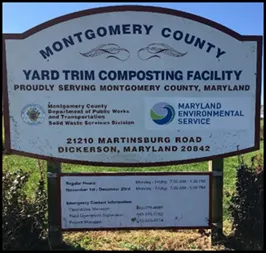
But executing that plan will be tricky. The county owns a yard waste processing site in Dickerson and has advanced plans to begin bringing food waste to the site for composting. But the Sugarloaf Citizens Association secured an agreement with the county decades ago requiring officials to close the incinerator before composting begins. The group has said the county can move forward with composting when it can come up with a date, but so far it hasn't received one.
Laleker said the county has explored other sites to get around the standoff, but the Dickerson site would be the most cost effective and quickest to convert to food waste composting. It would take about two years to bring that facility offline, she said.
Other initiatives remain in progress. The county has begun discussions with several stakeholders to improve C&D waste diversion, a stream that produces 256,000 tons of material annually. Efforts are underway to improve recycling at the county’s transfer station, and Laleker said staff have met with recyclers like Revolution Recovery about additional capacity. That company did not respond to a request for comment.
Laleker previously worked for the state Department of the Environment and said Montgomery County has strong recycling rates compared to the rest of the state. But that makes additional materials diversion difficult, she said, because the county has already started to address many of the easiest materials to recycle.
Chaz Miller, a member of the county's citizen Solid Waste Advisory Committee and a longtime waste industry professional, said the county should have moved years ago to begin updates to its facilities, especially the MRF. He also said he’d heard positive results from the food waste curbside collection pilots, but officials need to turn those results into action.
Despite the lack of progress, Montgomery County residents are primed for zero waste solutions, Miller said. He noted the continued success of the county's dual-stream recycling program, and he said that while it might be impossible to get every resident on board, there are certainly more things the county can do to improve its waste systems.
With the county scheduled to hold its primary for its next county executive in August, Miller said leadership should deliver on implementing longstanding zero waste recommendations.
"I think Montgomery County citizens will be ready," Miller said. "The incentive is there among major candidates running for county executive to get the recycling program moving, to get something done about food waste."