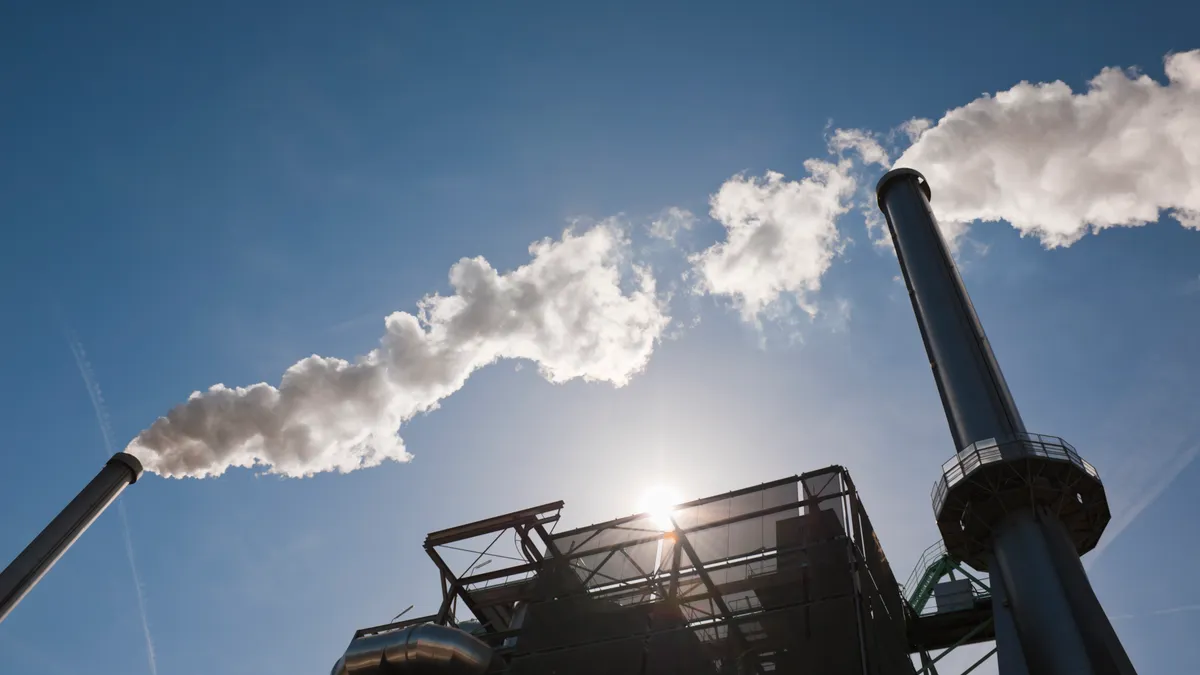
Combustion facilities in Minnesota turning municipal solid waste into energy and ash appear to be destroying somewhere between 99.6% and 99.97% of per- and polyfluoroalkyl compounds, according to a study commissioned by the Minnesota Resource Recovery Association.
The study also found that PFAS levels released at the stack were below Minnesota’s inhalation risk assessment level for five of six regulated PFAS compounds. While the final regulated PFAS compound was measured above the risk assessment level at the stack, it registered below that level at the fence line.
MRRA commissioned the study after the Minnesota Pollution Control Agency released its PFAS Blueprint in 2021. The agency subsequently began soliciting information from industrial facilities about their release of PFAS chemicals into the environment, leading MRRA to contract with third-party firm Barr Engineering for a report, said Steve Vrchota, chair of MRRA and executive director of the Pope/Douglas Solid Waste Management partnership.
An engineer by training, Vrchota said the study gave him confidence that incinerators are removing PFAS from the environment. It’s the latest study finding waste-to-energy facilities could be a solution for difficult to destroy toxic chemicals amid efforts to shut them down.
“We think we’re a net benefit,” Vrchota said. “Look at our numbers. We are doing significant net destruction.”
Analyzing Minnesota incinerators
The study used an experimental test method released by the EPA about five years ago to measure PFAS air emissions from stationary sources. It tested for 49 kinds of PFAS chemicals at three facilities after incineration, and found that they could reduce by 100 times or more the total mass of PFAS coming into the facility.
The study also found that the results were broadly consistent across technology type — the included facilities used different systems in their incineration but achieved similar results. Vrchota said that was further evidence the facilities were burning at high enough temperatures for long enough times to effectively destroy PFAS chemicals, echoing prior research.
The study effectively analyzed PFAS emissions in the air using the EPA's methodology, but there were some gaps in its results that could have been addressed with additional testing, said Yalan Liu, an assistant professor at Florida Atlantic University who studies PFAS destruction in incinerators but was not involved with MRRA’s study.
In particular, Liu took issue with the study’s measurements in bottom ash, the incineration byproduct that settles at the bottom of a facility’s furnace. The kind of PFAS most commonly found in that ash, known as fluorotelomer phosphate diesters, or diPAPs, are a precursor to PFOA and PFOS, the two PFAS chemicals that have been mostly consistently targeted by regulation.
Yet the MRRA study did not report measurements for diPAPs. It instead reported that levels of all PFAS in bottom ash at one facility were not detected, and were lower than air emissions at another facility.
“The reported amounts are very small compared to estimated incoming levels,” Liu said.
The study’s methodology is also not equipped to measure more volatile PFAS compounds in the air that pose a health risk but that newer test methods can measure. Vrchota acknowledged the study’s authors were limited by the methodology they used. He also noted that Minnesota’s regulations regarding safe airborne PFAS levels are evolving quickly and even changed over the course of the study.
Crafting policy with emerging science
With over 9,000 PFAS chemicals in existence and only about 100 that are measurable in air emissions using existing methods, crafting policy to address PFAS emissions as a whole can be difficult. And there are many questions still to be addressed, Liu said.
Even taking into account some uncertainty in the bottom ash measurements, she estimated the facilities are likely destroying more than 99% of the PFAS compounds that they’re estimated to receive.
“That's what a lot of scientists already agree on: Incineration does seem to destroy many PFAS compounds that we can detect at high temperatures. What we still don’t know is what incomplete combustion products might be formed,” she noted.
Marco Castaldi, a professor of engineering at the City College of New York and the director of the Waste-to-Energy Research and Technology Council, said there are steps regulators could take to more properly address outstanding questions about PFAS air emissions.
Castaldi, who is not affiliated with the study but said its findings appeared consistent with prior research, said regulators should pull together an anonymized database of PFAS emissions measurements from incinerators in order to get an accurate sense of how much of the chemicals are being released. They should also compare those rates to background levels of PFAS in the air before crafting regulation, he noted.
Vrchota said he expects PFAS emissions from waste-to-energy facilities to be regulated at some point. But he believes that process should occur after federal regulators conduct a risk assessment to determine what an appropriate level of regulation will be.
“This is assumed to be a significant health risk. I would assume at some point there would be an emissions level based on a risk assessment,” Vrchota said.
The study comes amid a broader debate about the future of Minnesota’s waste disposal infrastructure. The state landfills roughly two-thirds of its waste and incinerates one-third, according to Vrchota, but the MPCA considers incineration preferable. In January, the state’s Public Utilities Commission voted for a plan that affirmed energy produced from incinerators is carbon-free, setting up such facilities for subsidies.
But environmental justice groups have urged the state to pursue zero waste policies more aggressively. In particular, groups have continued to urge a closure plan for the Hennepin Energy Recovery Center in downtown Minneapolis, though county officials have argued they need an alternative plan for waste before they can shut down that incinerator.
Vrchota said his organization agrees that communities should move on from waste-to-energy incinerators if and when they can develop better alternatives to disposal. But he believes the benefits of the facilities outweigh the harms.
“We are all doing everything we can to starve the waste-to-energy side,” Vrchota said. “But at the end of the process, we're still recovering the energy, and we think that that's useful.”