Dive Brief:
- Corporate partners in the U.S. Food Waste Pact showed year-over-year progress in 2024 in wasted food rates, according to a report published this week by the project, led by Refed and the World Wildlife Fund. Yet the overall amount of food that went unsold in the retail sector increased to 3.98 million tons, representing $26.9 billion in lost sales.
- The food efficiency rate, a metric created by the project partners that tracks food waste as a percentage of total food purchases, fell by 5.7% in the food service sector, showing operators had reduced their food waste year over year. Another metric, the unsold food rate, decreased by 1.1% for the retail sector, indicating retailers wasted a slightly smaller proportion of inventory.
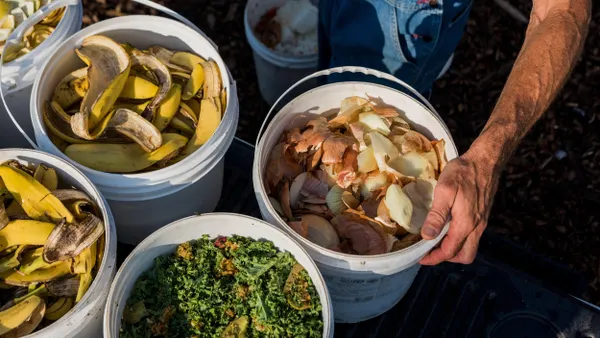
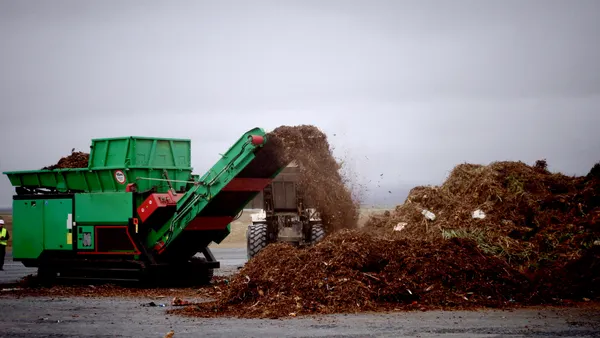
- Nearly 22% of food waste was sent to composters in 2024, and more than 14% was sent to anaerobic digesters, rates that each increased year over year. About 21% of food waste was landfilled, though the report noted that the percentage of food sent to unknown destinations fell considerably, indicating improved data collection may have played a role in the change.
Dive Insight:
Nonprofit Refed has led partnerships to reduce food waste across the supply chain for several years. The U.S. Food Waste Pact, launched in 2023, builds on a previous partnership on the West Coast between producers, grocers and food service partners to identify best practices to reduce waste. The partnerships have reported success in developing new strategies and improving food donation, among other process changes.
This is the second year the pact has reported data after establishing a baseline year in 2023. That data collection allows partners like Walmart, Sodexo, Del Monte and Hilton to take "informed and targeted action against food waste," Jackie Suggit, Refed's vice president of business initiatives and community engagement, said in a statement.
"Being able to measure these kinds of trends is a core reason for why we launched the U.S. Food Waste Pact over two years ago,” Suggitt said. “Measuring food waste is critical to making progress to reduce it."
The issue has drawn increased attention from the private sector as a cost-saving measure as well as an opportunity to reduce companies’ climate impact. A recent report from label and digital identification solutions manufacturer Avery Dennison found that food waste represents a $540 billion opportunity globally, and it argued that reducing waste was an important way for businesses to improve resiliency and reduce costs.
The U.S. EPA has set a goal to halve food loss and waste by 2030, though the country has made little progress since it was announced in 2015. Still, the initiative has attracted major corporate partners, many of which have also gotten involved with the U.S. Food Waste Pact. This year, the pact added 14 food businesses and organizations, including quick-service restaurants Cava, Starbucks and Wawa and organizations like the American Hotel & Lodging Association.
Like the waste hierarchy reintroduced by the EPA in 2023, the pact prioritizes pathways for food waste that avoid disposal. The pact’s most preferred pathway is food donation, followed by animal feed, then composting and anaerobic digestion before landfilling and incineration.
More food waste was sent to donation in 2024, rising four percentage points to more than 18% of total waste. Animal feed also increased, to 7.6%; the pact attributed that comparatively smaller proportion to a lack of infrastructure to recycle food waste for feed.
Pact partners completed six pilots across the supply chain in 2025 to test waste reduction strategies. One pilot that grew from the previous year involved reducing wasted strawberries across 34 food service sites in California. The strategy, which involved diverting berries that were too small for traditional standards but still edible, rescued nearly 10,000 pounds and reduced on-farm waste by 51%, according to the report.
Despite the progress on food waste diversion, the carbon footprint of wasted food in the U.S. rose as overall sales grew for food retailers. Associated emissions rose by 6.3% to 16.44 million metric tons of carbon dioxide equivalent, according to the report.
The report does not look at postconsumer food waste, though that remains a focus for Refed and other pact partners. The nonprofit’s insights engine shows 70.7 million tons of surplus food were generated across all sectors, including residential waste, in 2024. That was down from 72.2 million tons in 2023.