This is the latest installment in Waste Dive’s Biogas Monthly series.
Seventy new biogas projects came online in the U.S. in 2025, the lowest number of new facilities since 2019, according to the American Biogas Council's Biogas in America 2026 report. But despite that downturn, the industry group still sees signs of a snowball effect from the last few years of record growth.
Last year’s new facilities represented $2.1 billion of investment, according to the report. Since 2020, the number of facilities online producing renewable natural gas has tripled, and the amount of RNG produced has also doubled since 2022. That growth has been especially pronounced in agriculture — the number of farm-based facilities producing RNG grew from 90 in 2020 to 414 in 2025. Meanwhile, 159 landfill facilities and 53 wastewater facilities produced RNG as of the end of last year.
That growth has been largely driven by policy, noted Heather Dziedzic, ABC's vice president of policy, during a Feb. 24 webinar to discuss the report. In particular, policies like the U.S. EPA's Renewable Fuel Standard and California’s Low Carbon Fuel Standard are centered on reducing on-road transportation emissions, and as a result project developers are incentivized to transform biogas into transportation-ready RNG. But with transportation demand for RNG appearing to near its peak, and power demand fueled by artificial intelligence driving up the price of electrons, the pendulum may swing back toward biogas facilities producing electricity, Dziedzic said.
Moving forward, the industry is looking for new market drivers to fuel demand for RNG. That could include the power industry or newer markets like the maritime industry, where international groups are looking to step up their decarbonization efforts.
“Those doors haven't really swung open yet, but they are cracked open, and those policies are changing. And so I think you're just seeing a combination of factors that is making it right now a little bit slower for project developers to press go,” said Patrick Serfass, executive director of ABC.
ABC estimates facilities are capturing a quarter of all biogas that could be recovered for potential use, with considerable potential remaining in the agricultural sector and landfills in particular. The group says farms with more than 500 dairy cows, 1,000 pigs and 50,000 poultry are candidates for a facility, as well as those designated by the EPA’s Landfill Methane Outreach Program.
More policy updates may also drive future growth. The EPA recently submitted its final language for the Renewable Fuel Standard's update to the Office of Management and Budget, indicating finalization of the update is imminent. And the trade organization continues to advocate for supportive policy in vehicles like the farm bill, the U.S. Department of Agriculture’s reauthorization that may come this year.
Below is a selection of biogas industry highlights from January.
Food waste digester serving Twin Cities area breaks ground
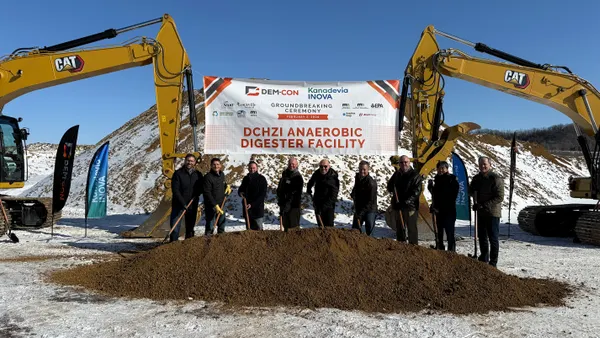
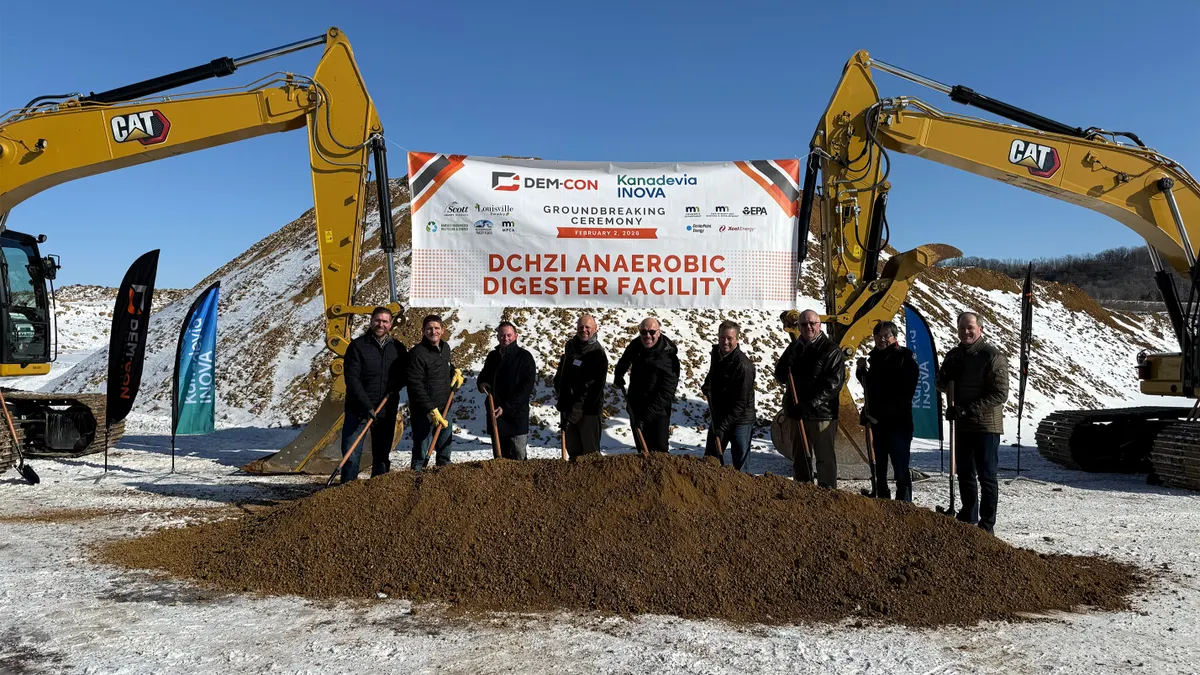
Project partners Kanadevia Inova and Dem-Con broke ground on a food waste anaerobic digestion facility in Louisville Township, Minnesota, last month. The site will accept up to 75,000 tons of organic waste per year, primarily from Ramsey/Washington Recycling & Energy, a public joint powers organization serving St. Paul and its suburbs.
The project comes as state authorities continue to look for ways to support landfill diversion. The Minnesota Pollution Control Agency in 2023 directed the Twin Cities metropolitan area to reduce waste amid a disposal capacity shortfall caused by the closure of waste-to-energy facilities and declining landfill space. Several public entities assisted with funding for the project, including the Minnesota Environment and Natural Resources Trust Fund and a grant from the Minnesota Department of Commerce.
CenterPoint Energy and Xcel Energy have gas offtake agreements with the facility, enabled by the state’s Natural Gas Innovation Act passed in 2021.
The facility uses a form of gasification that can enable the processing of compostable bags and residual contaminants. The process will produce about 200,000 mmBtus of RNG and 8,000 tons of biochar annually. The site is expected to be operational in 2027.
Utility commissioners recognize RNG as strategic energy resource
The National Association of Regulatory Utility Commissioners’ board of directors voted at its Winter Policy Summit to adopt a resolution recognizing RNG as a resource that can help meet growing energy demand while supporting emissions reduction efforts. The board resolved that NARUC supports “regulatory clarity” for RNG project development through streamlined interconnection standards and other means.
The resolution is the latest sign of utility support for RNG projects. While utilities in Canada have actively pursued RNG in recent years, American utilities have been slower to adopt policies explicitly calling for the technology or goals to incorporate it. But the resolution acknowledges that state public utility commissioners can change that.
“This resolution reflects an all-of-the-above approach that values reliability, affordability, and innovation. It also recognizes the important role that regulatory clarity can play in encouraging responsible investment and thoughtful integration of RNG into long-term planning and resource strategies,” Kathryn Zerfuss, a Pennsylvania public utility commissioner who backed the resolution at the policy summit, said in a statement.
Maas Energy Works develops truck-in California gas plant
Redding, California-based Maas completed interconnection to the Pacific Gas & Electric gas pipeline at its RNG facility at the Couco Creek Dairy in Turlock, California, the company announced in February. The facility provides “flexible infrastructure” that could allow additional RNG to flow into the pipeline, said founder and CEO Daryl Maas.
The facility collects and refines biomethane from the dairy on site before injecting it into the grid as RNG. But it also accepts RNG trucked in from other production sites, including the neighboring Blue Sky Dairy, through a specialized offloading and decompression facility.
“This ‘virtual pipeline’ approach enables additional dairies to participate even when direct pipeline access is not available, increasing overall system efficiency and supply potential,” the company wrote in a press release.
At full capacity, the Couco Creek facility can inject 350 mmBtus of RNG daily into the grid. The site has capacity available to bring in gas from other dairy digester projects in the future.
Alberta provides grant to digester through emissions reduction program
Taurus Canada Renewable Natural Gas Corp. received 10 million Canadian dollars from the Alberta government’s Technology Innovation and Emissions Reduction program to build a livestock manure digester and carbon sequestration facility. Taurus is partnering with feedlot companies KCL Cattle Co. and Kasko Cattle Co. for the facility.
This is Taurus’ first announced RNG project. Two of the company's co-founders previously worked at Ostara, a company that manufactures fertilizer from wastewater.
The Alberta facility is expected to produce 360,000 gigajoules of RNG annually once built out. Construction is projected to begin this summer, with full operations by January 2028.