This is the latest installment in Waste Dive’s Biogas Monthly series.
In late December, the U.S. EPA informed the judge overseeing a case related to the Renewable Fuel Standard that it was aiming to finalize 2026 fuel volume obligations sometime in the first quarter. The delay could trigger a shift in compliance deadlines for refiners expected to purchase renewable fuels, creating new uncertainty for producers.
In a letter sent Thursday to the EPA, Clean Fuels Alliance America said the delay is creating "intolerable uncertainty," especially for growers of crops used to create biomass-based fuels. Elsewhere, Argus Media reported that "the market is at a standstill" because final volume requirements that EPA will impose are still unclear.
When the EPA proposed its update to the Renewable Fuel Standard last year, it included volume obligations for 2025, 2026 and 2027 that biogas groups found to be disappointingly low. But having the certainty of multiple years of volume obligations would still send clear market signals, especially in comparison to EPA’s relative silence as it works to finalize the proposed update.
Last year, the Trump administration introduced a series of policy changes that affected the biofuels market from all sides. Among those changes is a plan to limit the amount of foreign fuels that can enter the RFS market, which would shrink supply and boost prices for domestically produced renewable fuels. But the administration is also granting a large number of exemptions from the program to small fuel refineries, reducing demand.
Despite those conflicting signals, experts predict the market will improve in 2026. D3 RIN prices, those used for cellulosic biofuels like RNG, began to trend upward in the second half of 2025, and may average around $2.50 to $2.60 per RIN in 2026, according to an investor note from Jefferies.
Below is a selection of biogas industry highlights from December.
Vanguard Renewables opens digester and depackager in Wisconsin
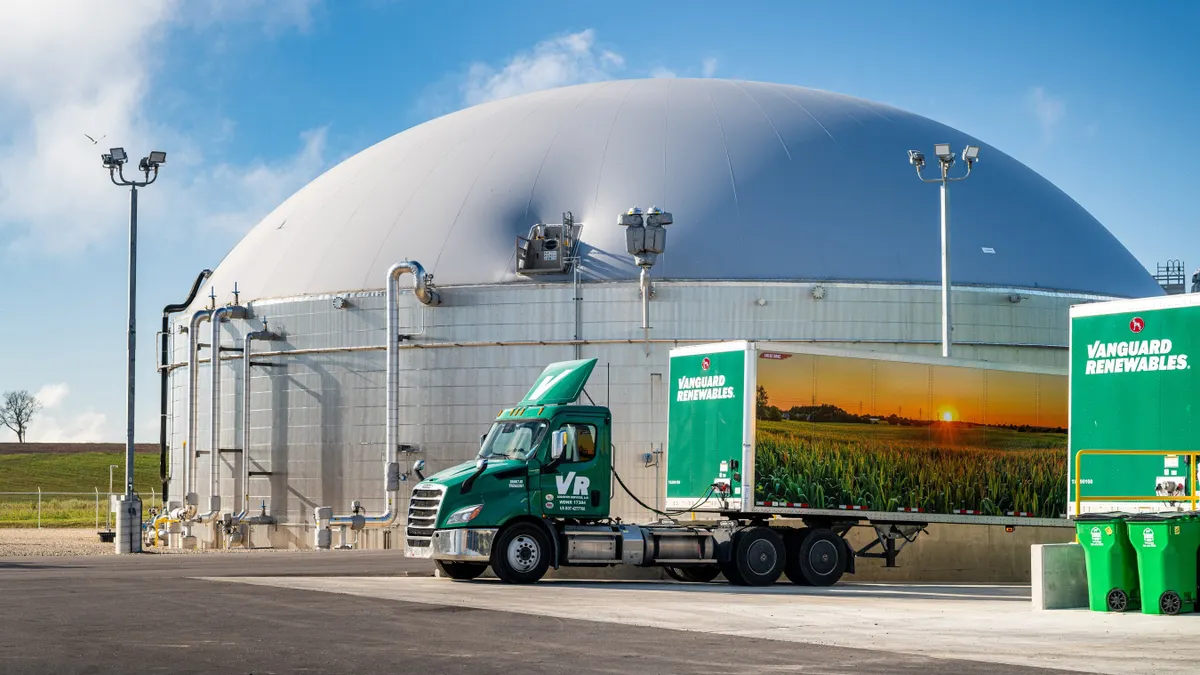
Private equity-backed Vanguard Renewables commenced operations at its anaerobic digestion and depackaging facility in River Falls, Wisconsin, last month. The site is processing food and beverage waste from manufacturers, retailers and processors in the Minneapolis-St. Paul region.
The new facility already has more than 30 customers, Vanguard reported. It can process up to 275 tons of food and beverage waste per day and generate up to 289,000 mmBtus of RNG annually. The facility is also part of a major deal Vanguard struck with AstraZeneca in 2023 to supply RNG for the company's U.S. pharmaceutical operations.
Vanguard has been pursuing an aggressive nationwide growth strategy with its facilities.
WM and Denver to collaborate on RNG facility
The Denver Arapahoe Disposal Site, a landfill owned by the city of Denver, will get Colorado's first landfill-gas-to-RNG facility thanks to a new agreement with WM. Approved by the city council on Dec. 1, the agreement allows WM to finance, build and operate the facility and pay the city royalties on revenue generated.
The landfill currently captures about a third of its gas and converts it to electricity, while the rest is flared. The project partners expect construction will begin later this year, and operations will begin in 2027.
WM has made steady progress on its goal to build 20 new RNG facilities between 2022 and 2026. It plans to deliver the final five facilities by the end of this year, according to the company’s most recent sustainability report. Combined, the 20 new facilities are projected to generate approximately 25 million mmBtus of RNG.
Clean Energy Fuels brings large dairy RNG project online
Public company Clean Energy Fuels completed work on an RNG facility at the South Fork Dairy plant in Dimmitt, Texas. The company broke ground on the $85 million project in July 2024 and is now injecting gas into the interstate natural gas pipeline.
The facility, which Clean Energy Fuels describes as one of the country's largest, has capacity to process up to 300,000 gallons of manure each day. It's expected to produce 2.6 million gallon-equivalents of RNG annually.
“The requirements to reach production and injecting milestones were extremely stringent and we are incredibly proud of the team for getting our seventh RNG facility online, on time and on budget. It’s no small feat,” Clean Energy Fuels Senior Vice President Clay Corbus said in a statement.
The company worked with T Diamond Bar and Montrose Environmental to develop the facility.
Noble Environmental sells $34.8 million in tax credits
Pennsylvania-based Noble Environmental closed the 34.8 million sale of tax credits generated by two RNG facilities. The company said the facilities are part of a portfolio of three landfill-gas-to-RNG plants that came online last year.
The transaction is enabled by the Inflation Reduction Act of 2022, which allowed developers of alternative energy assets to sell the tax credits that their investments generated to other entities looking to reduce their tax liability. Investment tax credits have historically been used to incentivize the development of clean energy technology, according to Crux Capital.
In September, Noble Environmental announced the closing of a $100 million bond backed by the Pennsylvania Economic Development Financing Authority. The company pursued the financing to improve its landfill gas facilities across the state, Noble Executive Chairman Nick Stork said at the time. Noble Environmental had previously closed an agreement with Clean Energy Fuels to build an RNG fueling station supplied by Noble's Westmoreland Sanitary Landfill.
Aemetis announces its first clean fuel production credit tax sale
Longtime RNG producer Aemetis secured $17 million from an unnamed buyer of tax credits related to its RNG production at the end of last year. The company has sold about $95 million worth of investment tax credits to date as its dairy biogas and alternative energy facilities come online.
The newest sale includes $12 million in proceeds from investment tax credits and $5 million in clean fuel production credits. It’s the first time Aemetis reported selling the latter type of credit.
Aemetis began generating the clean fuel production credits, known in the U.S. tax code as Section 45Z, on Jan. 1, According to its most recent annual report. Aemetis expects to generate an increasing amount of those credits as RNG production ramps up, and it will continue to sell them to improve liquidity.
The company advocated for the continuation of the 45Z program with the Trump administration last year. Aemetis Chairman and CEO Eric McAfee said in last month’s release that he expected the 45Z credits to be a “rapidly growing source of operating cash flow.”