Dive Brief:
- Waste Connections plans to build a “treatment facility for per- and polyfluoroalkyl substances at its Anson Landfill in Polkton, North Carolina. The system is expected to come online by the end of 2026.
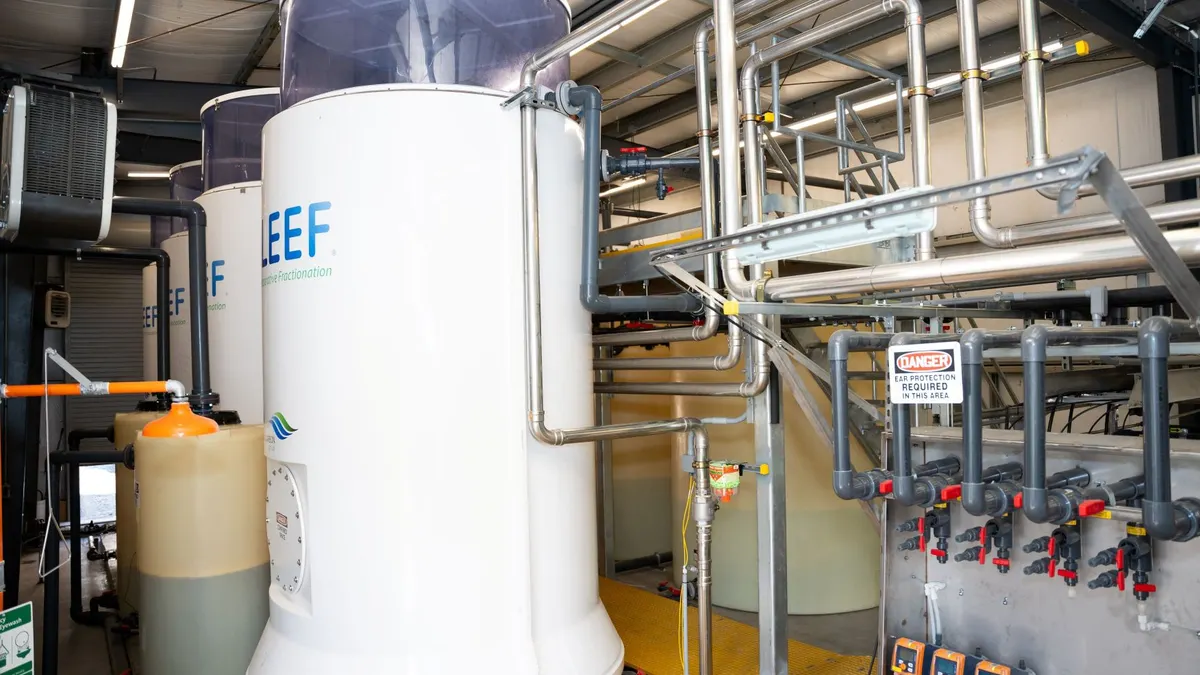
- The on-site foam fractionation system, built by The Water & Carbon Group, aims to treat up to 50,000 gallons per day of landfill leachate. Waste Connections has already installed a similar system from that company at its Bethlehem Landfill in Pennsylvania.
- Waste Connections sees its PFAS remediation plans as a “proactive” way to responsibly manage landfills. North Carolina state regulators are taking “a more active approach” to monitoring PFAS at landfills compared to some other states, said Matt Crockett, regional engineering manager for Waste Connections’ eastern region, in an interview.
Dive Insight:
PFAS management efforts are especially timely in North Carolina, where the state’s Department of Environmental Quality has required most solid waste landfills to conduct regular PFAS analyses of groundwater, surface water and leachate samples since 2023.
North Carolina has also made headlines in recent years over broader PFAS contamination concerns. Residents have long spoken out against industrial PFAS pollution in the Cape Fear River Basin and the surrounding region, particularly from companies like Chemours. That company in June settled a multimillion dollar federal lawsuit over PFAS contamination issues and agreed to enact PFAS mitigation plans.
North Carolina also recently proposed a rule that could require certain wastewater treatment plants and industrial facilities to monitor PFAS discharges and use monitoring data to make their own PFAS reduction plans.
Crockett said the Anson Landfill PFAS remediation project aims to respond not just to PFAS concerns in the region, but to broader PFAS regulations taking shape across the country.
Waste companies continue to invest in remediation technologies to capture per- and polyfluoroalkyl substances, even amid uncertainty over how state and federal PFAS regulations could affect operations, costs and remediation business opportunities.
For the last few years, the waste industry, along with related industries such as water treatment facilities, have also sought an exemption from certain PFAS liabilities under the Comprehensive Environmental Response, Compensation, and Liability Act, or CERCLA.
Industry groups say they are “passive receivers” of PFAS, meaning they do not generate PFAS or have control over PFAS-containing items that enter their facilities. These groups worry they will face lawsuits or high cleanup costs for receiving or handling PFAS-containing items. The National Waste & Recycling Association is a petitioner in an ongoing lawsuit over the issue.
Tyler Fitzgerald, district manager at Anson Landfill, says the landfill is one of those passive receivers. “Waste Connections does not generate or use PFAS, but we are in a position to help reduce its impact on our communities,” he said in a statement. “Installing treatment at our site gives us local control over how PFAS is handled, reduces the burden on downstream infrastructure and aligns our operations with evolving regulations.”
Crockett said foam fractionation is an ideal system for the Anson Landfill, in part because the technology has already been field-tested at Waste Connections’ Bethlehem landfill and has yielded good results.
Foam fractionation uses tiny air bubbles to separate and concentrate PFAS compounds from wastewater. The PFAS captured from the foamate is then solidified with a clay-like material and placed back in the landfill, taking up very little space, Crockett added. He estimates operating costs to be between 2 to 5 cents a gallon.
“It’s a simple process that can be scaled as big as you need it,” he said. “Later on, depending on whatever new regulations or limits come out, if we have to look at some other sort of technology, we can. It’s easy to pull on another system if we needed to.”
Waste Connections is also considering adding a foam fractionation system to its Seneca Meadows landfill in New York, which already has a reverse osmosis system, another common PFAS mitigation system. The company has submitted a permit application for a 200,000 gallon-per-day unit there, he said.
Waste Connections says some wastewater treatment plants aren’t designed to remove PFAS on their own. Crockett said he sees the new Anson Landfill PFAS system as a way to maintain good relationships with water treatment facilities it works with in the region.
Waste Connections also represents a major revenue stream for local wastewater treatment plants, and at the same time, sludge from those plants gets returned to Waste Connections’ landfills, Crockett said. “We’re all interconnected.”