As military bases and other facilities around the country work toward cleaning up millions of gallons of aqueous film-forming foam (AFFF), both the opportunities and challenges the work presents for remediation companies and government entities are coming into greater focus.
More than 700 DOD sites either have or are likely to have elevated levels of per- and polyfluoroalkyl substances in the water or soil, largely due to contamination from the use of AFFF over decades for putting out jet fuel fires and training firefighters on the practice. The department needs to remove more than 2 million gallons of AFFF concentrate across its facilities, plus another 1.5 million gallons of rinsate leftover from cleaning fire trucks and airplane hangars — a necessary step before switching to the new F3 firefighting agent, according to DOD. Millions more gallons of AFFF need to be cleaned up at airports, municipal firefighting sites and other non-military facilities.
PFAS have been linked to certain cancers, infertility and other serious health problems, and the military is under increasing pressure from communities and state regulators to clean up the chemicals. Litigation combining thousands of AFFF cases is pending in a federal court in South Carolina, adding further incentive to clean up the sites.
While Congress has mandated that the agency phase out PFAS in AFFF by October 1 of this year – with exceptions for ships and research – and facilities are switching to alternatives like F3, removing and getting rid of the existing contamination has proven to be a slow process. But industry experts are hopeful the pace of remediation may pick up soon, bringing a spate of new business opportunities.
A convergence of incentives
In recent years, a number of new technologies have emerged that more effectively treat PFAS from AFFF, with some now able to destroy certain PFAS — a feat that seemed elusive a decade ago.
DOD has funded a series of demonstration projects aimed at testing which technologies are most effective in purging surface water, groundwater and soil of PFAS and standardizing sampling methods across sites. It also has lifted a moratorium on incineration, adding one more key option.
The agency’s updated guidance on PFAS disposal, issued in February, now includes incineration among its approved methods. Other green-lit disposal technologies include granulated activated carbon, hazardous waste landfills, solid waste landfills with liners and leachate collection systems (though not for AFFF concentrate), underground injection and thermal desorption. EPA updated its own PFAS disposal guidance in April, which also noted incineration’s effectiveness but warned that operating conditions must be carefully monitored.
One key lesson from the DOD demonstration projects is that on-site treatment is more efficient and cost-effective than existing off-site disposal options, because of the logistical and permitting challenges of moving waste around. In its updated guidance, DOD encourages facilities to “consider if there is an available cost-effective technology that would separate or destroy the PFAS from the liquid to reduce the quantity of liquid that requires disposal.”
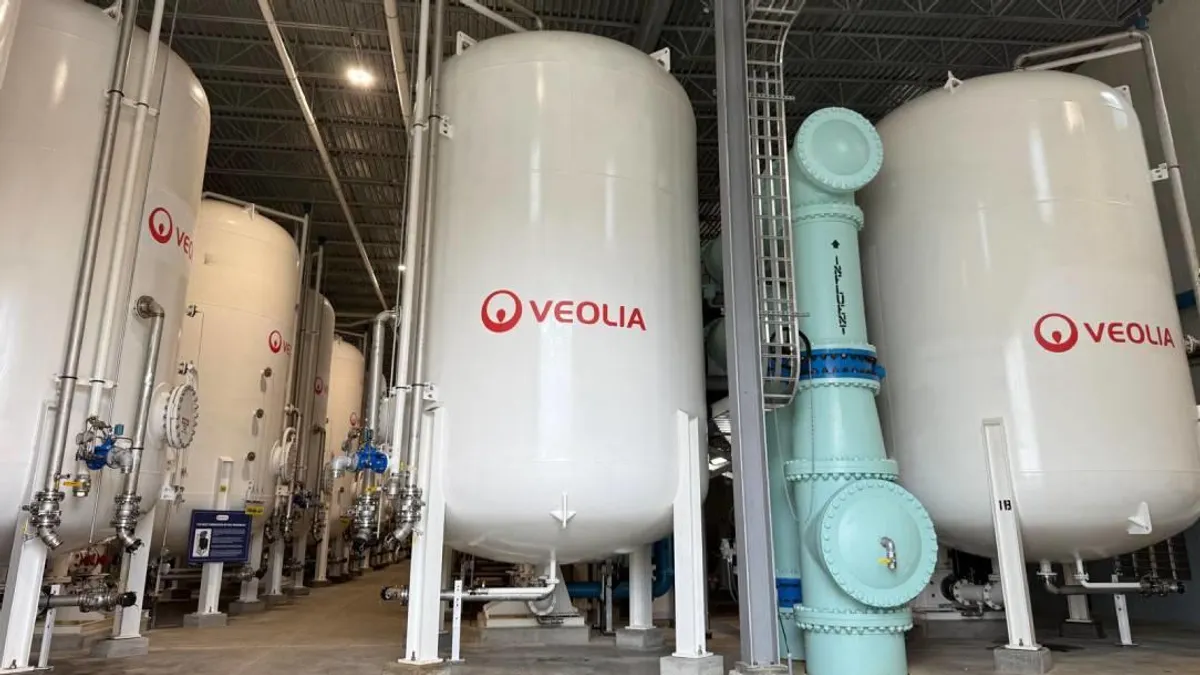
Paul Bratti, senior vice president of remediation at Clean Harbors, said that currently, most of the PFAS the company receives goes to Subtitle C landfills, but that he expects demand for incineration to increase in the wake of the Department of Defense’s lifting of its moratorium on the method and its inclusion in the agency’s updated disposal and destruction guidance. A study conducted at Clean Harbors’ incineration facility in Aragonite, Utah, one of only two incineration facilities currently authorized by DOD for disposal of PFAS along with a Veolia site, found that the company’s system can destroy 99.9999% of PFAS.
“What we’re seeing is much more detailed inquiries about the incineration network” from military facilities, Bratti said. Base officials have been asking for documentation that incinerators meet the department’s requirements. “So will that translate into volumes? I think you can easily connect the dots and say that it will,” he said.
And he expects the department’s encouragement of incineration at its own facilities to have a knock-on effect on the private sector.
“A lot of businesses will follow what the government does, specifically what the Department of Defense does,” Bratti said. “So now that the moratorium is lifted, what we’re starting to see is those folks too now are coming back to the incineration world,” particularly in the chemical industry, he said.
The total market for PFAS treatment — including soil remediation and wastewater and drinking water treatment — is expected to reach more than $100 billion over the next 30 years, according to a 2025 Environmental Business Journal report. Clean Harbors’ revenue from PFAS-related services spiked from $40 million in 2024 to $125 million in 2025, and the company expects those revenues to hit $175 million this year.
But there’s some concern that at DoD facilities, the war with Iran could cause a slowdown in military spending on other objectives like AFFF management, Bratti said. Military contracts for management of AFFF and other sources of PFAS could “get a slower start than people probably would have assumed,” he said.
Still, he expects the work to pick up momentum in the coming months, depending on how peace talks play out. “Some bases are a little more proactive than others” in getting PFAS contracts underway, he added.
Exactly where DOD’s AFFF PFAS cleanup efforts stand today is unclear. Its PFAS progress report, which tracks the status of PFAS assessments at 723 installations, was last updated in September 2025.
Asked if AFFF removal has been completed at any US military sites in the US or its territories, a Department of Defense spokesman said only that the department continues to remove AFFF from its installations and plans to update its PFAS web site with site-specific information “in the future.”
An Air Force spokesman said that Wright-Patterson Air Force Base in Ohio has completed the removal and disposal of AFFF, at a cost of about $370,000. No fluoridated AFFF remains at the base itself, and it finished transitioning to DOD’s designated alternative, F3, in July 2024, meaning that it has already met the October 1, 2026 deadline to phase out AFFF, the spokesman said.
The biggest barrier to expanding the use of incineration for PFAS disposal may not be permitting or logistical hurdles, but getting the message out to all the sites and their staff that incineration is now an option, Bratti said.
The company’s current contracts primarily involve treating PFAS-contaminated water on military bases, and the resulting PFAS has been going to the company’s landfills. “Whether they continue to move some of the lower-level concentration type stuff to the landfills or they start to move the higher concentration type material to the incineration network, we’re well-positioned for both,” Bratti said.
ASRC Consulting & Environmental Services (known as ACES) also sees new opportunities ahead.
The company, which successfully demonstrated a thermal soil treatment method at the Joint Base Elmendorf-Richardson in Anchorage, is wrapping up its work at the base and is awaiting a “success memo” from DOD that will likely lead to new contracts at other military facilities, said Liam Zsolt, senior director of innovation and new business development for ASRC Energy Services. The company is in discussions with three other bases that heard about the JBER project.
“We’re already seeing an increase in interest and it’s really exciting,” Zsolt said. “We’d like to get our system back to work as soon as we can.”
Much of the forthcoming work is likely to be in military construction, he added. The military is undergoing a building boom and needs to remove AFFF from the soil before beginning construction, he said. “We think there’s going to be a steady demand for PFAS cleanup services as DOD continues to build out its infrastructure.”
Identifying best practices
One source of uncertainty for the industry is the shifting regulatory picture at both the state and federal level.
In May, the EPA proposed rescinding the Biden administration’s limits on PFHxS, as well as PFNA and HFPO-DA (known as GenX chemicals), and also wants to alter rules for the Hazard Index mixtures of these PFAS plus PFBS. EPA has said it will keep the designation of PFOA and PFOS as hazardous substances as well as drinking water regulations for those two types of PFAS, but proposed extending compliance deadlines.
At the state level, an increasing number of states are banning the sale and use of AFFF with intentionally added PFAS and trying to accelerate removal efforts. In New Jersey, for example, a pending ban prompted a major collection program in the state. Revive Environmental partnered with the New Jersey Department of Environmental Protection and Republic Services on a free, 30-day program to collect, treat and dispose of AFFF.
In New Mexico, which has six established or suspected DOD PFAS sites, the state recently added AFFF to the state’s hazardous waste list, which allows the state to regulate the material and compel cleanups. The state also sued DOD to try to force it to stop the non-emergency use of AFFF and compensate affected landowners.
Still, even as companies find opportunity at the state level, the prospects for new DOD-related work remains unclear. A Notus investigation published in mid-June found that DOD has delayed PFAS cleanup timelines at 178 sites, pushing remediation back between one and 20 years.
Even after disposal, the risk can remain for many years. At Wright-Patterson Air Force Base in Ohio, while AFFF removal is complete, as of 2024, levels of PFOA and PFOS in three of the 22 private drinking water wells near the facility exceeded MCLs, according to the Air Force spokesman.
The base has been sending soil-based waste removed at the investigation stage to a hazardous waste landfill, and water has been treated with a portable granular activated carbon system to remove PFAS to meet contamination limits before the water is discharged to the city of Fairborn’s publicly-owned treatment works, according to the Air Force spokesman.
The biggest challenge in switching to F3 is understanding its effectiveness when measured against legacy AFFF, he said. According to a DOD fact sheet on a new performance specification for F3, the chemicals work for extinguishing jet fuel fires, “but they do have some limitations” compared to AFFF. It takes longer to put out a jet fuel fire with F3 than with AFFF, for example.
DOD has awarded contracts to support the transition to fluorine-free firefighting agents for about 7,000 mobile assets, such as firetrucks and other equipment that stores or dispenses AFFF, and 1,000 facilities, the DOD spokesman said.
DOD is continuing to invest in developing other PFAS-free alternatives to AFFF, the agency added.
As the transition to fluorine-free firefighting agents continues, the evidence in the scientific literature supporting the need for rapid cleanup of AFFF continues to mount. In a 2023 study published in Environmental Science & Technology, Elsie Sunderland, an environmental chemistry researcher at Harvard, and her colleagues found that precursors to PFAS are abundant at Joint Base Cape Cod and other military facilities where AFFF was used. Without remediation, elevated exposure to PFAS near more than 300 military facilities could persist for centuries, the team concluded.
At Joint Base Cape Cod, where the water table lies less than 10 feet below the surface, groundwater contamination is spreading toward nearby communities such as Falmouth and Mashpee.
“The majority of what you find in AFFF is the precursor,” Sunderland told Waste Dive. “There was a lot of AFFF used, so there are a ton of precursors in the soil at the fire training areas.”
When nitrate-oxidizing bacteria interact with the precursors, they help turn them into PFAS — typically PFBS and PFHxS, a type of PFAS that has been found in drinking water supplies and people’s blood.
“They’re basically trickling into the groundwater, but what you're seeing in the actual water around these bases is such a tiny fraction of the overall burden,” she added. “This is going to go on for a really long time.”