Dive Brief:
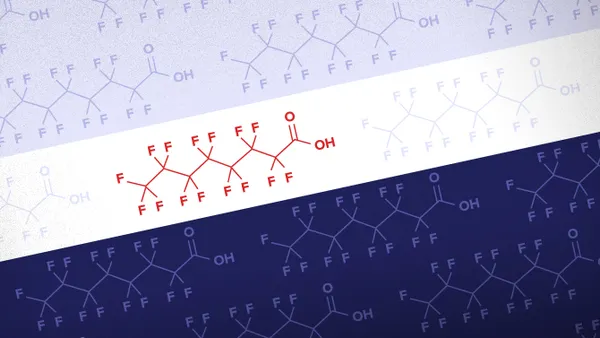
- The Pennsylvania Department of Environmental Protection is soliciting feedback on its draft general permits for land application of biosolids. The permits seek to address a variety of contaminants, including per- and polyfluoroalkyl substances.
- Proposed language would set monitoring requirements for PFOA and PFOS in biosolids that wastewater treatment plants must follow. It would also allow the codigestion of food waste at those facilities' digesters.
- States have taken a variety of approaches to monitoring and lowering levels of PFAS in biosolids, which the U.S. EPA defines as sewage sludge treated for use as a fertilizer. Pennsylvania's approach could leave critical decisions about upstream pollution up to local municipalities.
Dive Insight:
Several states in the mid-Atlantic region have advanced legislation to address PFAS contamination in biosolids. Most recently, Maryland and Virginia each passed similar legislation creating monitoring requirements for sewage treatment plants that would trigger remediation if their biosolids reached certain levels of PFAS contamination.
Pennsylvania DEP noted in a release that it convened a working group to consult on the permit language, including the Pennsylvania Water Environment Association, Mid-Atlantic Biosolids Association, Delaware Riverkeeper Network and Chesapeake Bay Foundation. It also consulted with the Pennsylvania Department of Agriculture.
"Today we are taking steps to keep forever chemicals out of our food and out of our groundwater,” DEP Secretary Jessica Shirley said in a statement announcing the drafts. “These updated permits will give the farmers of Pennsylvania peace of mind that the biosolids they use to fertilize their fields are not going to come with PFAS contamination.”
Pennsylvania's draft permit would prohibit the land application of biosolids with PFOA or PFOS levels greater than or equal to 100 micrograms per kilogram. Biosolids with at least 20 micrograms per kilogram of PFOA or PFOS must be applied at a reduced rate, and the plant producing such biosolids would need to implement a source reduction plan.
In a fact sheet, Pennsylvania regulators highlighted the success of states like Michigan and Wisconsin that have also taken a tiered approach. But some industry voices have noted DEP has diverged from those states in its regulation of upstream polluters that send highly contaminated streams to wastewater treatment plants.
Michigan's Industrial Pretreatment Program, which began work several years ago, monitors upstream sources of PFAS before they enter wastewater treatment plants, and requires corrective action if levels are too high. The program is enforced by the state's Environmental, Great Lakes, and Energy department.
But Pennsylvania DEP, the state's equivalent agency, has indicated it does not have the same enforcement power as EGLE, said Mary Baker, executive director of the Mid Atlantic Biosolids Association. She said if the agency holds that stance, it would force each Pennsylvania municipality to decide whether to regulate upstream polluters. Otherwise, the financial burden for remediation would rely on the wastewater treatment plants downstream, which are often publicly financed.
"That is going to fall upon the individual municipalities to police that, and that could be very difficult administratively and financially for the municipalities," Baker said.
She also expressed concerns with the thresholds Pennsylvania regulators proposed for remediation. She noted an early study of biosolids generators found about half of the facilities fell into an actionable tier under the current proposed limits. Her group plans to advocate for a monitoring period so facilities can gather more information before they may be required to take action.
Municipalities in Pennsylvania have faced other challenges with managing PFAS contamination as well. The town of Plainfield in March joined a lawsuit seeking to compel federal regulators to set limits on PFOA and PFOS in sewage sludge. In an amicus brief filed with the U.S. District Court of Appeals, lawyers noted Plainfield is facing legal action over an ordinance prohibiting the land application of sewage sludge on certain properties.
Save Plainfield Township, a group backing the ordinance, has argued that the ordinance was necessary because state regulators were not taking adequate steps to protect municipalities from contamination. The group has also called for residents to comment on the draft permits.
The 60-day public comment period for the draft general permits began on July 4 and ends on Sept. 2.