The nation’s first extended producer responsibility program for household hazardous waste will be run by Vermont’s Agency of Natural Resources, but regulators hope that will be temporary.
“It is not our preference to be running this program,” said Josh Kelly, solid waste program manager for the Vermont Department of Environmental Conservation.
“The state of Vermont would be very open to any group coming forward to be an overarching PRO,” he said. “We remain open to dialogue with the industry as this process unfolds.”
A wide group of covered products, a lack of consolidated trade associations and tight timelines all posed challenges to companies in Vermont looking to stand up a producer responsibility organization to manage HHW.
Developing a unique EPR law
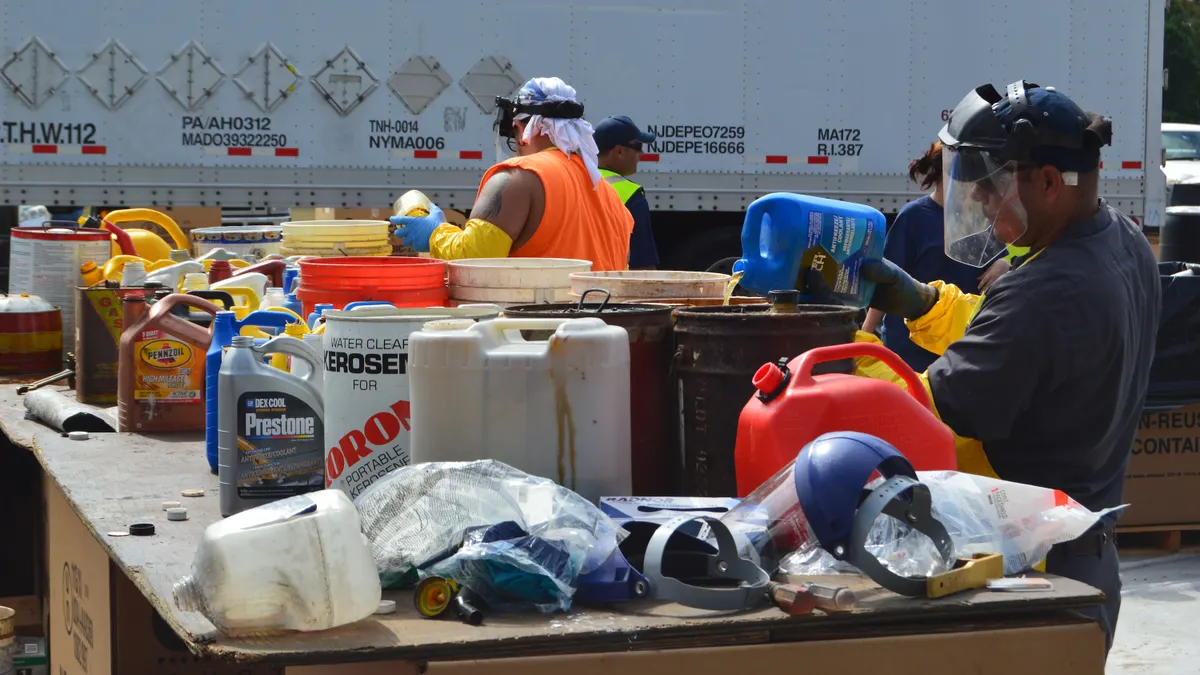
The 2023 EPR law covers adhesives, lubricants, degreasers, aerosols, automotive chemicals, non-refillable propane cylinders and cleaning solutions. It used to cover paint-related products, but the existing PaintCare program moved those products under its umbrella.
One of the main drivers was cost, according to Kelly. Municipalities were struggling to cover the expense of running HHW disposal events as inflation soared and available companies consolidated over the past five years.
“Their costs were rising and they did not have enough companies to obtain quotes from,” Kelly said, adding that “we’re a rural state and not really on the way to anywhere.”
The law text said solid waste management entities spend approximately $2.2 million a year to manage HHW, “costs that are subsequently passed on to the residents of Vermont.”
“Funding constraints are a current barrier to new collection sites and educational and informational activities,” the law text stated. It estimated that 855 tons or more of HHW are being disposed of annually.
Collection event costs rose as much as 50% over the last five years, Kelly said. But to keep programs accessible to citizens, many municipalities were charging $20 to drop off a carload of HHW materials, when the management cost was closer to $500.
“It’s not sustainable at that rate, so there needed to be some industry support,” he said, especially to expand the programs and capture more of the HHW currently going to landfill.
The state plans to release a plan by July 1, the official start date of the program. It also has RFPs out to do a waste characterization study, and for a contractor to handle sales data for covered products and set up a system for billing manufacturers. Kelly said both contracts were expected to be finalized soon.
“It’s a state-run program, but we’ll still produce a plan because municipalities need to know what to expect and producers need to know where the state is going,” he said.
The agency also plans to hold a producer call, once the contracts are signed, to share information about how the system will work.
Once the EPR program goes live in July, municipalities can opt in to get reimbursed for collection costs. The law initially intended for manufacturers to provide those reimbursements via a PRO, but no such group formed before a July 2025 deadline. Because the state is now running the program it’s permitted under statute to charge 110% of the costs.
Kelly said that surcharge was a “way to encourage a PRO to form — and it was not enough of an encouragement.”
“We’re in a position to try to implement it as a state-run program and that is probably going to be costly for producers, because we have to hire people to do it,” he said.
Scott Cassel, CEO and founder of the Product Stewardship Institute, said industry is usually spurred to act by cost concerns, and that “the state is doing them a big favor by taking this on.”
However, there is precedent: Many early U.S. electronics EPR laws functioned without a PRO, Cassel said. He noted that in some states, such as Oregon, Washington, Vermont, and Connecticut, state governments were especially involved.
“More recently, as states switched from performance targets measured by tons collected to a percentage of market share, producers have played a more significant role in compliance,” he noted via email.
He said producers should recognize that other states will likely pass similar HHW legislation, and should be thinking about using this opportunity to “get a model and develop an efficient, effective operation moving forward so it’s the least cost to the industry.”
A formidable covered product list
One factor that made implementation challenging is the multi-product nature of this EPR program, which “comes with complexity and chaos,” Kelly said. That’s similar to packaging, but very different from other, longer-running EPR programs in the United States, such as for paint and mattresses.
“It’s exciting and it's worth focusing on household hazardous waste because it's the most toxic part of the waste stream,” Kelly said, but the broad range of products covered means there are no existing trade associations that could easily step into a PRO role.
The state also has seven other EPR programs, and any products covered by another EPR law are excluded from the HHW program. The auto lubricant industry is interested in being a separate PRO, Kelly said, but there’s not currently any bill in play to do that.
The Household & Commercial Products Association worked toward becoming a stewardship organization, and started a nonprofit with that goal in mind, but ultimately decided not to move forward.
COO Mike Gruber said the organization has been involved from the start because it's a high priority issue for its members and “we were one of the few trade associations in this industry that has a relatively long history of working on household hazardous waste issues.”
“In a way we drew the short straw of being a high-priority association engaging with lawmakers,” he said, because HCPA then was looked at to stand up the PRO. HCPA tried to find a service provider to help administer the PRO, but “that universe is very small,” he said, and no one was willing to take the program on.
In addition, the law was designed in a way that made administration “unusually difficult,” Gruber said. For example, prior to an amendment made this year, manufacturers were not required to pre-register with the PRO. This made it harder to assemble a list of covered producers.
Gruber said he estimated startup costs of $1.5 million and it was difficult to secure funding without enough upfront commitments. All of that, plus managing accelerated compliance deadlines, “turned into a very heavy lift for a new organization that has no operating history.”
Cassel said other successful EPR programs for specific hazardous materials — such as paint, batteries and electronics — also did not necessarily have one overarching industry trade group prior to establishing a PRO.
“It’s just identifying the problem and agreeing that it's your responsibility and you’re going to figure it out,” he said.
Ultimately, Gruber said the problem is that “Vermont tried to build a sophisticated EPR architecture for a waste stream that is operationally messy, variable and already managed through local infrastructure.”
HCPA would have preferred a fee-based program, he said, because the main problem was the cost of the management.
“We said early on that we believed that EPR was not appropriate for household hazardous waste,” he said. “It adds bureaucracy without necessarily improving on the municipal collection framework.”
To Cassel, the EPR method offers the opportunity to build trust between disparate stakeholders and get to the root of a problem rather than focusing on its symptoms.
Unlike a fee-based program, “it’s the best way to make sure everyone's voices are heard and understood, and they can talk together to develop these very important policies,” he said.
Learning from the process
Kelly anticipates other states looking to enact EPR for HHW may run into similar issues, but “time will tell what the best model will be.” He expects a producer-led group may yet emerge to step into the PRO role.
Kelly noted the state made some changes to the law to address pain points, such as the registration issue and strengthening the ability of the PRO to charge fees.
Gruber gave the state “a tremendous amount of credit” for its responsiveness.
“We spoke with them at a regular cadence about what we were trying to do, the challenges we were facing, and they worked with us to try to amend the law, but we ultimately handed administering this back to the state,” he added.
Cassel said governments working on first-in-the-nation EPR programs must be “entrepreneurial.”
“They are changing laws, they are flexible, they know it needs to be eased in,” he said. “They are the creative officials who understand the law and understand how to innovate within the constraints.”
He said he expects other states to follow Vermont’s lead on HHW, as has been the pattern for other types of EPR laws in the United States. As the number of programs reach an inflection point that can create efficiencies, he added.
“You have to lay the groundwork, you have to develop the model, you have to educate advocates and you have to send the message to industry that legislation is important and inevitable,” he said.
It’s always difficult to be the first state to do something, Gruber said, and this is no exception. However, he said, lawmakers in other states “shouldn't assume that a PRO is magically going to appear.”