Dive Brief:
- Otto Environmental Systems is in the midst of involuntary Chapter 7 bankruptcy proceedings triggered by three debtors in May, according to legal filings. Quantum Polymers, Vinmar Polymers America and Trademark Plastics collectively alleged nearly $2.6 million in debts owed by Duramax Holdings, which does business as Otto Environmental Systems.
- The company won a contract in 2024 with the New York Department of Sanitation to manufacture the city's curbside NYC Bins. So far, New Yorkers have purchased around 1.1 million bins, according to DSNY.
- A trustee has been appointed to oversee the company’s assets during bankruptcy proceedings. Court filings show an ongoing dispute over contracts, accounts and assets transferred from Duramax to other companies set up by Duramax CEO Brian Coll.
Dive Insight:
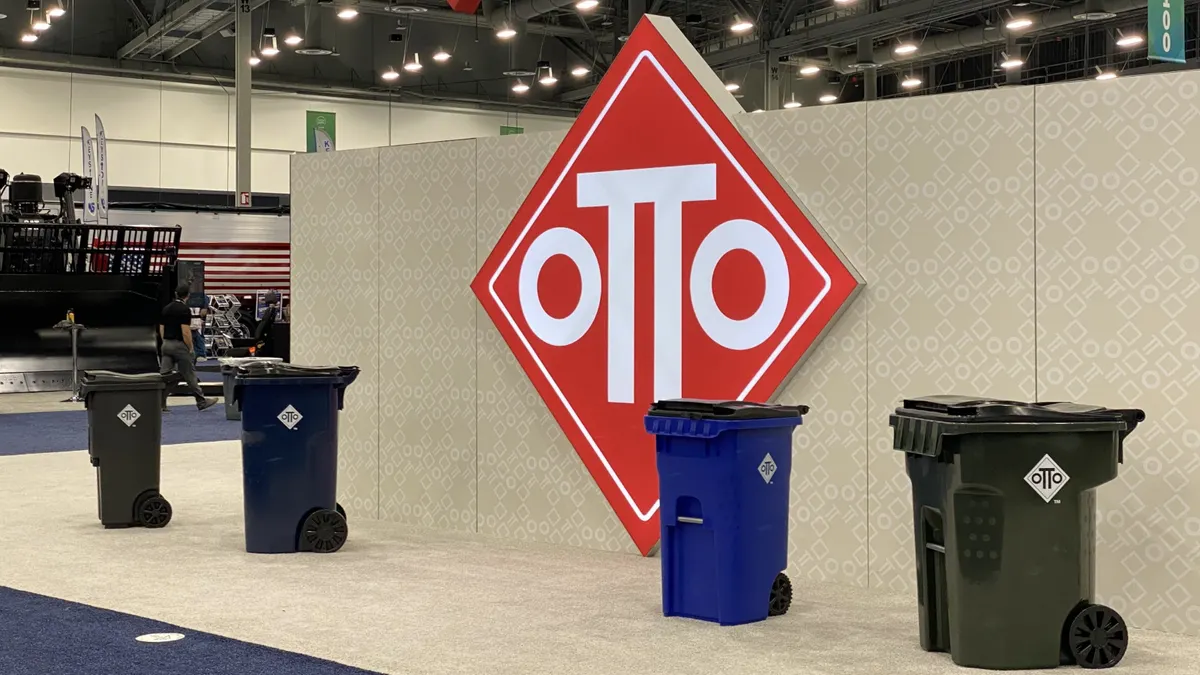
Headquartered in Charlotte, North Carolina, Otto has manufactured waste bins since 1934. The company lists offices and manufacturing facilities in North Carolina, Ohio, Michigan and Mexico on its website.
Otto was among several large binmakers, including Wastequip, Rehrig-Pacific and Cascade Cart Solutions, to meet with DSNY and discuss its request for proposals for residential collection bins. The city has been working to containerize waste across all five boroughs, and wanted to standardize the carts used by residents.
The contract DSNY signed with Otto runs for 10 years. It included a maximum price set at the lower end of retail prices in the area, per the contract. “These prices must be inclusive of the proposer’s entire operating costs, as there will be no additional reimbursement or expenses from the Department,” the contract noted.
By May 1, 2026, Otto was expected to manufacture and deliver a total of 3.39 million bins, enough to cover all properties with between one and nine residential units in the city.
But questions surfaced around the pricing model. Last year, the manufacturer reportedly asked to raise prices for each bin by $25 to $30, or otherwise fund them through a property tax rather than ask residents to pay for the bins themselves, according to the New York Post. When the city turned down that request, Otto reportedly shut down its New York facility.
Vincent Gragnani, press secretary for DSNY, said in an emailed statement that production and delivery of the bins has continued this year. He also noted that “thousands of NYC bins” are still available in Home Depot, which was designated as the exclusive retailer for the bins.
The city’s requirement that all residential buildings with one to nine units use the bins kicked in on June 1. But Gragnani said the department would be issuing warnings, not fines, until Sept. 8. Fines for failure to use the bins begin at $50 for a first offense, $100 for a second offense and $200 for a third and subsequent offenses.
In the meantime, bankruptcy proceedings for Otto continue. On Friday, CEO Brian Coll filed a list of the company's creditors. Besides DSNY, other creditors on the list included major waste companies Republic Services, Clean Harbors and GreenWaste; trade groups NWRA and SWANA; the U.S. attorney general and the IRS; several state officials; cities in Arizona, Florida and North Carolina; and several plastics and polymer suppliers.
Cole Hayes, a bankruptcy attorney assigned as trustee for the case, is seeking additional information from Coll as well. In filings, he alleged that Coll set up new LLCs in Michigan and Ohio in late 2025 and early 2026 at the same time that Duramax’s creditors were going unpaid.
“Coll sat on both sides of the table, and it appears that Coll and others engineered a paper transfer of Duramax—its name, its contracts, its accounts receivable, its customer relationships, its operations—to a newly-formed entity controlled by the same principals, when Duramax was insolvent and unable to pay its debts as they came due, and without paying reasonably equivalent value to Duramax,” Hayes alleged in a July 1 complaint filed with the bankruptcy court.
A spokesperson for Otto and lawyers for Coll and his associated businesses were not immediately available for comment.
Hayes’ complaint noted creditors had filed proofs of claims totaling an additional $160,000 since the initial bankruptcy filing. The trustee further expressed concern that assets could be sold or transferred to Mexico by Formex, the company Coll set up to receive Duramax’s assets. Hayes filed for a preliminary injunction to prevent that transfer, as well as for a subpoena seeking documents from Coll and affiliated companies involved in the transfer of Duramax's assets to Formex.
Judge Ashley Edwards granted the subpoena, leading to the release of the creditor list on Friday. The court is scheduled to hold a hearing on a preliminary injunction and consent order on Aug. 13.