As landfill capacity in the Northeast United States continues to tighten, waste companies are investing more heavily in rail infrastructure to unlock airspace and lower tipping fees hundreds of miles away.
Competition for these faraway waste assets — out to Pennsylvania and Ohio or south to Virginia or Alabama, for example — is expected to only increase in coming years. Several Northeast landfills are set to reach capacity in the coming years, and local permitting entities and host communities are not easily convinced to expand the regional landfills that remain.
The Northeast Waste Management Officials’ Association estimates the region disposed of 33.56 million tons of waste in 2024, and about 23% went to landfills expected to close in less than five years. Another 12 million tons of that waste was exported out of the region that year.
Waste companies have been playing a long game to find workarounds for the Northeast waste capacity crunch for decades now, said Tara Hemmer, COO of WM, during the Oppenheimer Industrial Growth Conference in May.
Waste-by-rail has been a saving grace for bigger companies that handle large volumes. But calculating shipping costs, as well as managing logistics and last-mile considerations, are challenges that are becoming more complex with time.
“How do we make the connection between these large centers of waste to more regional landfills? We've invested quite a bit in looking at how to connect the dots between our transfer station network and our landfill network,” she said.
Long-term investments
Moving waste by rail isn’t a new idea, and numerous major companies have relied on rail-served landfills and transfer stations for years. Many of the industry’s largest companies have used rail to move about a third of MSW in the Pacific Northwest over the last 25 years, said Waste Connections CEO Ron Mittelstaedt in an April earnings call.
But the capacity issues in the Northeast have become more and more pronounced in recent years, prompting companies to accelerate rail-related investments. Over the past decade, Waste Connections, Republic Services, Casella Waste Systems and others have acquired companies with rail transfer capabilities in the region.
Communities in Maine, New Hampshire, New York, Pennsylvania and elsewhere are protesting proposals to expand landfills. Casella is ramping down volumes it sends to a landfill in Bethlehem, New Hampshire, which is due to close at the end of 2027. And a Casella-operated landfill owned by Ontario County near Stanley, New York, is expected to close by the end of 2028.
Waste management companies “are not building new landfills in the Northeast, and it's obviously difficult to expand landfills in the upper Northeast,” said Mittelstaedt during the call. Those conditions “are ripe for rail to take waste out of the geography as landfill airspace and scarcity gets tighter.”
Waste Connections has been optimizing its rail operations in the years since it acquired Arrowhead Environmental Partners in 2023. This included a rail-served network that connects to a massive Alabama landfill, which sits on a 1,345-acre site with a 425-acre Subtitle D footprint.
The facility has approximately 60 million cubic yards of permitted airspace and can receive up to 15,000 tons of waste per day. It takes 95% of its waste from rail.
“We've grown our Arrowhead landfill rail network over the last two years by effectively 300% now, and all of that is moving off the Eastern Seaboard from New Jersey north through our intermodal facilities,” Mittelstaedt said during the earnings call. “We'll continue to grow that as we go forward.”
To combat its own Northeast landfill closures and other volume management considerations, Casella recently completed rail infrastructure improvements at its McKean Landfill in Western Pennsylvania. McKean, the company’s only rail-served disposal facility, has reshaped Casella’s strategy for managing volumes.
That landfill “is a great rail option for the Northeastern waste that does not have access to local disposal,” CEO Ned Coletta said during a May earnings call. “About 30% of the waste that's generated in the Northeast needs to be exported given the lack of disposal capacity in our markets.”
That’s an important consideration for Casella, which acquired Boston-area Star Waste in April and expects to send some of the internalized volumes to McKean later this year.
“It’s one of only a few rail-served landfills that can service the market, given the capital intensity and logistical complexity” of building rail services, said Coletta.
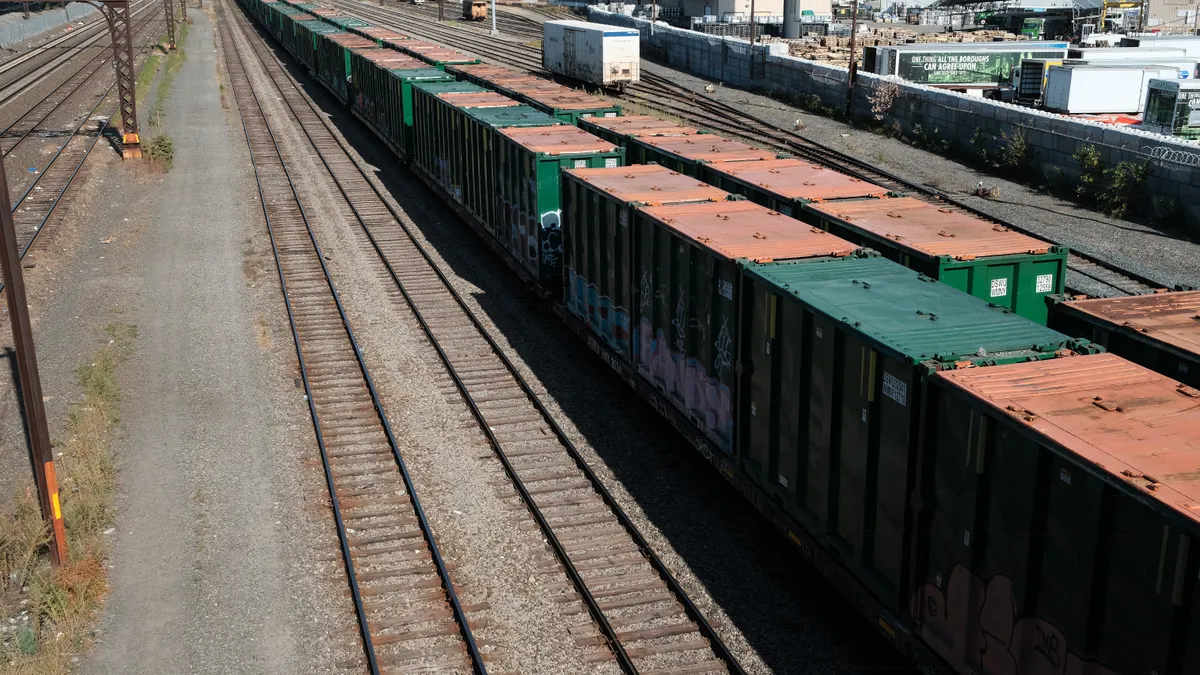
Casella is still ramping up its usage of the site as it finalizes upgrades, which include building over a mile of spur track meant to fit numerous rail cars. The landfill also has new gantry cranes to offload containerized waste and a dedicated transfer station for open gondolas.
As part of that ramp-up, McKean currently only accepts about 200,000 tons per year of its 1.6-million-ton annual permit capacity.
Coletta said in a June interview that this investment is intended to preserve Casella’s operations rather than create a new option in the market.
“We never really built out McKean to be a merchant facility for others. We always looked at it as this is a long‑term solution for many of our important customers over the next 30 years,” he said.
Other waste operators in the area are working with more established rail-served landfill sites.
New Hampshire-based Win Waste Innovations describes itself as the largest waste-by-rail operation in the U.S., due to its acquisition of Tunnel Hill Partners in 2019. The company now has two rail-served landfills in Ohio, multiple transfer stations and a fleet of 2,300 rail cars. The company estimates it moves about 5 million tons of waste via rail per year.
Interstate Waste Services also made a strategic rail decision when it acquired the Apex Landfill in Amsterdam, Ohio, in 2020. IWS has three rail-served facilities in New Jersey and two gondola operation facilities in Connecticut and New Jersey. As of 2025, the company used rail to move about 2.5 million tons of waste each year.
Other rail-served landfills may see interest from private equity investors or major waste companies looking for vertical integration opportunities in the coming years, said Dickson Suit, president and chief investment officer of Laurel Mountain Capital and managing partner of Environmental Services Investors.
Suit has worked on several industry deals involving waste-by-rail assets. One example in recent years is New Jersey-based Hainesport Transportation Group, which recently sold to Terramont Infrastructure Partners.
Another site that could fit the bill is Big Sky Environmental, which operates a landfill and disposal facility in Adamsville, Alabama, that’s close to a rail line. The landfill is permitted to accept 25,000 tons per day and currently accepts waste from all of the lower 48 states.
Costs and bottlenecks
Rail infrastructure also comes with hurdles, such as price considerations, said Suit. Companies have to calculate whether the typically cheaper tipping fees at landfills in Ohio or Alabama make up for other added costs of doing business by rail.
Plus, a chosen rail line might not go directly into the landfill, meaning the company has to pay to unload the material onto trucks or a short line to bridge the gap.
“Every time there's an additional touch, the cost increases,” he said.
Shipping by rail can cost Casella up to eight times more than traditional trucking, said Coletta in a June interview. That’s partly because one truck moving waste can make a loop from a transfer station to landfill in one day, but a train car might need around 20 days for a round trip before that asset is available to use again.
“When you think about the capital involved with that, it’s very, very high versus having one truck and one trailer that's just making a loop,” he said. “If we can continue to flow waste to either third‑party sites, like waste‑to‑energy incinerators or to our own landfills, we’ll do that before putting waste on a rail car. It’s just … really complex and costly.”
Coletta said another consideration is that transfer stations are often constrained by their daily capacity to fill cars, and the receiving landfills deal with daily permit volume caps.
But some companies say rail could also deliver cost savings over time, particularly related to fuel costs. IWS estimates rail services have taken more than 96,775 trucks off the road each year. That’s an important consideration during a time when national fuel costs have skyrocketed due in part to the war with Iran.
Win Waste estimates moving waste by rail is “four times more fuel efficient than trucks on a highway.”
Fuel costs have also prompted more kinds of customers to research rail as an alternative to trucks, said Jonathan Stuckey, manager of media relations at rail transport company CSX, via email. The company has "seen a growing interest among customers in shifting business from truck to rail as a result of rising fuel prices and truck rates.”
Waste shipped by rail has another distinct advantage over trucks, said Suit, because trains can carry much bigger volumes of waste in one trip.
Forming strong relationships with the railroad companies is another part of the process, Suit said. In the Northeast region, waste-by-rail is mainly handled by either CSX or Norfolk Southern.
Rail companies want to see consistent large volumes of material they can rely on, and waste companies want an assurance that their MSW volumes will move quickly and efficiently, Suit added.
“You want to make sure that there's no kind of bottleneck along the way. If you're unloading three or four or five cars a day there, you want to have consistency of those cars coming back,” he said. “If things get stuck somewhere, that might create additional costs, and also impacts operations by creating backlogs.”