Dive Brief:
- The eight Northeast states that are members of the Northeast Waste Management Officials’ Association reported disposing of an estimated 33.56 million tons of waste in 2024. About 23% went to landfills that could close within less than five years.
- An additional 12 millions tons of waste was exported out of the region, accounting for 26% of the overall disposal-bound waste managed in the Northeast. Pennsylvania, Virginia and Ohio were the primary destinations for MSW; Ohio was the main one for C&D.
- “Massachusetts and Connecticut are increasingly relying on exports,” said John Fay, program manager for solid waste at NEWMOA on April 28 while debuting the report. Fay added there are also “some red lights blinking in New York and Maine” depending on outcomes for certain facilities.
Dive Insight:
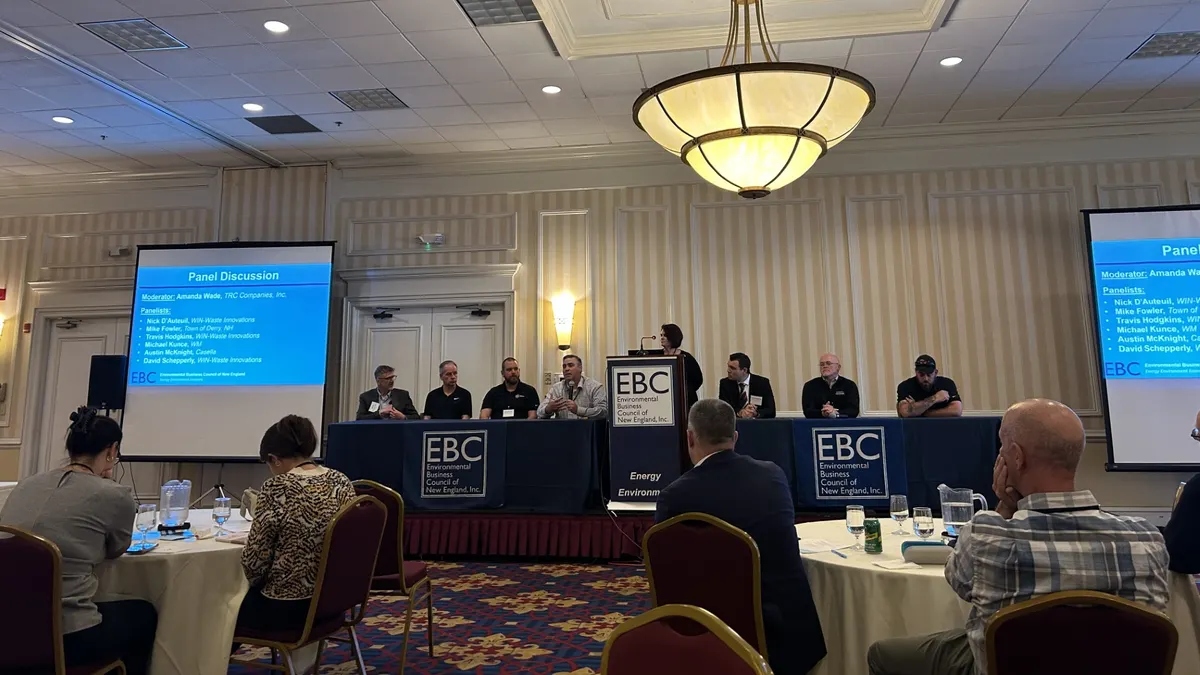
NEWMOA’s warning of potential “significant disposal capacity loss in the region within the next five years” helped spur an updated conversation at a recent Environmental Business Council event in Massachusetts.
The group’s report covers MSW and C&D in Connecticut, Maine, Massachusetts, New Hampshire, New Jersey, New York, Rhode Island and Vermont.
While the region manages about 32% of its solid waste via various types of waste-to-energy facilities, it is still primarily using landfills. Four incinerators have also closed in states such as Connecticut and Massachusetts in recent years, along with other landfills reaching capacity.
NEWMOA’s 2024 report said about 7.6 million tons of material was going to sites that might have to close soon. Notable examples include the state-owned, Casella Waste Systems-operated Juniper Ridge Landfill in Maine. The state recently approved an incremental step for that site’s expansion. Waste Connections’ Seneca Meadows Landfill in New York, the state’s largest, is another key site seeking expansion approval.
Even if both expansions were approved, there could still be 5.2 million tons in need of a new home.
The permitting landscape is challenging, but the region has seen proposals for new or expanded landfills in recent years. This includes efforts by Casella in New Hampshire, as well as WM and public sector entities in Massachusetts.
At the same time, the region has also increasingly gained access to rail transfer infrastructure that limits the need for as much local capacity. Attendees noted that lower tip fees at out-of-state landfills has kept the overall tip fees relatively stable for regional customers.
NEWMOA’s report did not cover pricing, though a recent Environmental Research & Education Foundation report shows the Northeast’s tip fees remain higher than any other area in the country. The average MSW landfill tip fee was $80.67 per ton in 2024, versus a national average of $62.28.
The region’s uniquely high proportion of WTE facilities is another factor that could help preserve capacity.
David Schepperly, regional director of operations for WTE at Win Waste Innovations, said long-running facilities such as its Saugus, Massachusetts, plant could continue to be retrofitted for many years.
Such facilities do require ash disposal, which accounted for 2.37 million tons of regional material disposed in 2024. An estimated 17% of that ash was sent to landfills that could close within the next five years.
While some in the industry feel more capacity is needed, attendees agreed that any major new projects are unlikely. Panelists estimated it could take at least five to seven years to permit any hypothetical new landfills and possibly a decade for a new incinerator in the Northeast.
Overall, the NEWMOA report found that regional waste volumes had declined by 5% since 2018. This tonnage doesn’t account for any material being directed to recycling or other forms of recovery.
Some might have hoped to see a greater decrease, given many states’ reduction and recycling efforts. Organics disposal bans exist in many Northeast states but aren’t fully enforced. Michael Kunce, an engineer at WM, said anecdotally the company had noticed the gas curves declining at its regional landfills in a sign that more organics may be staying out.
Recycling processing infrastructure has also improved, leading to lower amounts of residual waste going to disposal, but certain markets remain challenging.
Austin McKnight, a market area manager for Casella’s MRFs, said the region lacks a viable glass market, so the material is currently turned into aggregate for road uses. McKnight also said fiber values had declined 15-20% in recent years.
"We are starting to see some of the domestic mill infrastructure come into fruition,” he said, before noting a newer concern. “Right now, we are actually dealing with a negative value on PET — which is our largest, plastic commodity — and we're paying $10 a ton to get rid of it.”
A recent Northeast Recycling Council report estimated regional recycled PET was worth 1 cent per pound during April, down more than 18 cents from a year ago.
C&D, which accounted for 11 million tons of material disposed in the region during 2024, is also increasingly exported by rail. This is in part because the New England market has consolidated in recent years to the advantage of vertically integrated companies with rail-served landfills or transfer stations.
The Massachusetts Department of Environmental Protection’s 20% minimum recycling standard for C&D facilities is seen as a regional trendsetter for trying to reduce disposal, but operators also feel it has limitations.
Nick D’Auteuil, a general manager at Win Waste, said collecting source-separated materials at job sites helps create cleaner streams but also affects the math at processing facilities. C&D recyclers still need to recycle at least 20% of the remaining, lower quality material coming to them.
“I think that's a key one as we start to navigate source separation and escalating MPS, because the quality problem is not one that can be fixed with a price lever,” he said, adding that in some cases processors are rejecting or limiting what they’ll take “because we cannot continue to bear the compliance burden.”
MassDEP’s MPS threshold is currently set to rise to 23% by 2027 and 25% by 2030.