Waste companies are struggling to take a full account of their scope 3 emissions, leaving open a path to reducing their climate impact, a new report from the Environmental Research & Education Foundation found.
Scope 3 emissions, which are the emissions stemming from both upstream and downstream activities of a reporting company, are still an “emerging question” in the waste industry, said Bryan Staley, president and CEO of EREF. Gaining a better understanding of them may help companies get a more complete understanding of their climate impact.
“This is where things become a little more cutting edge,” Staley said. “As the waste industry, we’re just getting our arms wrapped around what scope 3 means and is and what are its contributions.”
While many large waste companies have been voluntarily reporting emissions for several years, regulators are increasingly interested in setting broad requirements for companies to report their emissions. A law passed in California in 2023 will require businesses with revenues exceeding $1 billion to annually report scope 1 and 2 emissions beginning in 2026 and scope 3 emissions beginning in 2027. The U.S. Securities and Exchange Commission also proposed and then dropped plans to require scope 3 emissions reporting.
North Carolina-based EREF looked at the self-reported emissions in 2022 of some of the country's largest waste companies by fleet size. Those companies released roughly 111 billion pounds of carbon dioxide equivalent into the atmosphere that year, equal to driving more than 11.7 million gasoline-powered passenger vehicles for a year, per EPA data.
The study examined whether the top waste companies were measuring and reporting scope 3 emissions in 2022. It found seven that reported scope 3: WM, Republic Services, Waste Connections, GFL Environmental, Reworld, Casella Waste Systems and Interstate Waste Services. The researchers also determined that Clean Harbors and Recology reported scope 1 and 2 emissions but not scope 3.
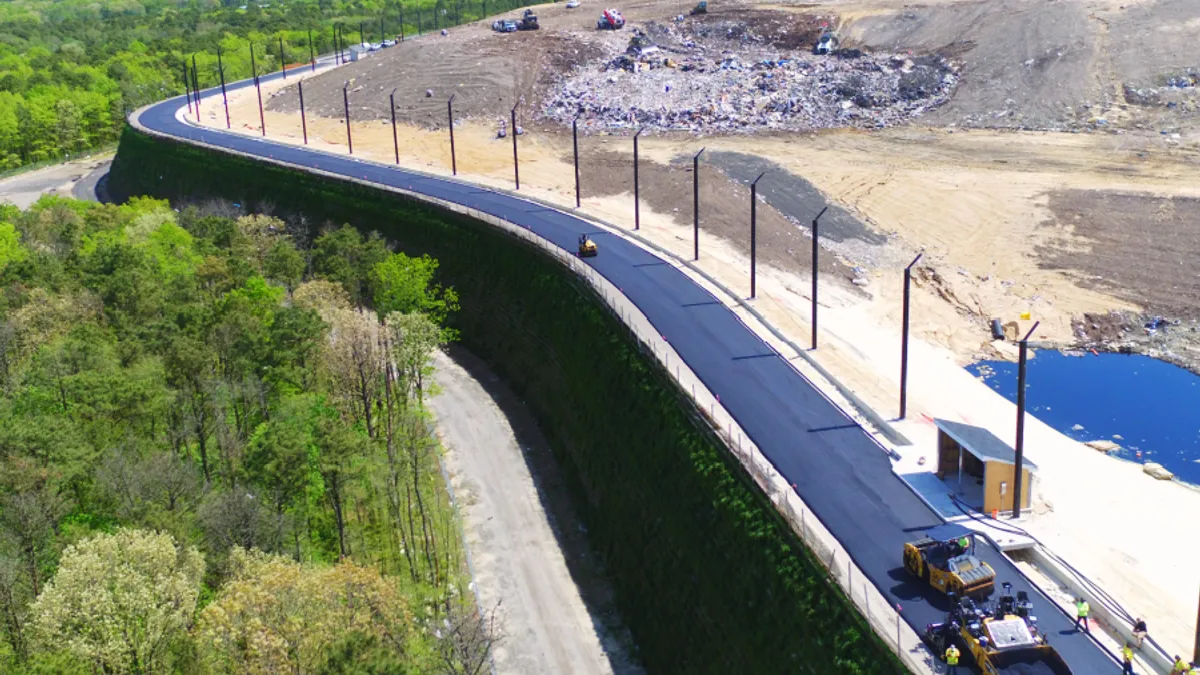
Perhaps the biggest surprise in the study came from understanding the role of landfills in a company's relative emissions, said Staley. Landfill emissions are responsible for the vast majority of a waste company's scope 1 emissions, the category derived directly from a company's vehicles or facilities. But the size of a landfill portfolio heavily impacted a company's overall emissions mix.
In 2022, WM's scope 1 emissions were responsible for 90% of the company's overall emissions, while scope 3 comprised just 9%. That total was heavily skewed by the 259 landfills the company owned that year. Meanwhile, Interstate Waste Services, which owned just one landfill, reported its scope 1 emissions were roughly 63% of the company's overall emissions, while its scope 3 emissions were roughly 35%.
The report determined that "there is a greater potential for waste companies with minimal landfill ownership business models to prioritize scope 3 emission reporting and reduction efforts compared to waste companies with heavy landfill ownership."
Scope 3 encompasses 15 categories of emissions-generating activities. Categories like upstream transportation and distribution, purchased goods and services, capital goods and fuel and energy related activities appear to be the most relevant to waste companies, the study found. But the study of such emissions is relatively complex, as it requires detailed conversations with customers, suppliers and other third parties that might not be closely measuring their own emissions or willing to share them.
Among the waste companies that were reporting scope 3 emissions, many were unable to acquire supplier-level data, instead relying on industry averages to calculate their reports. Improving that data quality will give waste companies a better idea of how to tackle their emissions, Staley said.
"The companies that fit into that scope 3, these are the vendors and so forth, a lot of them really aren’t tracking this sort of stuff," he said. "There’s a buildout of data infrastructure that’s needed."
That buildout will likely come through purchasing decisions. In the same way that a consumer might buy a product that they perceive to be greener, waste companies could influence their scope 3 emission generators if they signal a preference for doing business with those that report and limit their own emissions.
"The vendors ... they have an interest in wanting to show that they’re being sustainable as well," Staley said.
Still, he expects that scope 1 emissions will remain waste companies' first priority for the foreseeable future. Advancements in methane tracking and landfill gas capture technology have only just begun to impact operations, and there's still plenty of work that waste companies can do to limit their own emissions.
But Staley said gaining an understanding of scope 3 emissions now ensures that when companies are willing to take a look, they'll have a good sense of what to target first.