TerraCycle, known for its niche recycling services capturing hard-to-recycle items like cigarette butts and cosmetics packaging, is in the midst of a new $75 million investment offering round. CEO Tom Szaky envisions using up to three quarters of the next round of funding on acquisition investments, with the rest going toward infrastructure and personnel investments
The Regulation A funding round, announced last week, is also the next step in the company’s exploration into someday taking the company public, Szaky told Waste Dive. Because Reg A funding comes with strict public reporting requirements, it’s an ideal “warm-up” for exploring a possible IPO in the future, he said.
The round comes just after TerraCycle completed a separate $5 million Regulation CF crowdfunding raise in the fourth quarter of 2025, a move meant to test the waters and determine whether a larger fundraising endeavor would work, Szaky said. The company hit its goal in about 60 days, prompting TerraCycle to make plans for a larger fundraising round.
TerraCycle reported a revenue increase of 75% over the last four years, from $24.7 million in 2020 to $43.1 million in 2024. It reported $19.3 million in gross profits in 2024.
This is the second time TerraCycle has pursued a Regulation A funding round. In 2018, the company launched a $19 million round from about 6,300 investors, which it used to help fuel the acquisition of three companies.
The first was Air Cycle, now known as TerraCycle Regulated Waste, a Chicago-based lightbulb and e-waste recycler. In June 2023, TerraCycle acquired Massachusetts-based universal waste company Complete Recycling Solutions. In September 2024, it acquired North Coast Recycling, a specialty waste company, for about $5.5 million.
“The place where we’ve mainly played and made a name for ourselves is in the category of ‘not profitable to recycle, but not mandatory to recycle,’” which Szaky characterized as types of waste that typically go to landfills, like writing instruments and chewing gum.
“But we also focus on the category of items that are not legal to dispose of, like universal waste such as batteries and lightbulbs,” he added. “That’s where our acquisition activity has been.”
Szaky said the ideal acquisitions are standalone companies that can continue to serve their unique niche markets after TerraCycle acquires them.
“What we liked about those acquisitions is we didn't buy them and slice and dice them. We invested in them. Every one of those companies is now bigger than they were before,” he said. Air Cycle, for example, originally had about 20 employees at a 15,000-square-foot facility in Illinois. That facility now operates with closer to 60 employees in a 115,000-square-foot expansion, he said.
Since TerraCycle launched, its business model has drawn support from investors, as well as skepticism and past legal action from environmental groups such as The Last Beach Cleanup, which described the company’s business model as greenwashing.
But Szaky says the company’s operations are based around recycling models and partnerships it has been honing for years. The company is mainly known for partnering with brands and retailers to offer drop-off or mail-back options for niche items like instrument strings, old toys and branded hair care product packaging.
It also markets mail-back “zero-waste boxes” for consumers to purchase and fill with specific items. Box options include those for oral care items, contact lenses, disposable gloves, single-serving coffee pods, snack and candy packaging, and pet products like chews and leashes.
“In our world, we are only dealing with things that are intrinsically not profitable to recycle. The output material value is never going to cover the cost of collecting and processing it — not even close,” he said.
The company aims to maintain what Szaky calls a “full recycling guarantee” by finding markets that take highly specific outputs. At the same time, TerraCycle aims to maintain about a 1% contamination rate. That could mean processing chip bags to yield about 99% polypropylene after separating out the aluminum layer and inks, he said.
TerraCycle also aims to invest in infrastructure improvements, either for equipment at its partners’ processing facilities or at its own recycling facilities that Szaky describes as less like a MRF and more like a “reverse Amazon warehouse.”
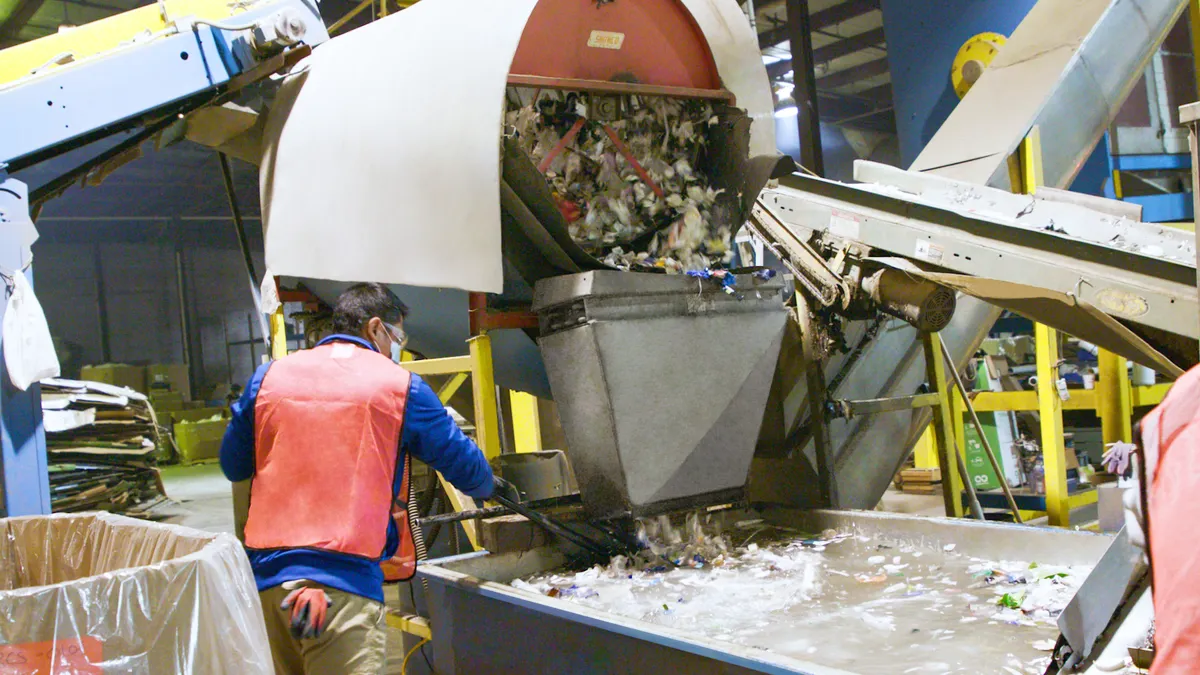
Instead of items being boxed up and shipped to consumers, boxes full of consumers’ old goods are shipped into TerraCycle facilities like its location in Illinois. There, they are unboxed, sorted and processed into smaller and smaller material fractions before being sent to end markets.
TerraCycle is also investing in its laboratory in Trenton, New Jersey, where workers experiment with ways to more efficiently separate components of tough-to-recycle items, like shoes that have multiple types of foam, plastic and glue.
“We’re agnostic about the processes we use to get there, but first and foremost, we care that it’s a process where we can maintain a recycling guarantee — that everything has been recycled, all the way through,” he said.
This story first appeared in the Waste Dive: Recycling newsletter. Sign up for the weekly emails here.