Dive Brief:
- In a new report, the Basel Action Network (BAN) projected that between 395 million and 617 million metric tons of electronic equipment could be retired between 2025 and 2050 in connection with artificial intelligence, which is triple the current volume of equipment.
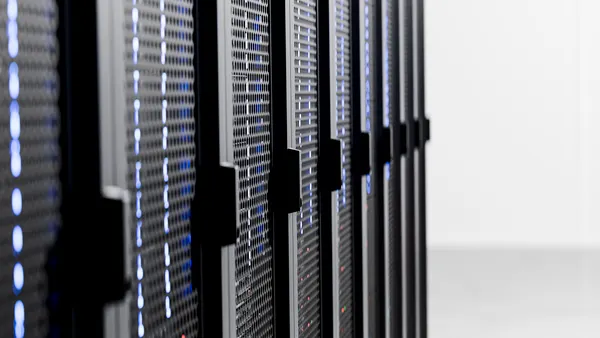
- That includes the entire ecosystem of material: servers, accelerators and racks (13% of a data center's electro-mechanical infrastructure by mass), power supply and distribution (34%), cooling systems (35%), backup power systems (15%) and networking equipment (3%).
- This report is the first part of four planned releases in “The Coming AI Waste Wave” white paper. Following releases will explore whether it will be possible to reuse, refurbish and repurpose material to reduce the impact, the toxicity of the stream, and the policy responses BAN suggests to manage the outcome.
Dive Insight:
The goal of the white paper series is to slow down the AI boom, said Jim Puckett, BAN founder, via email, but not halt it entirely.
“I earnestly hope we can slow the horserace, the freight train, the juggernaut that is the ‘AI revolution’ down,” he said. “From what I have learned in just the last few months, and only looking at this one segment of its impact — toxic e-waste — I am scared for that outcome, while realizing there are so many other results far more harrowing.”
Illustrating the challenge of that goal, Puckett noted that he used Anthropic's Claude AI model to help him craft the white paper, and pointed to the many beneficial uses of AI models, such as in cancer detection and early warning systems.
“Given the speed at which things are moving with the AI horserace, I felt I could not afford to worry about this moment’s ironies in order to match that sense of urgency,” he said via email, adding that he is “harnessing the power of AI in the most positive way now in the hope of being able to rein in its likelihood of it creating havoc.”
Puckett added that “it's the same irony even the masters of AI are facing down when they remarkably beg governments to control their product.”
The UN Global E-Waste Monitor estimated that 62 million metric tons of material were generated in 2022, and about 22.3% was properly recycled. Scaled up based on that estimate, the amount generated in 2050 would be about 165 million metric tons — but that’s not including the kind of increased demand AI could create.
The key, Puckett said, is preemptively working to mitigate the risks, including the potential for vast amounts of electronic waste.
That starts with determining the scope. BAN’s model's inputs include how fast capacity is growing, how much equipment each added gigawatt requires and how long that equipment lasts.
The report counts not just servers, but networking equipment, power distribution, data storage and backup systems, cooling infrastructure — and what BAN dubbed “AI waste contagion,” which is electronics outside data centers that may be retired early as personal devices and telecommunications networks need to be updated to work with AI.
“This AI contagion obsolescence as we call it, will not take place in data centers but with our own IT equipment in our homes, our businesses, and our gaming rooms,” the report noted.
That “contagion” could add between 16.2 million and 30.7 million metric tons of retired equipment annually to the overall e-scrap total by 2050, the report projected. That would push global generation of e-scrap to up to 211 million metric tons annually, which is 28% above BAN's previous estimates and triple today's annual total.
BAN warned that the numbers in its report could be pushed even higher under certain scenarios. As more countries pass data sovereignty laws this could require redundancy in data centers, especially if such centers become critical infrastructure and become targets in conflicts. A wholesale upgrade of current, aged telecom infrastructure could also greatly increase the tons generated, the report added.
If there’s a "rip-and-replace" transition, with data centers switching to superconducting power systems, liquid cooling and new battery chemistries, that could also force the retirement of otherwise functional infrastructure earlier than projected.
However, the report also noted that equipment may last longer than the projected lifespans, or servers could be modularly upgraded. A secondary market encouraging reuse and refurbishment may also emerge, the report allowed, and future software efficiency could reduce the estimated hardware demand. There’s also the possibility that AI and data center demand could plateau before it hits the 2050 levels BAN estimated.