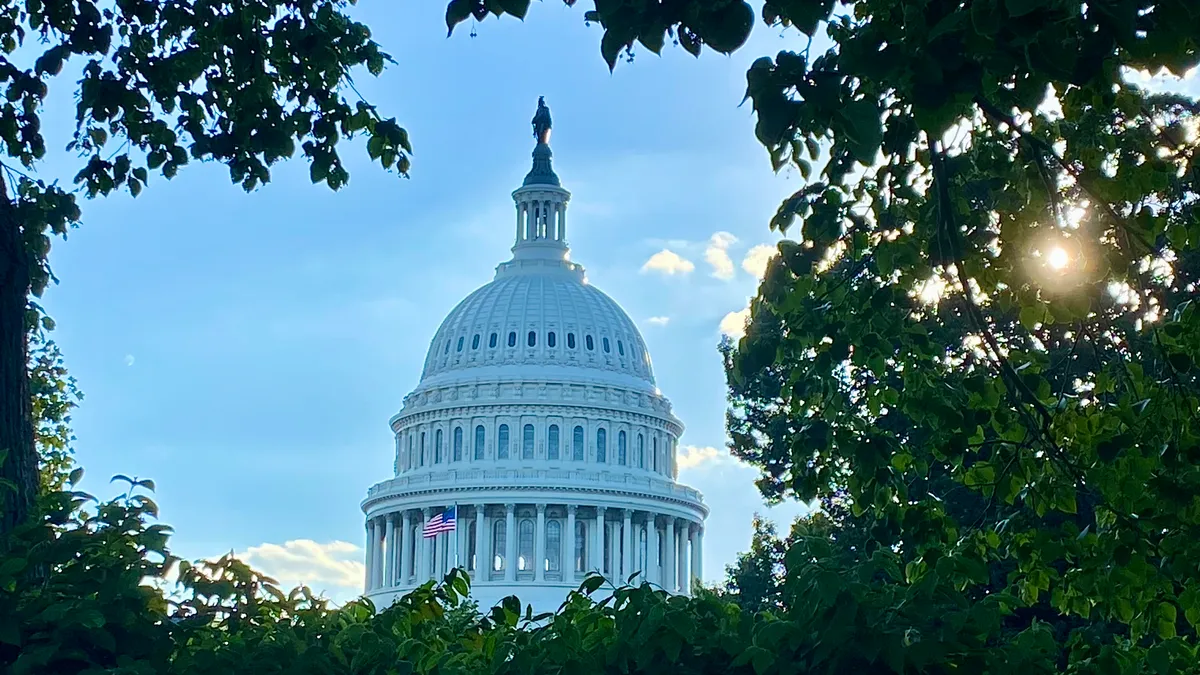
The U.S. House of Representatives voted to approve three bills with waste implications, ahead of an extended recess before the midterm elections.
The bills were among a package of legislation from the House Committee on Energy and Commerce that passed yesterday.
Each bill has connections with the Trump administration’s focus on critical minerals, driven in part by a push to bolster domestic supply for defense and advanced manufacturing applications.
Battery Recycling for America’s Competitive Economy Act
HR 9615, introduced by Rep. Marianette Miller-Meeks, R-Iowa, would update federal battery regulations to account for current lithium-ion chemistries.
The bill would direct the U.S. EPA to conduct rulemaking to recognize lithium-ion batteries as universal waste, a category of hazardous waste, within 18 months of its enactment.
According to Miller-Meeks’ office, this would reduce costs and permitting requirements by allowing “destination facilities to store lithium-ion batteries at the same location where they are recycled.” The statement also cited the potential to recover more lithium, cobalt, nickel and copper from these batteries for a range of applications.
"China dominates the global battery supply chain, and outdated federal rules have made it harder for American recyclers to compete. The BRACE Act fixes that by cutting red tape and letting our recyclers recover the critical minerals already sitting in used batteries right here at home,” Miller-Meeks said in a statement.
This would update regulations from the Mercury-Containing and Rechargeable Battery Management Act of 1996.
Coordinating and Harnessing America’s Recovery of Minerals Act
HR 9617, introduced by Reps. Gary Palmer, R-Ala., and Paul Tonko, D-N.Y., would direct the U.S. EPA administrator to consult with other agencies on the creation of a National Critical Mineral Recovery Strategy. This would include a focus on opportunities to recover more of these minerals from “discarded materials.”
At the time of the bill’s passage out of committee in July, Rep. Palmer similarly cited a desire to boost domestic supply resilience.
"Critical minerals are essential to our economy and national security, yet America remains too dependent on China for these resources,“ he said in a statement. “The CHARM Act takes a commonsense approach by directing the [EPA] to develop a coordinated federal strategy to identify new opportunities to recover critical minerals from electronic waste, legacy mine sites, coal ash, and other overlooked sources already here at home.”
If passed, this law would amend the Solid Waste Disposal Act of 1965.
Environmental Monitoring and Remediation Technology Assessment Initiative Authorization Act
HR 9616, introduced by Reps. August Pfluger, R-Texas, and Greg Landsman, D-Ohio, would direct the EPA to make updates to a 2023 program focused on recovering critical materials from contaminated sites.
The EMRTAI is focused on developing technology to recover materials from mining waste at legacy sites during remediation. Pfluger’s bill would direct the EPA to broaden the program to also include a broader range of sites, including a focus on Superfund sites on the National Priorities List. It also calls for $10 million in annual funding to assist this work.
“Today, the House took a critical step toward ending our dependence on foreign adversaries for the minerals America counts on. This legislation turns contaminated sites into strategic assets while speeding up the restoration work our communities need,” said Pfluger in a statement.