Landfill operators across the country continue to navigate complex capacity and expansion issues.
Local officials in Eau Claire, Wisconsin, decided not to sell GFL Environmental a parcel of land needed to expand its Seven Mile Landfill. Meanwhile, hauler deals, data center builds and other factors are influencing capacity elsewhere in the country.
In California, an ongoing elevated temperature event at the Chiquita Canyon has prompted California’s attorney general to file a lawsuit against Waste Connections.
What landfill news are you following? Contact us at waste.dive.editors@industrydive.com.
California AG sues Waste Connections over Chiquita Canyon Landfill management
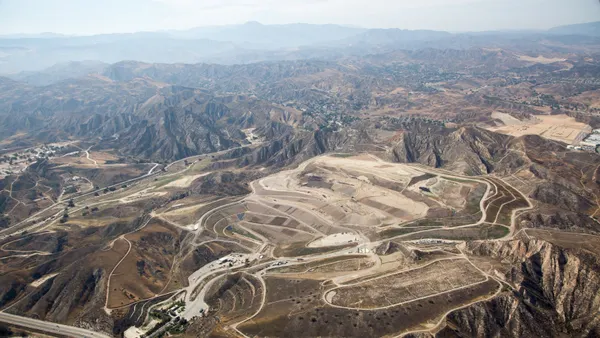
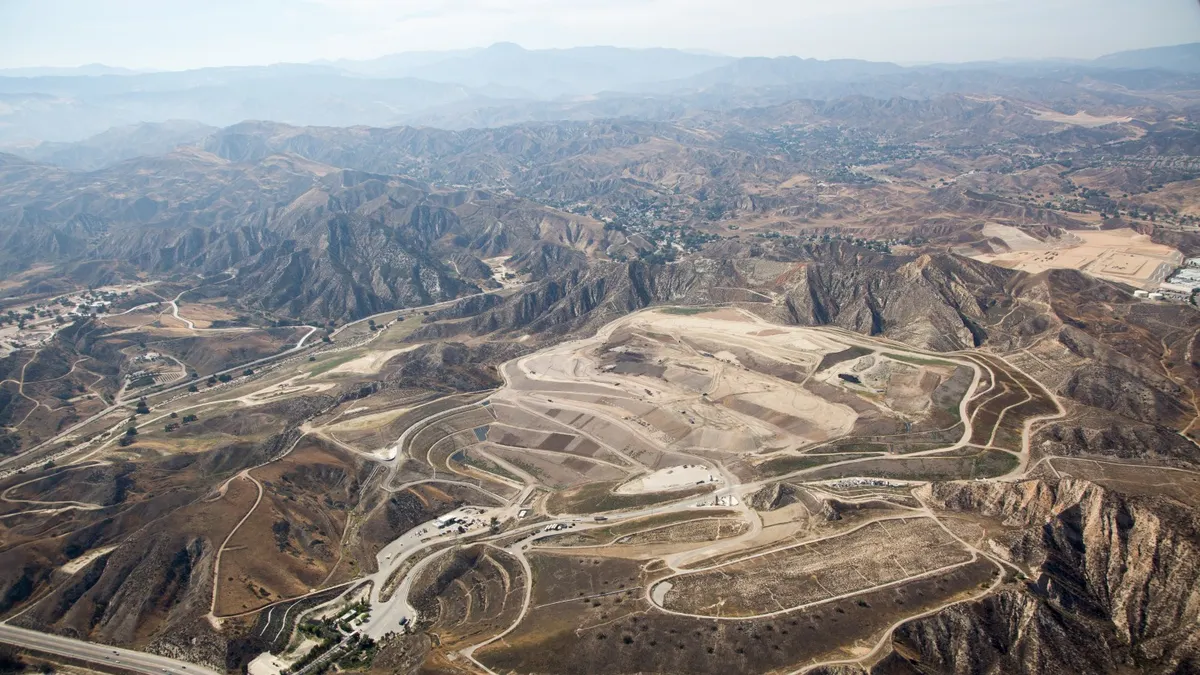
Earlier this week, Attorney General Rob Bonta and the California Department of Toxic Substances Control filed a lawsuit against Waste Connections related to an ongoing subsurface elevated temperature event at the closed Chiquita Canyon Landfill.
The landfill, located in Los Angeles County, closed in 2025 after facing years of regulatory and legal pressure. Nearby residents had filed complaints about odors, which they said caused headaches, nausea and breathing issues. Those complaints became more frequent due in part to an elevated temperature issue that residents said worsened landfill gas emissions and odors.
The lawsuit alleges that Chiquita Canyon’s operators have “repeatedly, consistently, and pervasively failed to lawfully manage hazardous waste.”
In a statement, Bonta said regulators have seen “consistent evidence of leaks, seeps, and spills of hazardous leachate and improper transport, treatment, and storage of hazardous materials.” The suit alleges these issues have negatively affected several neighborhoods and schools nearby, including one neighborhood that is within 1,000 feet of the landfill’s border.
The lawsuit alleges that the elevated temperatures beneath the landfill exceeded 212 degrees Fahrenheit, have released “odors and toxic fumes,” and generated millions of gallons of leachate.
The lawsuit alleges that landfill operators have “mismanaged the collection and removal” of that leachate, which it says contains chemicals such as benzene and methyl ethyl ketone.
According to the lawsuit, about 8,000 gallons of leachate flowed into the landfill’s eastern stormwater sedimentation basin in November 2025, an area that was not permitted to hold or store the leachate. Rainfall later in December caused that segment to overflow, causing stormwater to mix with leachate and be released to Castaic Creek, which flows into the Santa Clara River.
“Protecting the environment and safeguarding Californians requires quick and effective action from the Chiquita Canyon Landfill’s owners and operators. For too long, the Chiquita Canyon Landfill has done the opposite, which has resulted in numerous spills of leachate and other violations of our state’s hazardous waste laws,” Bonta said in a statement.
Waste Connections did not respond to a request for comment.
An unattributed statement posted on the landfill’s website said “many of the allegations in this lawsuit are without merit and much of the political rhetoric ignores the current conditions at the landfill and the hard work of Chiquita and its employees.”
During several earnings calls in the past year, CEO Ron Mittelstaedt has said the company was working closely with local officials, including the state and U.S. EPA, to mitigate issues at the landfill.
During last week’s Q3 call, which took place before the lawsuit was announced, Mittelstaedt said remediation efforts at Chiquita are following “a typical curve of a decelerating ETLF,” noting that work to mitigate leachate and odor issues is on schedule.
He expected the mitigation efforts would cost the company less in upcoming quarters. “As the reaction cools with time, you get less leachate generation. Therefore you have less leachate disposal cost, and you have less infrastructure such as wells to do cover to put down over the reaction area,” he said.
Bonta and the DTSC allege the landfill has violated California’s Hazardous Waste Control Law relating to the management of hazardous waste, and the state’s Business and Professions Code prohibiting businesses that profit from unfair competition.
The lawsuit seeks civil penalties, disgorgement, and injunctive and other equitable relief.” It also calls for the establishment of an abatement fund to help address pollution.
Chiquita Canyon has been the focus of several lawsuits and violations in recent years, including suits filed by Los Angeles County and the landfill operator itself.
GFL’s Seven Mile Landfill expansion blocked
The Eau Claire County Parks and Forest Committee in Wisconsin has decided not to sell a parcel of forest land to GFL Environmental. This effectively blocks GFL from expanding the nearby Seven Mile Landfill by about 120 acres, WQOW reported. The proposed expansion would have extended the landfill’s lifespan by about 15 years.
The landfill expansion proposal had faced opposition from nearby residents over water pollution concerns and concerns over losing access to public lands.
Josh Pedersen, the director of Eau Claire County Parks and Forestry, told local station WEAU that GFL might be able to pursue a different land sale proposal in the future, but the committee’s decision not to sell this particular land parcel is an indication that GFL may need to pursue land agreements along other borders of the landfill.
Other landfill news
- Residents near Republic Services’ Middle Point Landfill in Murfreesboro, Tennessee, called for independent air and water monitoring and public reporting of environmental data related to the landfill, citing concerns involving odors, “seeping mud” and possible pollution. (WGNS)
- Charleston County, South Carolina, is expanding the Bees Ferry Landfill. New cells are expected to open in 2027 and add another 20 years to the landfill’s lifespan. (Charleston City Paper)
- The Vernon County Landfill in Wisconsin is debating its future financial plans and capacity now that local hauler Big Hook has been purchased by GFL. Big Hook had been regularly delivering waste to the county landfill, but county officials anticipate much of that waste will now go to a GFL-run landfill instead. (Vernon Reporter)
- A landfill in Cedar Rapids, Iowa, is under capacity pressures after waste volumes rose over 10% in the latest fiscal year. The Linn County Solid Waste Agency attributes the increase to a boom in data center construction. The agency is in the process of finding other destinations for waste once the landfill reaches capacity in 10 to 13 years. (Iowa Public Radio)
- A judge in Maine agreed with a state finding that expanding the Juniper Ridge Landfill is in the public interest. The landfill is owned by the state through the Bureau of General Services, which has a contract with NEWSME Landfill Operations, a Casella Waste Systems subsidiary. (Maine Morning Star)