Dive Brief:
- Ameresco and Maryland-based investor HA Sustainable Infrastructure Capital announced the formation of Neogenyx Fuels last week. HASI committed to invest $400 million into Neogenyx, which is a spinoff of Ameresco's renewable fuels segment with plans to grow its biogas portfolio.
- HASI has been active in the biogas industry. It previously invested $207 million in Vision RNG to back a pair of landfill gas facilities and made a $30 million investment in anaerobic digestion company Bioenergy Devco, now called BTS Bioenergy.
- Mike Bakas, formerly Ameresco's president of renewable fuels, will lead Neogenyx. “As much as I think it's exciting, it's a new name, it's a new business, we've been doing this for almost 26 years,” Bakas said. “These are people that have a proven track record, they're not newbies to it, and we complete what we start.”
Dive Insight:
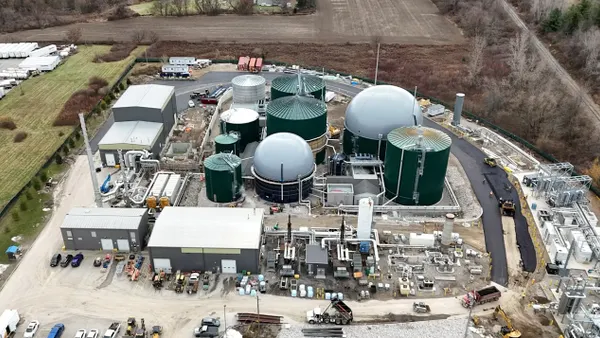
The biogas industry has seen a boom in recent years as evolving engine technology and policy drivers have fueled demand for less carbon-intensive forms of natural gas. That has led owners of landfills and wastewater treatment plants to take a close look at the possibility of converting the biogas their facilities generate into RNG, and has attracted outside investment.
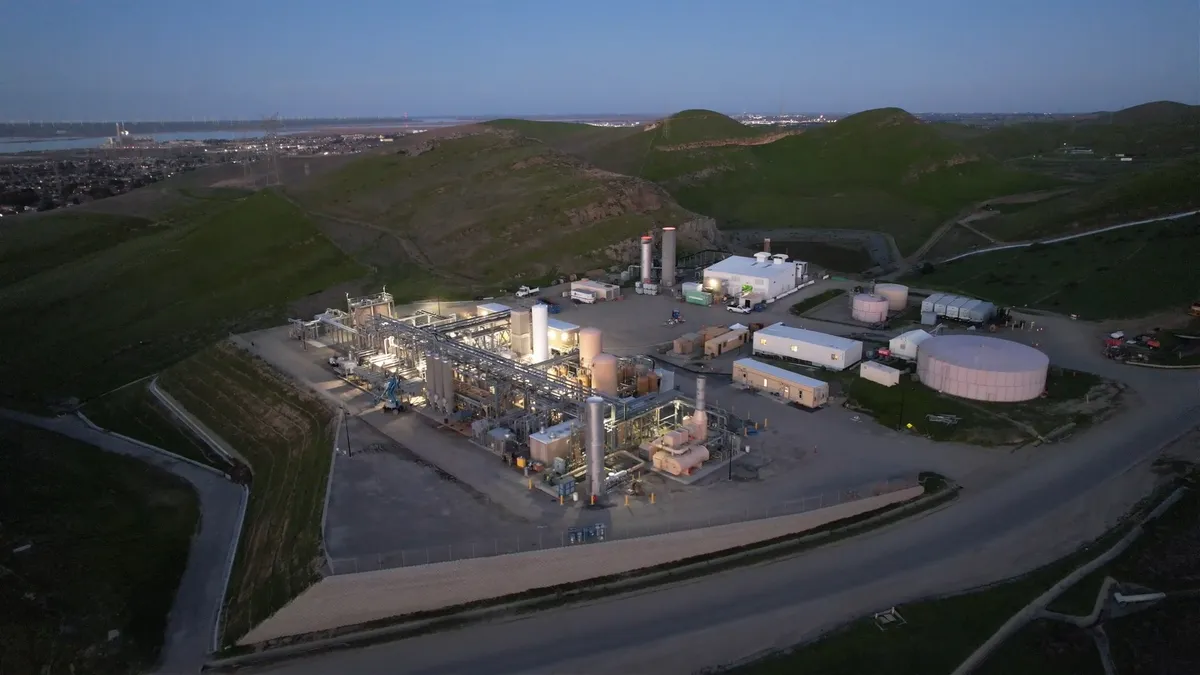
But the technology to capture biogas and convert it to energy is decades old, and Ameresco's work in the sector predates the current boom. Founded in 2000, Ameresco built its first biogas facility at a wastewater treatment plant in 2001. It later grew its portfolio considerably in the landfill space, where most of its biogas facilities operate today.
Ameresco owned and operated 10 RNG facilities and 16 non-RNG biogas facilities in 2025, per its annual report. The RNG facilities produced the equivalent of 87 megawatts of energy annually, while the non-RNG facilities produced the equivalent of 69 megawatts of energy annually. The company will remain heavily involved in the battery and solar business, which has also developed landfill solar installations.
Ameresco holds a 70% stake in Neogenyx, while HASI will take a 30% stake. The partners have a history, executing more than 60 transactions together over the last 25 years. The Neogenyx deal values the new company at $1.8 billion. The company will launch with more than 170 employees spun off from Ameresco, and Bakas said it has immediate plans to grow the workforce.
Of HASI’s announced investment, $300 million is set to be directly invested in Neogenyx to drive growth, while $100 million will go to Ameresco for “strategic opportunities, working capital, and deleveraging throughout the year.”
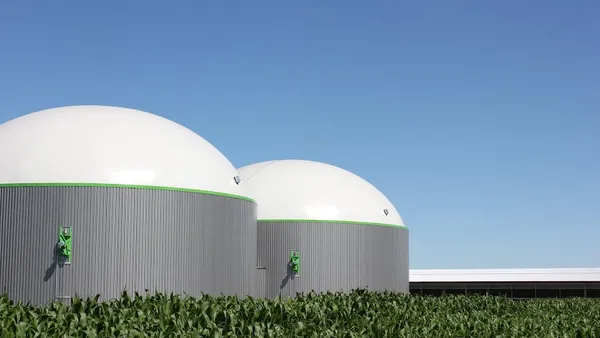
Bakas said Neogenyx would continue to focus on landfill and wastewater treatment plant facilities, while also exploring a small number of agriculture projects. That's the strategy long pursued at Ameresco, which has built biogas facilities for major landfill operators like Republic Services as well as smaller municipal operators.
On Tuesday, Neogenyx announced its first agricultural project at a feedlot in Broken Bow, Nebraska, that’s expected to produce 1.2 million mmBtus of RNG annually. That project will be jointly developed with Anaergia, which announced a $58 million (Canadian) contract with Neogenyx.
Operating independently will allow Neogenyx to accelerate its development pace, which could eventually ramp to four to six projects per year, Bakas said. He also noted the possibility of strategic acquisitions in the future, though he said Neogenyx would remain focused primarily on its own pipeline of projects.
Last year, the number of new biogas projects that came online in the U.S. overall was the lowest since 2019, though still far above historical levels. Opposition to certain sustainability-related investments from the Trump administration has forced the biogas industry to tweak its pitch to the market, and there were some signs the demand for RNG from the transportation market had neared its peak.
Bakas acknowledged the market has slowed slightly as investors look to make their next moves carefully. But he believes growth in the sector is "a marathon, not a sprint," and that Ameresco's track record of building “utility-grade plants that will stand the test of time” insulates it from those near-term headwinds.
"There's a lot of new players in the market the last few years, and there's a lot of changes going on in the industry, and so a number of people have pulled back and are standing back waiting," Bakas said. "But our business plan is not to slow up, and we haven't slowed up."
On the horizon, Bakas sees significant opportunity in the global maritime fuel market, which appears to be moving toward support for alternative fuels that can be produced from biogas. Multiple Neogenyx plants have also been certified to send fuel to the European market, which is also accelerating demand for alternative fuels.
The company also has the flexibility to pivot into other uses for biogas, such as electricity or hydrogen. Neogenyx is currently developing biogas-to-electricity plants on the West Coast, Bakas said. And while about two-thirds of its pipeline is currently RNG projects, Neogenyx has the expertise to pivot and focus on other end uses for biogas as the market demands.
"Our business is going to evolve into a green molecules business, and it's really going to come down to it's not about one particular technology, it's a broad stroke of all those options," Bakas said.