Dive Brief:
- The Polystyrene Recycling Alliance, an industry-led group that aims to grow recycling systems and end markets for many types of PS, is working to develop an inventory of U.S. and Canada-based end markets for the materials.
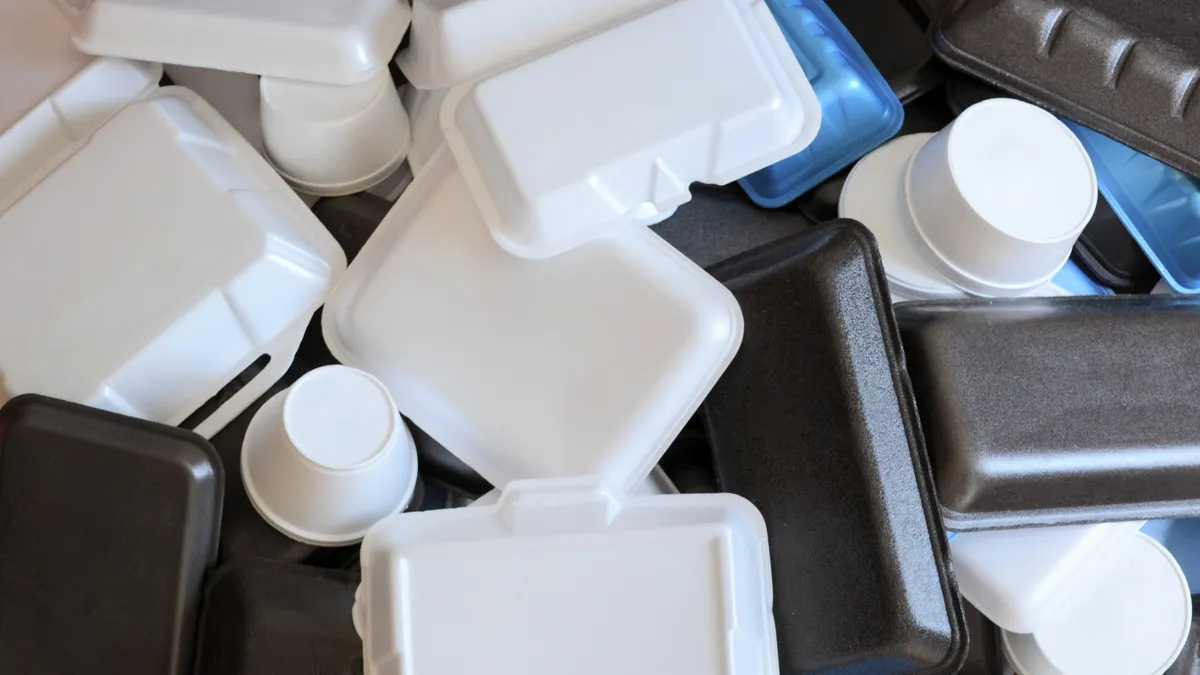
- A recent end market study, conducted by Resource Recycling Systems on behalf of PSRA, identified 81 companies and about 119 total facilities that handle expanded or extruded polystyrene foam. About 52% of them are manufacturing end markets that use recycled EPS or XPS as a feedstock to make transport packaging or consumer products.
- The study also identified 45 companies representing 50 facilities that handled recovered “general purpose” PS, as well as high-impact PS. These denser types of PS are more commonly used in consumer-facing applications, such as packaging for yogurt and other foods. About 13% of these companies use recovered GPPS/HIPS as recycled feedstock for consumer products.
Dive Insight:
Industry groups like PSRA have been working to raise awareness of PS recycling systems and demonstrate their effectiveness. That’s partly due to numerous state policies restricting or banning the use of some types of the material, such as in food service ware. California’s EPR for packaging law also has certain EPS food ware restrictions.
The Plastics Industry Association launched PSRA in 2025 as a group of brands, converters, manufacturers and recyclers. Among their goals is to gain “widely recyclable” status for PS.
Consolidating current and accurate end market information is a critical part of the effort, said PSRA chair Justin Riney in an interview. The group is also working to help major NGOs and recycling groups understand end market pathways for EPS, XPS, GPPS and HIPS in an effort to to “move the needle” on recycling regulations.
Riney, who works for styrenics supplier INEOS Styrolution, says his company is part of the U.S. Plastics Pact. But the pact lists EPS and other kinds of PS on its “problematic and unnecessary” materials list. And food service foam in particular has faced criticism from environmental groups that say it’s not widely recyclable, has low recycling rates, and contributes to pollution, particularly along waterways.
“Now we've got something that we can take in conversation with regulators, NGOs and others, to have a conversation. We can say, ‘Here’s where our access is, here’s where the end markets are. Now, how do we connect those two pieces?” he said.
About 105 million Americans have the ability to recycle one or more types of polystyrene, Riney said. That includes the ability to recycle it at the curb or at a nearby dropoff location.
RRS’ study described a range of collection processes and end markets for the materials depending on their format and use. He noted that reliable supply and demand will be key to growing recycling rates and recycled content use for EPS, XPS, HIPS and GPPS.
The recovery and end market landscape for EPS and XPS is “well developed within the commercial business-to-business supply chain,” the report states. That’s in part because of direct manufacturer take-back programs, along with “large end users” such as big box stores that backhaul the material to their distribution centers to densify it before sending it to end users.
The transport packaging industry is another key sector driving EPS recycling, Riney said. EPS from the transport packaging sector has a 31% recycling rate in North America, according to the EPS Industry Alliance.
Riney said there’s also strong domestic and international demand for EPS and XPS. Some European and Asian companies are importing the material from North America to use in their reclamation and manufacturing sites in other countries, the RRS report adds. Some of these vertically integrated businesses will sell or lease foam densification equipment to end users, then purchase the densified material for use in overseas manufacturing, RRS said.
Markets that do this include the fish industry, which uses the materials for coolers. The medical, automotive, sports equipment and insulation manufacturing sectors as other key end markets.
“Vaccine shipments, any kind of application where it needs to be temperature controlled, or something that's fragile, needs to be delivered safely to the medical facilities, and it’s all being collected there. You can identify it, and reverse logistics back to a distribution center,” Riney said.
Because medical packaging is typically very clean, it’s a good candidate to use as recycled feedstock for new products, he said.
According to RRS, medical plastics are also the dominant forms of GPPS and HIPS reclaimed and used as PCR today. Electronics collected through special e-waste recycling programs also source postconsumer recycled HIPS, it said.
PSRA is working with the Mexican Plastics Pact to boost collection and recycling of collecting and recycling HIPS dairy packaging throughout central Mexico, the groups announced in April. The move is meant to connect major brands like Danone, Lala and Yakult with “specialized recycling networks,” such as Ecolana and Grupo Mexico Recicla, to build an integrated system to recycle dairy containers into resins for new products.
On the foam front, PSRA recently launched a partnership with Foam Cycle and the Nashville Department of Waste Services in Tennessee for a collection program in that city which covers all formats of EPS, including transport packaging and clean food service and food packaging. PSRA helped donate a Foam Cycle densification system to a NWS-operated convenience center in Nashville. After densification, the material is transported to protective packaging company EFP in La Vergne, Tennessee.
Correction: This article has been updated to note that INEOS Styrolution is a styrenics supplier.