The final costs waste companies expect to face from PFAS treatment is still unclear, but executives expressed optimism about their ability to recover revenue during panels at the National Waste & Recycling Association's Waste Leadership Summit earlier this month.
That comes despite ongoing litigation and claims that removing per- and polyfluoroalkyl substances from landfill leachate could cost the industry at least $1 billion. The debate is playing out as the U.S. EPA navigates implementation of its decision to designate two PFAS chemicals as hazardous substances under the Comprehensive Environmental Response, Compensation, and Liability Act, or Superfund law.
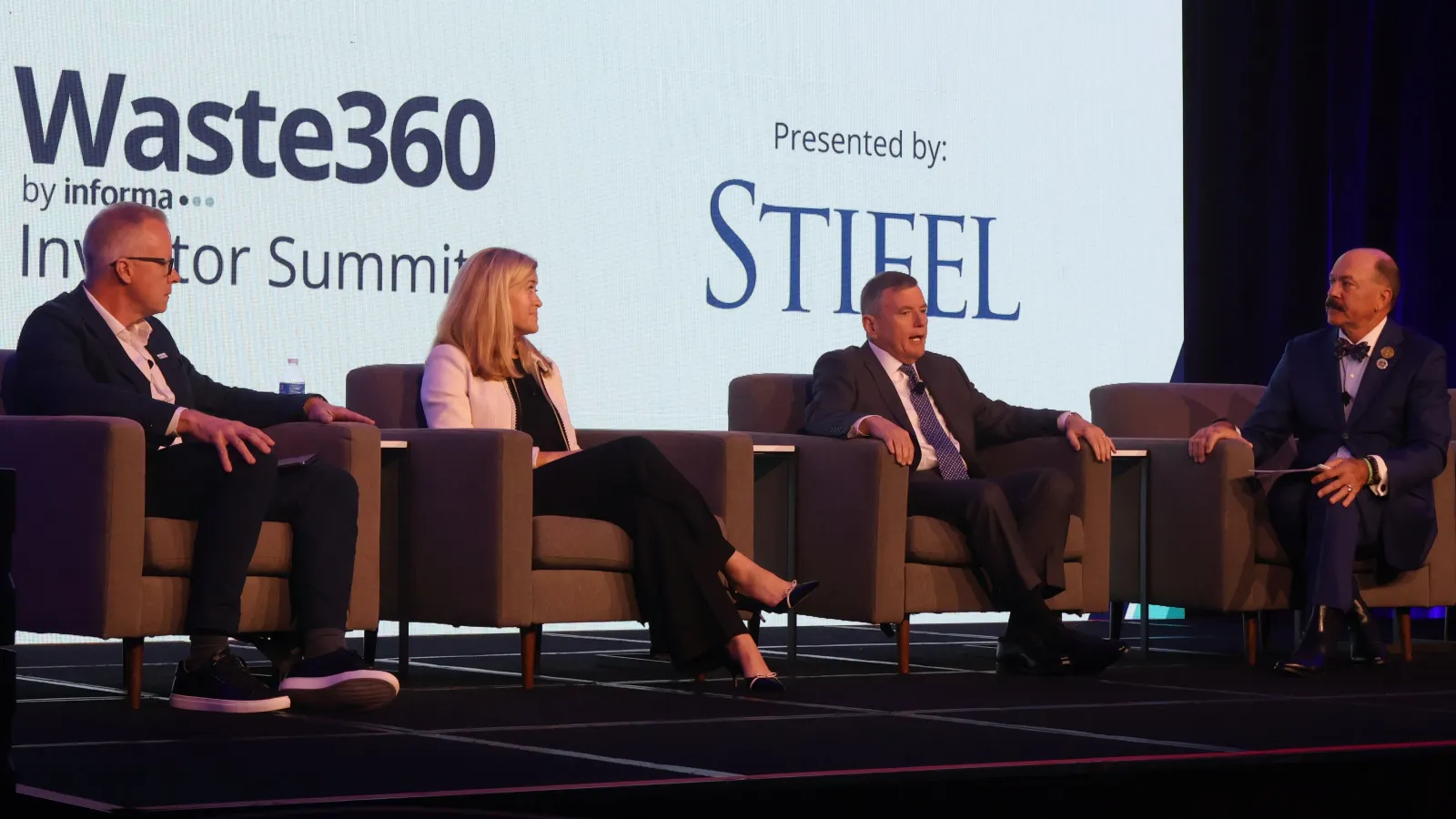
"For all the people who are listening about this relative to solid waste, this is not going to massively change the cost structures for leachate treatment," Michael E. Hoffman, president and executive director of NWRA, said during a panel at the investor summit.
NWRA has come out strongly against EPA’s decision to designate PFOA and PFOS as hazardous substances. It has argued, alongside some of the largest waste companies, that the designation unfairly exposes to liability passive receivers of the chemicals, such as landfills.
The industry group is a petitioner on a lawsuit led by the U.S. Chamber of Commerce seeking to compel EPA to revisit its rule. In court, the petitioners have said that EPA failed to "even-handedly assess costs and benefits" of the proposed designation.
NWRA argued in comments on the CERCLA rule that removing PFOA and PFOS from landfill leachate "could increase costs by 400% to 800%, or $966 million and $8.2 billion per year-for municipal solid waste landfills."
In its own testimony filed in connection with the case, Waste Connections noted that the "vast majority" of the leachate from its 90-plus landfills is sent to publicly owned wastewater treatment works, which are increasingly turning away leachate over PFAS concerns. Republic Services also asserted in a court filing that it would be harmed by the designation, though it did not go into detail on management pathways.
The lawsuit remains ongoing, with EPA continuing to defend its decision.
Large waste companies — including WM, Waste Connections and Casella Waste Systems — without remediation businesses may also be forced to recover costs in other ways. That could include surcharges on landfill users that work similarly to the fuel surcharges waste companies have used to weather recent diesel price increases, Shlomo Rosenbaum, a managing director at Stifel, said in an interview.
“In a vacuum, this is going to be something that would weigh on their cost structure. I assume that they're going to go ahead and look for some way to push that into their pricing,” he said.
Yet two of the largest waste companies, Republic Services and Clean Harbors, are expecting to leverage their hazardous waste and industrial wastewater treatment and disposal services to drive major revenue from remediation work triggered by the CERCLA designation.
Clean Harbors is not a party to the Superfund lawsuit, though it is a member of NWRA. The company expects costs associated with PFAS at its own facilities to be minimal, as it already manages leachate at its hazardous waste landfills in a closed-loop system.
Speaking about regulatory impacts, Co-CEO Mike Battles said at the investor summit that Clean Harbors is able to withstand potential costs and come out ahead.
"I would say that CERCLA has raised the bar. It has put the generators in a tough spot," Battles said. But "in my mind, CERCLA is a plus to the business model."
Estimating cost of leachate treatment
Large waste companies have become increasingly diversified, and some own assets like deep well injection facilities or incinerators that can provide a permanent solution for PFAS extracted from leachate. But smaller landfills, as well as companies without such sophisticated facilities, face steeper costs.
The expected total cost to remove PFAS from landfill leachate nationwide depends on a wide range of factors, including facilities' choice in remediation technology, disposal costs for post-treatment material, the size of each landfill and even rainfall totals, which impact leachate generation, experts told Waste Dive.
Foam fractionation remains the most common method of removing PFAS from landfill leachate, according to Ivan Cooper, a senior consultant and former wastewater practice leader with Civil & Environmental Consultants. The process uses rising air bubbles which capture PFAS chemicals in leachate and then gather at the surface as foam. That foam is then separated from the remaining leachate, removing almost all of the PFAS chemicals.
The foamate produced by the process concentrates the solution by a factor of 40,000, significantly reducing the amount of PFAS-contaminated material that needs to be managed, according to Ali Ling, an assistant professor of civil engineering at the University of St. Thomas.
The next most common treatment technology is reverse osmosis, though this process is significantly more expensive. In contrast to foam fractionation, which only addresses PFAS, reverse osmosis removes a wide range of chemicals of concern. That process only concentrates the contaminated leachate by a factor of four, according to Ling.
The concentration factor of treatment processes becomes a particular concern if landfill owners want to dispose of the resulting product. Disposal costs for the leftover contaminated material can range from 10 cents to $2 per gallon for reverse osmosis, versus a fraction of a cent per gallon for foam fractionation, Ling said.
But those numbers can add up: If landfill operators opt to destroy the foamate produced by fractionation rather than recirculate it back into the landfill, costs can double, according to Ling.
Rosenbaum said the largest waste companies have projected costs of around 5 to 10 cents per gallon if they decide to treat leachate on-site, versus 10 to 20 cents per gallon if they send leachate off-site to a third party for treatment. With 15 to 20 billion gallons of leachate generated annually across the industry, that could add up to significant costs, he said.
Yet that assumes EPA will require all leachate to be treated to a strict standard, something the agency has yet to commit to requiring. That leaves a final industry-wide cost uncertain, Rosenbaum said.
Quantifying remediation opportunity
Executives are also expecting PFAS remediation to be a fast-growing business in the coming years for those who stand to benefit.
Republic Services projects reaching $100 million in PFAS-related revenue this year across its service offerings for impacted materials, with an annual growth rate of 15% to 20%. Clean Harbors has previously projected it will reach $175 million in revenue from PFAS-related work this year, with an annual growth rate between 20% and 30% in the next few years.
That rapid growth is driven by several factors, including the EPA and Department of Defense's recent alignment on destruction and disposal guidance. This year, the latter agency lifted its moratorium on incineration for impacted material, opening up a new disposal pathway for soils and groundwater that must be managed from DOD property.
Rick Gillespie, CEO of Revive Environmental, estimated that the one-time market for destroying firefighting foams that contain PFAS and rinsate from impacted sites could near $1 billion over the next five to eight years.
But his company, which uses supercritical water oxidation to destroy PFAS-impacted materials, is also planning to target repeat customers in the coming years as industrial facilities continue to manage their effluent and leachate.
“The really interesting part about PFAS destruction and PFAS streams for me is the recurring, durable market and how widespread it is with semiconductor, industrial wastewater. Right now we're built on [firefighting foam], but we're building for that long-term durable market,” Gillespie said at the summit.
The total size of the PFAS treatment market is still unclear, though experts have projected it to be larger than $100 billion. The EPA has previously said it would explore industry concerns about being held liable as passive receivers, and has indicated it was not planning to target publicly owned landfills and wastewater treatment plants for enforcement.
Some members of Congress have indicated they’re open to exploring ways to protect certain passive receiver facilities from liability, but so far has yet to act on any legislation that would do so.