Dive Brief:
- The Harris County Attorney’s Office in Texas filed a federal lawsuit on Tuesday against a subsidiary of WM in an effort to shut down the nearby Hawthorn Park Landfill in the Houston area.
- The county alleges that the landfill, operated by USA Waste of Texas, poses “imminent and substantial endangerment to Harris County” due to what it says are ongoing excessive methane emissions. The county has also raised concerns about possible soil and water contaminants.
- The county says the landfill’s operations violate the Resource Conservation and Recovery Act. It calls for USA Waste to close the landfill, install a permanent cap, and perform ongoing groundwater remediation and methane abatement. In an emailed statement, WM said it does not comment on pending litigation.
Dive Insight:
The county announced over the summer that it intended to sue USA Waste over emissions and groundwater pollution from the landfill. The official lawsuit, filed in U.S. District court for the Southern District of Texas, shares more details about the county’s efforts to engage with the landfill operator.
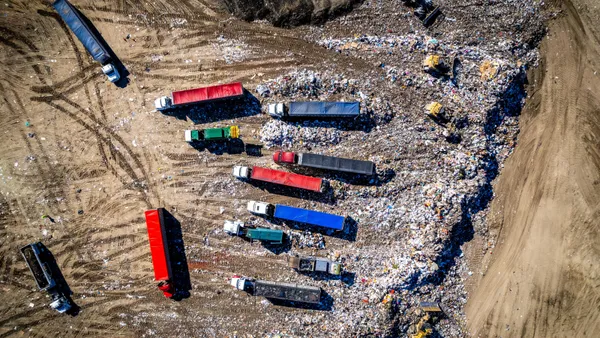
The landfill has a permitted footprint of nearly 130 acres on a 171-acre site and can accept construction and industrial waste, but not municipal solid waste.
The county alleges the landfill is "functionally inactive” with less than 2% of its permitted capacity remaining. WM said in an emailed statement that the landfill is still accepting materials.
The landfill was a source of tension in the community for years before the lawsuit was filed. Residents have pushed back on USA Waste’s proposals to expand the landfill, most recently in 2023, and WM withdrew its expansion request in 2024.
Harris County was among the groups that protested the expansion effort and asked a judge for the ability to conduct environmental contaminant testing at the site. The judge granted the request, but the county said the landfill operator would not allow the county to conduct the inspection.
“In order to avoid allowing Harris County and others the right to inspect the Hawthorn Site and to test above and underneath the ground, USA Waste voluntarily agreed to pay its opponents in the Permit Action hundreds of thousands of dollars,” the complaint states.
Environmental justice advocates have also pointed to the landfill as an example of discrimination due to its proximity to the historically Black Carverdale neighborhood.
The lawsuit centers mainly on methane and groundwater pollution concerns, which Harris County says harm the wider community and impede the County’s roadwork and stormwater improvements on the road adjacent to the landfill. The county plans to add an underground storm sewer along the southern edge of the landfill.
The county alleges that the landfill has produced methane readings above the regulatory limit along the property boundary “for three decades, from 1995 through 2025, including in 2023, 2024, and 2025.” If untreated, the county says it could reach “explosive concentrations” inside underground storm sewers, creating dangerous conditions for workers.
Landfill operators in 2024 “treated those exceedances as Hawthorn landfill-gas conditions and attempted to respond through the Landfill’s gas remediation and monitoring program,” and installed a gas interceptor trench meant to limit gas migration, according to the complaint. “USA Waste’s efforts have been unsuccessful,” it said.
The county also alleges elevated concentrations of “longstanding and newly identified hazardous constituents in groundwater,” including arsenic and barium that exceed maximum contaminant levels.
WM has said it regularly samples and analyzes water from groundwater monitoring wells that surround the landfill.
The landfill predates modern federal landfill regulations, and was originally a sand mine, according to court documents. Permitted waste disposal activities began at the site in 1977, one year after passage of RCRA.
The landfill’s current permit dates back to 1994. USA Waste acquired the landfill from Sanifill in 1996, and merged with WM two years later.
The lawsuit alleges that because a portion of the landfill once experienced pre-RCRA dumping before the site was permitted, “USA Waste cannot fully account for the nature and composition of the waste buried in portions of the Hawthorn Landfill.” The county says it’s unclear whether all areas of the landfill have liners, which is required by RCRA.