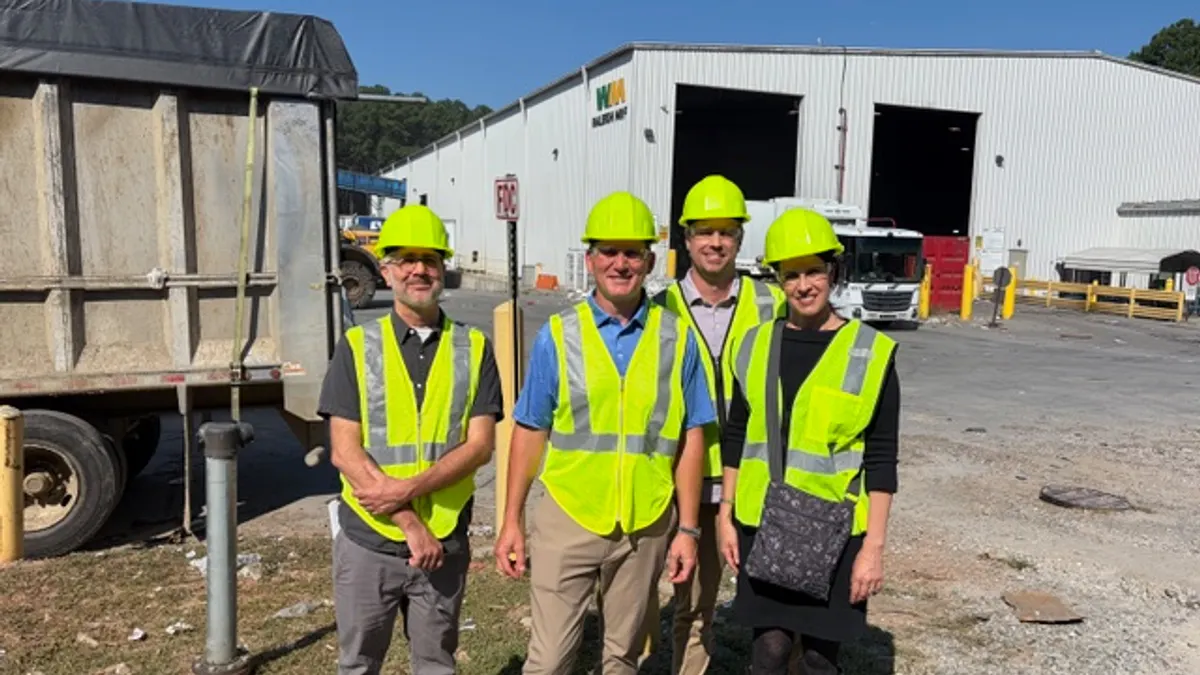
For the last four months, The Recycling Partnership’s new CEO Greg Saxon has been on the road. His travels have taken him to numerous MRFs, meetings with brands and the halls of Congress.
Saxon took the helm in July after TRP’s founder, Keefe Harrison, announced in April she would step down. He says the cross-country travels are helping him understand the balance TRP wants to strike as an organization: improving recycling systems for residents while also making recycled commodity supply chains more resilient.
Saxon, a U.S. Navy veteran, has previously worked in the packaging, supply chain and electronics recycling sectors. He most recently served as COO of PedalPoint Recycling and PedalPoint LifeCycle Solutions, which provide IT asset disposition and electronics recycling services.
Saxon talked with Waste Dive about TRP’s plan to continue community-based grant programs while also engaging at state and federal policy levels. That will include initiatives to increase consumer confidence in recycling systems, update recycling messaging to respond to more complex waste streams, and engage with new and returning members of Congress.
This interview has been edited for length and clarity.
WASTE DIVE: What lessons or experiences are you bringing from other industries you previously worked in, and what similarities and differences are you seeing that inform how you work at TRP?
GREG SAXON: It’s actually a lot the same, but altogether different. In the ITAD e-waste space, there’s a shared recognition that as much as we’d like to, we really don’t know what’s coming in the door, right? That’s kind of a similar problem with curbside recycling. The value of a piece of electronics is going to have a much, much higher yield than, let's say, a plastic bottle or an aluminum can or a piece of cardboard.
There’s a recognition in the e-waste and ITAD space that the material that’s coming in is indeed an invaluable resource. Where gold and silver have been now for the past two years or so, everybody recognizes we want to get our hands out as much as we can. That’s what the TRP team’s been trying to do now for quite a while in terms of looking at the demand markets and creating the proper domestic demand for things like plastic and other recyclables that are coming through the system. We want to view them as this indispensable resource as opposed to something that has to be dealt with.
When I was the head of packaging for North America for Johnson & Johnson’s consumer business, I was there during the rise of ESG and sustainability, where the idea was to find unique and bespoke ways to make packaging either more recyclable or less impactful on the environment. We still want all the ESG and sustainability, but we also need to now tie it directly back to the economics of being able to do it well within the system.
Where do you see The Recycling Partnership in the broader ecosystem of organizations that aim to support recycling end markets and the economic aspects of driving recycled commodity demand?
Our place will always be in the data, since we represent the system so well, and also have the data to show what's actually coming in, what should be coming out, and what can be the economic impact of that.
We are the convener. We're bringing all the parties together so we can have a very broad conversation about the system, and then once we have that conversation we come up with a process and find a solution. Then we start executing on that solution.
That could be a small pilot or some large-scale market definition approach. And really, it doesn't stop even when you finally find the solution, because then we have to start to reeducate people about the system. Our conversations at the federal level are engaged with the idea that we want folks to be educated in the system. We recognize what the data is showing us. As the shepherds of the recycling data in the system, we can really help with those conversations. That’s where we have the best impact.
What’s been happening at the federal level for TRP, and how do you think the recent election is going to impact some of these broader federal recycling policies TRP is working on, such as the CIRCLE Act?
A lot has changed in the past week, so I think time will tell. I don’t want to speculate on what's going to happen in a new Congress, especially during a lame duck session.
Our hope is that we can continue to have the conversation, because we're in the business of educating and having impact. Our hope is that we continue to get invited to the table. We have some great folks interested in what we're doing, both on the Recycling Caucus and elsewhere. We're going to continue to engage them with data-driven insights and on-the-ground observations to guide legislation going forward.
As far as the CIRCLE Act, it’s a great piece of bipartisan legislation that we're really proud of. We need direct investment into the recycling system, and to do that, and to motivate that change, one of the ways is to motivate through tax credits. It has bipartisan support, but it has been stalled out now for a little while. Our hope is when the new Congress comes back, we'll be right back in the saddle with them and talking about it and figuring out how we move that forward.
What is The Recycling Partnership monitoring at the state level in terms of policy, and how are you managing your focus on that — especially since extended producer responsibility has become such a huge driver and influence on both states and brands?
We want legislation that's going to actually drive impact. And impact in the recycling system means getting more material into the system and then sold back through the system. So what we monitor at the state level is how to create those end markets in the most efficient and economical way.
What that means is that we keep doing exactly what we have been doing for the past 12 years, which is having an impact in the system down on the ground with communities.
In Northwest Arkansas, we've been doing remarkable work with a community that really had underperforming recycling. There's no EPR there. There's no legislation. It's because a community wants to do better, and we want to be there to help them.
The crux of it is there's 43 states that don't have packaging EPR, but they still have recycling challenges. That's where we can step in, and we do step in every single day to really help those communities improve their recycling rate, improve their yield on the back end of those recycling rates as well.
In Arkansas, with support from the Walmart Foundation, the project has been improving recycling rates and improving them with a very metered roadmap over the next few years that gets them from what I can only describe as a very low recycling rate, up to about 30%.
As we drive those numbers forward, we're showing that progress: things like bins, behavior change, educational programs in communities, working with the MRF to make sure they can handle the materials, getting them the grants they need so they can make equipment upgrades. That's the kind of work that we really get excited about.
Some of these examples you just gave are things that TRP might be best known for, like carts and grants. How is TRP balancing those programs and projects alongside a shifting focus toward more policy-centered initiatives?
I would certainly not say that we've been shifting our focus under my leadership. Our focus will always be on the impact we're having on communities. Policy is merely a lever in order to drive higher recycling rates. It shouldn't ever be our primary focus as an organization. If we represent the recycling system well, that means we're going to take any and all tools we can, whether it's bins on the curb, ‘oops’ tags, education, behavior management or behavior change, MRF grants, or legislation. Or all those things combined.
We may have gotten a little bit loud about policy because, quite frankly, EPR was so loud during a time. But it didn't stop the work. Our work is actually getting much, much heavier in terms of the plans that we have with our partners.
At any given moment, we have about 80 projects that are underway in communities around the country, from putting bins on the curb to doing educational outreach programs. Behavior change is a really big focus. We have a behavior change team that is just remarkable. They have really gotten to the heart of why people recycle, what drives them to put the right thing into the right bin, and that's awfully exciting for me.
When I was growing up as a kid, it was “reduce, reuse, recycle.” We all just wanted to recycle stuff, but the complexity of the recycling stream and the products that we're putting into the stream have grown exponentially. Because of that, that means the consumer is going to be even more confused.
The message you’re going to hear from us a lot more in the coming year is that we don't just want to educate people on what can be recycled and where it should go. We actually want to increase their confidence that when they throw it in the bin, it's actually being recycled. The worst-case scenario is that folks do all this work to recycle and they feel like it's still just getting thrown in the trash.