Demand for textile recycling services is growing, and AI-driven technologies are emerging as options to more quickly identify a garment’s makeup and its condition for potential reselling, reuse or recycling in certain end markets.
It can be tricky for textile-to-textile recyclers to sort the material because one garment can be made from so many different blends of natural and synthetic fibers. That poses issues for mechanical and chemical recyclers trying to sort for specific feedstocks, said Sarika Bajaj, CEO and co-founder of Refiberd, an AI-enabled platform for textile recycling and quality control applications.
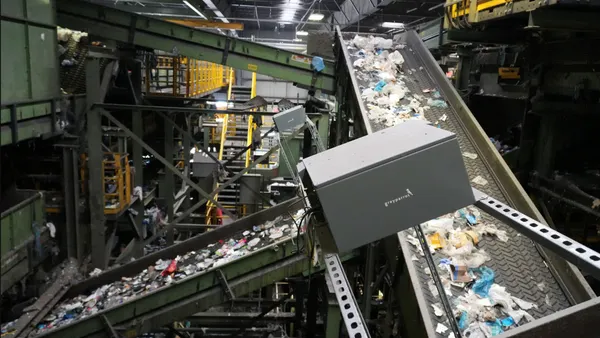
Refiberd uses spectroscopy and AI to sort materials for textile-to-textile recycling and reuse applications. The tech is designed to identify more minute qualities of a garment that aren’t obvious from a label.
“A polyester recycler might care a lot about elastin detection, but a cotton recycler might care more about identifying polyester,” she said in an interview with Waste Dive. “The idea is tailoring AI to focus on the key portions that matter to their key feedstock.”
Refiberd is currently testing a new element of its technology, which aims to identify whether a specific garment has rips, tears or pilling that would make it ineligible to be resold. Thrift stores and clothing resellers are the target for this newer offering, she said.
In both recycling and reuse applications, Refiberd aims to speed up a process that was once done solely by hand. Some textile sorting previously required workers to identify textile composition by reading clothing labels, which Bajaj says is not always accurate — on top of being a time-intensive process.
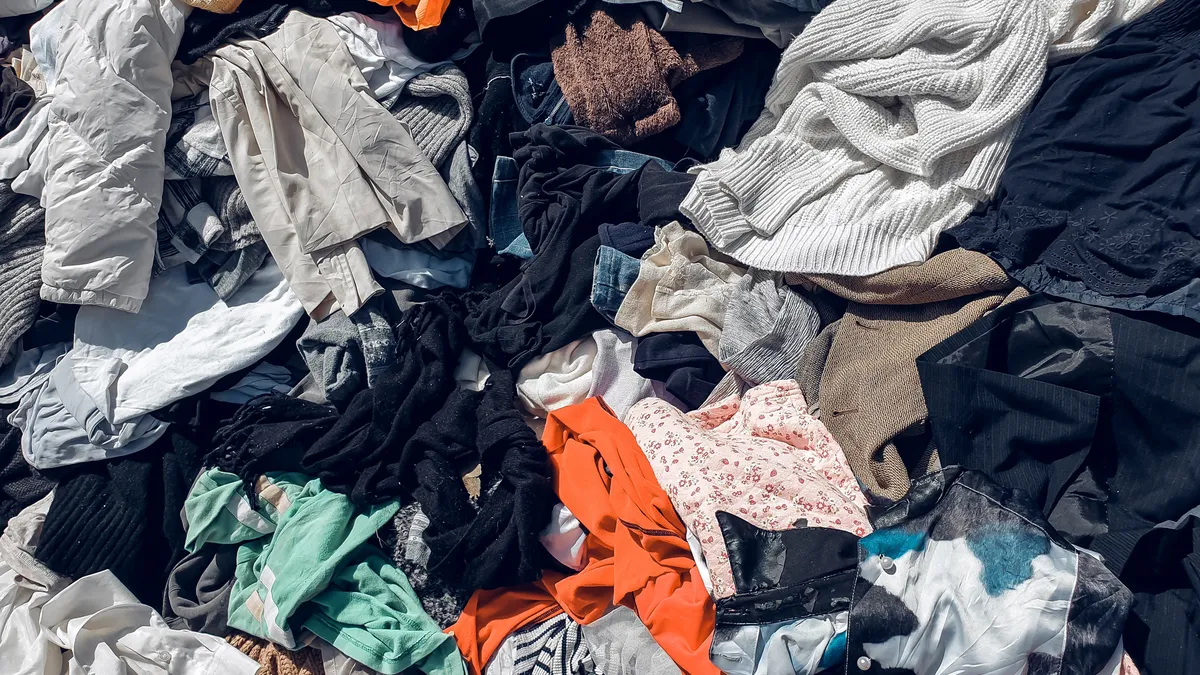
Refiberd aims to gain a foothold in a fast-innovating recycling space where demand for more efficient and accurate textile recycling processes are increasing. Textile waste is the fastest-growing waste stream in the U.S., and only about 15% of these materials are recycled or reused each year, according to 2018 U.S. EPA data.
Innovating in the fast-moving textile sorting space
Bajaj and others in the textile-to-textile recycling space discussed how to streamline and improve textile recycling infrastructure during the March 11 Remade conference in Washington D.C.
Collecting the right kinds of feedstock remains a major challenge, said Matthew Allen, head of North American business development for Reju, a textile-to-textile “regeneration” company that makes 100% recycled polyester. The French company announced in January that it is opening its first U.S.-based facility in Rochester, New York.
“We've got to figure out how to divert this material and start utilizing it as a raw material for new products,” he said during a panel discussion.
In past years, Reju had partnered with WM and Goodwill on regional textile collection, sortation, reuse and recycling systems. The three groups continue to work closely together to sort textiles through WM’s facilities in North Carolina and Arizona. They funnel higher-quality garments back into Goodwill’s retail stores while sending lower-quality items to recycling end markets that include Reju and others.
Jennifer Lake, CEO of Goodwill of the Finger Lakes, said technology to sort and identify textiles has changed so rapidly in the last few years that the industry is constantly adjusting in response to material stream innovations.
She noted how emerging technology like Refiberd’s can open doors to more quickly identify which garments are either ideal or ineligible for resale.
“Things are moving really fast, and it’s important we understand what utilization we want. Up until very recently, there wasn't a solution that I would have considered for reuse, repair and recycling until Refiberd hit the market,” Lake said.
Stepping up to demand from policy, municipal drivers
Adopting new layers of identification and sortation technologies will be necessary as the space develops further, added Raymond Randall, senior manager of textile recycling for WM, during the panel.
WM has textile recycling operations in South Carolina and Arizona that sort textiles for both resale and recycling applications. Randall says its South Carolina facility is the first in the U.S. to use robotics and near-infrared sensorsfor this process. “It really allows us to test the technology and understand what works and understand the end markets,” he said.
WM has also backed textile sorting companies like Debrand, which uses both automated and AI-enabled sorting equipment, along with hand-sorting techniques, to send end-of-life apparel and footwear to recycling and reuse applications.
WM is beginning to see municipalities issue RFPs that include requirements for textile recycling options, he said, which further underscores the importance of adopting new technologies to automate and improve textile sorting tasks.
“There’s a growing awareness that this is a problematic material strength, and there are emerging technologies and vehicles to manage that differently. I see that as progress,” Randall said.
State policy is another element driving more textile recycling conversations, Bajaj added in the interview with Waste Dive. California, the first state to pass a textile extended producer responsibility law, just reached a milestone of naming Landbell USA as its producer responsibility organization. That program is expected to be fully implemented by 2030.
EPR could prompt more brands to take an active role in finding different end markets for their products, she said. If textile EPR can effectively funnel funding into recycling infrastructure, she sees the possibility of being able to install Refiberd’s tech in more recycling facilities, especially those looking to invest in quality control services that aid in ensuring feedstocks meet offtake agreement parameters.
Other states, including New York and Minnesota, are also pursuing textile EPR this year, with bills proposing programs that support a mix of reuse, repair and recycling programs for the materials. Meanwhile, Washington’s 60-day legislative session ended without lawmakers being able to advance textile EPR bill HB 1420, which also called for repair and reuse.
It will take several years to get EPR programs off the ground. Bajaj is cautiously optimistic about the reach such policies will have into the tech sector, but “we think any EPR could help the economics of textile recycling, especially for recyclers,” she said.