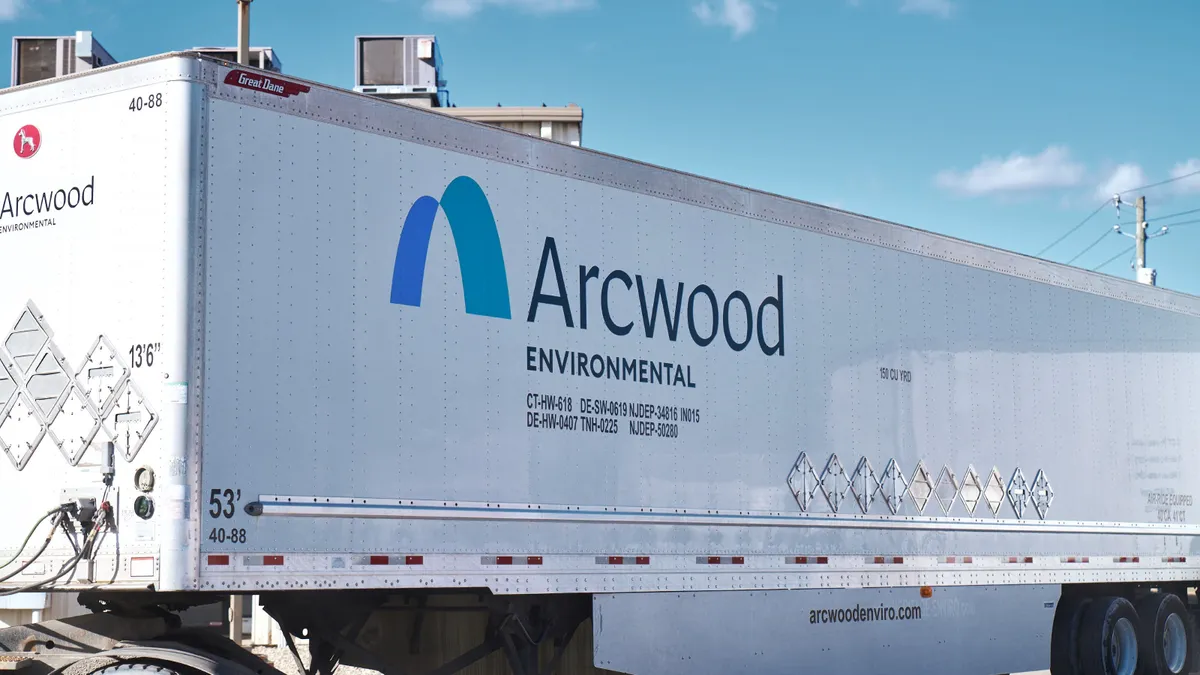
One year since its rebrand, Arcwood Environmental has invested millions in growing its portfolio, expanding capabilities in its existing facilities and setting the company up to be a national player in special waste and environmental services, CEO HP Nanda told Waste Dive.
“A lot of investment has truly gone in in the last 12 months,” Nanda said. “We have been super busy hiring people, building our culture and doing acquisitions and integrating them and bring them as part of the Arcwood team.”
The company has been on a significant growth trajectory since EQT Infrastructure acquired a majority stake in Arcwood, which was then known as Heritage Environmental Services, in 2024. Nanda was brought in shortly after as CEO, and since then he said the new leadership has helped redefine the vision of the company.
In 2025, the company invested roughly $80 million in capital improvements, four times its historical average, according to Nanda. And it also added 400 to 500 employees through both organic growth and acquisitions, reaching a headcount of roughly 2,000 employees across 38 facilities.
In January, Arcwood announced its acquisition of Virginia-based MXI Environmental Services, its third deal in six months. Nanda said the companies have been integrated alongside upgrades to the company's backend systems. This has allowed Arcwood to further onboard capabilities like household hazardous waste services to its broader business.
While the company is growing through acquisitions, Nanda also sees the opportunity to address new waste streams from rising industrial activities in the U.S. related to manufacturing onshoring and artificial intelligence as well.
In the near term, the rise of semaglutide injectables in particular has created a new liquid hazardous waste stream from manufacturers that Arcwood has positioned itself to manage and incinerate.
“I think that market is really going to expand tremendously, and they will be producing a lot of hazardous waste,” Nanda said.
The company also sees an emerging opportunity to address PFAS-contaminated materials. When the U.S. Department of Defense lifted its moratorium on incineration of such materials, it opened up the possibility that Arcwood could destroy them at its existing facilities.
Arcwood is now working on a full suite of solutions for customers that need to dispose of PFAS-containing materials, Nanda said. That includes the company's landfill in Roachdale, Indiana, where Arcwood is exploring closed-loop leachate treatment systems.
“There is a lot of inventory sitting in all the warehouses all over the country,” Nanda said. “I'm super glad that the government is now able to have confidence in the technology that exists.”
Upgrades have also been completed at several other Arcwood facilities. The company spent roughly $40 million at its Orange, Texas, incineration facility alone, where it went from about 12 employees to more than 100. That facility can now handle gas cylinders and a broader range of liquid waste streams. The company also created a new aerosols processing facility at its Benton, Arkansas, plant which doubles Arcwood's capacity for such materials.
Nanda said the company is “very well positioned” in the Northeast, Midwest and Gulf regions. That leaves the West Coast as the next logical geographic area of expansion, where he said Arcwood is not as well integrated.
Adding capacity has been a key part of the company’s growth, Nanda said. He said as the United States adds new manufacturing capabilities, Arcwood is working to provide its services to a growing list of customers.
“Without having capacity, we will not be able to grow,” Nanda said. “We have expanded a lot.”