Dive Brief:
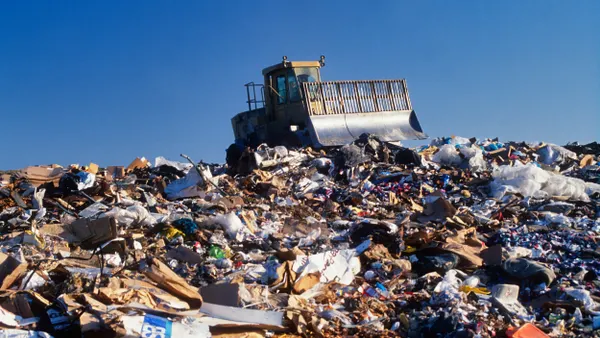
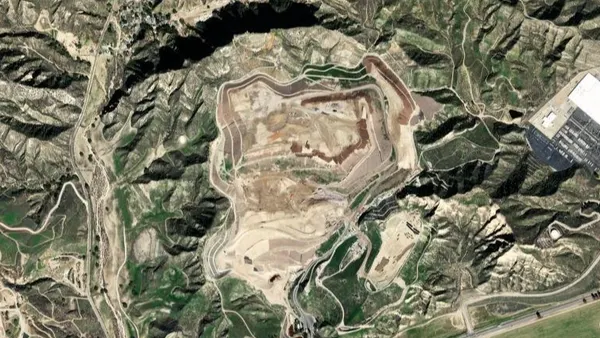
- Casella Waste Systems is mulling its next steps now that it plans to close its North Country Environmental Services Landfill in Bethlehem, New Hampshire, a year earlier than previously anticipated.
- Casella moved up the closure date to Dec. 31, 2026, citing air space and other factors in a securities filing. In a separate Oct. 1 letter to residents, NCES General Manager Marc Morgan cited zoning challenges as another factor.
- The landfill serves about 200 New Hampshire communities, along with a range of contractors and other haulers, the company said. Casella did not specify where material would go after the closure, but Jeff Weld, Casella’s vice president of communications, said there are “near-term solutions available through our transfer and disposal network, as well as third-party disposal sites.”
Dive Insight:
The announcement comes as Casella and other landfill operators in the Northeast grapple with disposal space, especially in the face of community efforts to block landfill expansions and greenfield projects.
New Hampshire has been at the center of an ongoing debate about how to manage waste that comes from both within and outside of the state. In 2023 and 2024, about 39% of total waste in New Hampshire facilities was generated outside the state, according to a report from the state’s Department of Environmental Services.
Weld said capacity will be a challenge in coming months. “When NCES closes, that waste does not disappear, it will compete for increasingly limited disposal capacity elsewhere. Those capacity constraints continue to create ripple effects across the Northeast, including longer transportation distances and increased costs.”
Casella subsidiary North Country Environmental Services has operated the Bethlehem landfill since purchasing and remediating the facility in 1994. But the site has been the subject of recent scrutiny. In January, NCES agreed to pay $1.9 million in civil penalties to settle a range of waste management regulation violation claims.
The complaint claims that the landfill stored waste outside its permitted vertical limits, violated its permit by storing "significantly" more leachate than allowed, and “caused a release of leachate by failing to have a leak-tight leachate collection system.” The complaint also alleged that operators drilled gas wells through the landfill’s overlay liner and failed to place alternative daily cover.
The landfill also faced a court battle over whether it should have been granted an expansion permit in 2020. In 2024, the New Hampshire Supreme Court ruled in favor of Casella.
Casella had previously said it planned to stop accepting MSW at the Bethlehem site by the end of 2027, but Morgan wrote in his letter to Bethlehem residents that the new 2026 end date is unavoidable. “Although the current site has space to expand and operate for many years, without changes to local zoning, December 31, 2026 will be the final day NCES accepts municipal solid waste for disposal,” he wrote.
Morgan noted that the closure would also “bring real changes for residents.” NCES offers about $1.3 million a year in services such as “curbside waste and recycling collection, property tax payments, transfer station operations, annual host community fees, community donations, and Household Hazardous Waste Day.”
Kirstie Pecci, executive director of Just Zero, says the fate of Bethlehem is likely to shape future landfill projects in New Hampshire. That includes the fate of the proposed Granite State Landfill, a greenfield project Casella wants to open in Dalton, New Hampshire.
Casella had originally proposed the Dalton landfill project partly to ease capacity concerns at Bethlehem. Yet that landfill project has faced strong opposition from residents and activist groups, leading Casella to withdraw a key wetlands permit application, The New Hampshire Bulletin reported in June.
New Hampshire’s governor, Kelly Ayotte, has been a vocal critic of Casella’s proposal to build a landfill in Dalton. She visited the city in July to sign a new state law meant to tighten state landfill regulations.
That new law creates a solid waste evaluation committee, made up of state officials and appointees from the governor, that will be tasked with reviewing any proposals for new and expanded landfills. It also enacts a moratorium on expanding landfill capacity until at least July 1, 2027.
Pecci said imminent closure of the Bethlehem landfill and Casella’s latest Dalton hurdles, paired with the new state law, is a sign the state is ready to change how it handles its waste.
“Nobody wants another landfill in New Hampshire. No one wants to expand on an existing landfill in New Hampshire. Let's find some real solutions to reduce the amount of landfill cells open in New Hampshire,” she said.
Pecci says the state has the opportunity to enact some longer-term diversion strategies, such as a more robust composting strategy and a bottle bill, among other diversion plans. Without work around these landfill diversion tactics, “in five to 10 years, you’re going to have the same fight” over expanding area landfills, she said.
Though New Hampshire is a contentious region for Casella’s landfill operations, the company has found recent success expanding landfills in other states. The company announced last week that it had received an expansion permit for its Hakes C&D Landfill in Campbell, New York. Casella plans to add about 43.3 acres of disposal area with about 5.8 million cubic yards of additional disposal capacity.
Casella is also hoping to receive a permit to expand another New York site, its Hyland Landfill, sometime in early 2027, executives noted during a May earnings call. Casella had been pursuing the two New York expansions to counteract landfill capacity constraints caused in part by the planned closure of the Ontario County Landfill in New York, expected by the end of 2028. Casella operates that landfill under a contract.