What makes a successful recycling system, and how do you measure it? The U.S. EPA hasn’t had an answer for at least six years.
For decades, the conversation about how to improve U.S. recycling rates has been hindered by the lack of comprehensive national data. Recycling advocates say it’s difficult to make progress without a clear picture of what the system is currently handling. The recycling landscape is incredibly fractured, with sometimes significant differences town-to-town in what kind of data is collected.
Over the years, government agencies, environmental groups, academics and trade organizations have all tried to come up with a recycling rate. Those numbers rarely align and some say the range of estimates can erode the public’s confidence in recycling.
The U.S. EPA, which has a 50% national recycling goal by 2030, has long struggled to build a reliable picture of the national recycling rate. Its “Facts and Figures” reports were once an important part of the national recycling conversation. But after years of a steady two-year report lag cycle, there has been no update since 2020. The most recent report covered 2018 data and found a national rate of 32.1%, down from 35.2% in 2017.
The report tracks how much MSW goes to landfills, combustion, recycling, composting and “other food management pathways.” That final category was new for 2018, and was part of the EPA’s updated methodology for food.
An EPA representative said over email that the agency is in the process of developing a new methodology for making national estimates “and anticipates releasing a new report and methodology document soon.” The agency issued similar statements during the Biden administration.
The new methodology will require harmonization of data coming from each state, the EPA noted, and the agency is “committed to working with states in support of cooperative federalism to improve states’ abilities to measure and report their data in a way that makes it easier to compare data with other states.”
Nora Goldstein, editorial chairperson at BioCycle, has experience trying to tie all those state data points together. She created a “State of Garbage in America” report with various partners from 1989 through 2010. Goldstein said the privatization of hauling and processing, along with the decline of state-level recycling and waste program staff, ultimately led to the end of the report.
“2010 was the year where it really hit us that the data just wasn't there to give a really good national recycling number, because fewer and fewer states were collecting the data,” she said. “It was pushing us to have to do what EPA always did, which was extrapolate off manufacturer data and other metrics, and that's why we ended it.”

What counts toward the US recycling rate?
There’s an initial scope that needs to be set when discussing recycling measurement— whether to include residential, commercial or industrial materials.
Kristyn Oldendorf, senior director of public policy at the Solid Waste Association of North America, said there are so many metrics that it can be hard to choose what to focus on.
SWANA has a resource document on measuring recycling, released in 2018. Oldendorf said the organization recently discussed how to update it, or whether to just remove it.
The policy document focused on measuring the amount and type of materials recycled and recognizes multiple methods.
“What are we really trying to get at?” Oldendorf said. “There are many different ways to measure success.”
She looks to the EPA’s reports for reliable data, as well as The Recycling Partnership’s annual “State of Recycling” reports and Eunomia Research & Consulting “50 States of Recycling” report. Eunomia’s report, conducted in partnership with Ball, was released in 2021 and updated in 2023. Eunomia had been working on an updated report, but hasn’t confirmed release plans as of publication.
John Carhart, senior consultant with Eunomia, said the key to the firm’s report is “piecing different sources of data together.”
It requires “careful review of data from trade organizations, state reporting systems, and some primary data collection from large recyclers,” he said. “Some trade organizations have put a lot of effort into reporting annual statistics for their respective packaging, however, these reports are not all-encompassing of each material and there is no consistent method across trade associations.”
The Recycling Partnership also carefully evaluates the data it uses in its annual reports, said Chief Programs Officer Cody Marshall, because there’s a level of responsibility that comes with releasing a national report.
“You can’t manage what you don't measure, and so with that void of data at a national level, we've tried to model and put that information out there,” he said, because building a better system requires collaboration and “we have to be looking at the same information.”
TRP also launched a collaboration with waste diversion software company Re-Trac Connect in 2018 that aimed to give more resources to municipalities for reporting data and information sharing.
The Municipal Measurement Program program sought to address the reliance on modeling, which is a common criticism of the EPA’s report methodology. By gathering more direct data from states, the hope was that models, if used, could be refined.
The program was based on an existing State Measurement Program, which was created in EPA Region 4 a decade earlier. By 2016, 37 states and Washington, D.C., engaged in the State Measurement Program. But even then, advocates called for more participation and more standardized data to improve the value of the inputs.
EPA Region 4 has a long history of collaboration for better data. In 2018, stakeholders from the region held a Measurement Matters Summit in Chattanooga, Tennessee. The summit brought together officials and recycling professionals to discuss ways to work toward a national recycling rate and standardized data.
The summit was co-hosted by the EPA, the Southeast Recycling Development Council, and the Tennessee Department of Environmental Conservation. The seed of that summit was planted a decade earlier, when eight EPA Region 4 states started to collaborate on data sharing and collection after connecting at an annual meeting.
The problems organizations are facing today when it comes to standardization are very similar to those of the past, said Josh Reid, CEO of Re-Trac, which was recently purchased by Kanopy, said. In some ways, they’re circular: “The challenge without standardizing is if we’re not speaking the same language, it becomes very difficult for us to agree on policy, funding and everything the system needs,” he said.
There are other avenues of data collection. Carhart noted that several states conducted waste characterization studies in recent years after receiving EPA Solid Waste Infrastructure for Recycling grants.
As part of the grant reporting requirements, recipients were required to submit the tons of MSW and C&D collected, recycled, composted, or managed via other management pathways in the state, as well as the tons generated per material type and source in the state.
Why is there no reliable national recycling rate?
For TRP’s first report, released in 2016, Marshall said he started by calling local governments and programs. He quickly realized that a stumbling block was just how under-resourced programs were.
“They never have enough people, they never have enough money to run their program, let alone track progress other than the basics,” he said. “They're just trying to provide a strong service to their residents.”
There’s also a wide range of definitions in play, he added. Communities across the U.S. have different words for the receptacle that recycling goes in — cart, barrel, bin — let alone for more complicated concepts like participation rate.
Along those lines, consistency in what is reported is the main challenge, Oldendorf said, and there are layers to it.
Not only does each state ask for different information to be reported, as they may have different goals or a different vision of success for a program, but all of that data comes from the often-understaffed local cities and jurisdictions. If local governments do their own collection or operate publicly owned facilities, they have direct access to needed data. But in some states, private recycling or hauling entities aren’t legally required to report what they collect, Oldendorf added, leading to incomplete data sets.
Even when states do set reporting requirements, sometimes what’s on paper doesn’t translate to what municipalities are dealing with, Reid said.
“Where do you get your data is the first question, and that’s where we start,” he said. There are plenty of technological advances over the past decade, such as artificial intelligence, that can help manage huge data sets. But they require having that data in the first place, and clear guardrails on how AI will be used. Ideally, hauler contracts would include data reporting requirements to provide more of that needed information, he added.
There’s both a numerator challenge and a denominator challenge, Carhart said. On the numerator side, as others have pointed out, there’s “little to no consistency in the way data is reported by different organizations and governments.” This means any kind of comparison requires “extreme attention to supporting documentation, and in some cases discussions with those compiling the data, to fully understand what the number you are looking at represents.”
As for the denominator, Carhart said that data on the quantity of material sold in the U.S. is limited, with much of it coming from states with bottle bills, trade organizations and, in the future, extended producer responsibility for packaging programs, but “oftentimes we have to use a proxy.”
Most reporting today is also weight-based, which Oldendorf said is no longer the best way to get the full picture of recycling as material streams change and get lighter.
Goldstein said keeping the questions and metrics the same is the only way to paint a reliable picture from any kind of year-over-year survey.
“Come up with a methodology and keep using it,” she said. Small adjustments are okay, but “at least be measuring the same thing so you can compare.”
Looking more broadly, Oldendorf also pointed out that traditional recycling rates are focused on residential streams and do not reflect commercial recycling that may be occurring. That’s a significant oversight, she said.
TRP’s report looks only at residential packaging materials. Marshall said the organization chose that focus “with the understanding that it’s just one piece of the whole.”
“The thing that we're focused on is how can we recover more and therefore where should we invest to help bring the system up with residential recycling,” he said. “That’s not to say that it's more important than the rest of the waste stream,” it’s just what TRP decided to tackle.
Oldendorf noted that the Canada Plastics Pact has done some recent studies on data collection and the industrial sector that the U.S. could learn from. This includes a 2023 report from British Columbia about industrial, commercial and institutional packaging and another study about improving data collection.
The reports found that the lack of a harmonized framework creates additional administrative and financial burdens on industry, “with the expected reporting burden likely to increase as additional data is required.” Solutions suggested include developing a framework that leans on existing standards, as well as neutral, non-proprietary solutions that let industry meet requirements “at the lowest possible cost to industry and without additional burden.”
That definition harmonization is vital, Marshall said. Once the data is collected it has to be usable and result in action, which isn’t possible if it isn’t comparable.
“It doesn't need to be a drastic change in how we measure, but just alignment and agreement on some simple things … would be huge and that would certainly help how we model and try to understand the system,” he said.
Can EPR and federal policy fix recycling measurement?
To tackle a problem of this scale, experts say, policy is another vital element. The SWIFR grants were an early signal that the federal government was turning its eye to recycling, Marshall said, and there are several bills in play at the federal level, such as the Circle Act and the Recycling Infrastructure and Data Accountability Act.
The latter bill, if passed, would require the EPA to conduct a study on the feasibility of establishing a standardized national database. That would include tracking recyclable materials, recycling infrastructure capacity, material recovery outcomes, landfill diversion, areas with limited access to recycling and EPR program performance.
“The interest from the elected officials is greater than I’ve seen — and I've been in the business about 20 years,” Marshall said. “There’s a lot of energy, more energy that people might realize at the federal level,” but lawmakers can be hesitant to act without enough information, which brings the conversation right back around to needing better data on the current recycling systems in the U.S.
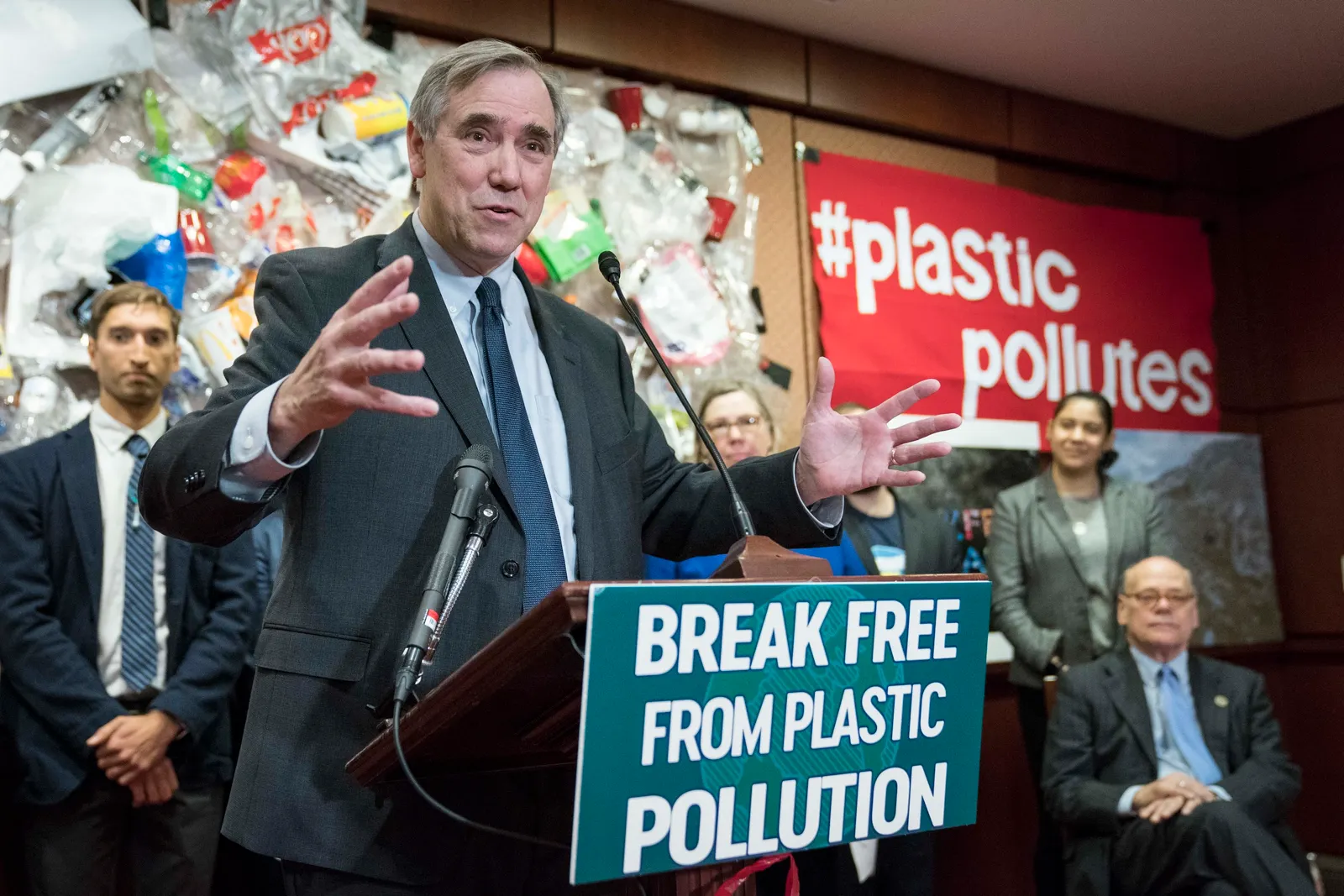
Senator Jeff Merkley, D-Ore., who has sponsored several recycling bills at the federal level, said via email that decisionmakers need comprehensive data to have the best possible recycling systems nationwide and “to best understand how these systems are operating, what challenges remain, and how we can ensure that these systems operate most effectively.”
Merkley recently announced he will chair the Senate Environment and Public Works Committee in the next Congress.
In the U.S., seven states have passed EPR laws for packaging. Those laws mandate a variety of data reporting, with most of the programs run by the same producer responsibility organization, Circular Action Alliance.
“Through policies like EPR, states like Oregon have taken the initiative to gather some of this data, and at the federal level, I’ve supported improvements for data collection because there are still many gaps when it comes to national recycling data,” Merkley wrote.
He supports that data collection because “this information is critical to making sure our recycling systems are working for consumers, businesses, and our environment,” adding that “I will continue to push for Congress to get legislation over the finish line that bolsters recycling data collection and our recycling system at large.”
To Oldendorf, one of the more interesting aspects of EPR data collection is getting more granular information on the type of packaging material.
“You can get a little better snapshot on some of that — it’s not just straight-up weight,” she said. “It will be really interesting to see what comes out of that and what it looks like.”
An EPA spokesperson said that the agency could incorporate EPR data into its reporting, if it’s made public, but the agency doesn't have the authority to require states to collect and report data from their programs.
Carhart sees EPR programs as the biggest contributor to more data reporting in the past few years, and likely into the future. He cautioned that each EPR program has a slightly different material scope. That means those datasets may still be incomplete, but they should still provide a “relatively consistent measurement methodology.”
Reid said he hopes as each program gets up and running, everyone involved will seize the opportunities to create harmonization.
“It's hard when you get too entrenched,” he said. “If there’s a willingness across leaders, it would be to everyone's benefit.”
Seven states out of 50 is by no means a majority, even if one of the states is California, but Marshall said there’s still a big opportunity to improve modeling. Combined, the current EPR states cover about 20% of the U.S. population.
“Local programs and processors and organizations across the supply chain will be putting data forward and tracking their programs in a more consistent way than the U.S. has ever seen,” he said, and while recycling programs are different between states, “there are a lot of similarities that we can grow and improve from.”
While the lack of national data has plagued the system for decades, Marshall said he does see progress and feels it’s important to keep in mind that when it comes to data, “we're never satisfied” but “each year we get a little bit better.”