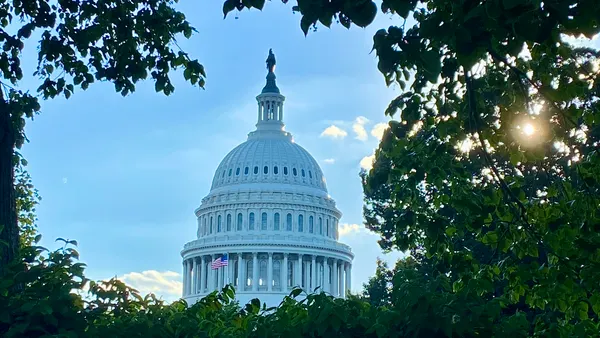
Lawmakers are entering their final few weeks of the 119th Congress and several recycling and waste-related bills are still in the mix.
A handful of bills, including ones addressing critical minerals recycling and regulations related to the Resource Conservation and Recovery Act, have passed the House. Yet these bills are running out of time to be heard in key committees and by the Senate as a whole. The outcome of the recent election could also be a factor in how these bills move before the end of the session and whether they are reintroduced next year.
Congress has not passed a major recycling related bill in several years. The ones that have advanced this year reflect wider themes of how recyclers, associations and environmental advocates hope to manage recycling systems in coming years. Several bills also center on the Trump administration’s focus on framing domestic critical minerals supply chains as a national security issue.
Battery Recycling for America’s Competitive Economy (BRACE) Act
HR 9615 calls for updating federal battery regulations to account for current lithium-ion chemistries. The House of Representatives passed the bill on Sept. 15. It was referred to the Senate Committee on Environment and Public Works but has not yet been scheduled for consideration.
The bill would direct the U.S. EPA to conduct rulemaking to recognize lithium-ion batteries as universal waste, a category of hazardous waste, within 18 months of enactment.
The bill was introduced by Rep. Marianette Miller-Meeks, R-Iowa, who recently lost her reelection bid. She says the bill would reduce costs and permitting requirements by allowing “destination facilities to store lithium-ion batteries at the same location where they are recycled.” It would also help streamline the potential to recover more lithium, cobalt, nickel and copper, she has said. The bill has additional bipartisan cosponsors in the House.
Some waste and recycling groups have urged the EPA to work more quickly on updated rules for lithium-ion batteries under RCRA, especially as these batteries continue to cause fires at facilities and in collection vehicles.
Miller-Meeks said during a July hearing that battery handlers and recyclers have “wrestled with a lack of clarity and confusion surrounding current regulations.” She argued that outdated RCRA rules “have made it harder for American recyclers to compete” with China in the critical minerals arena.
Coordinating and Harnessing America’s Recovery of Minerals (CHARM) ACT
HR 9617, titled the Coordinating and Harnessing America’s Recovery of Minerals Act, or CHARM, passed the House in September and is now in the Senate Committee on Environment and Public Works.
The bill would prompt the EPA to develop a national strategy to support critical mineral recovery within two years. That would include finding ways to recover critical minerals from “discarded materials.”
The bipartisan bill is sponsored by Rep. Gary Palmer, R- Ala., and Paul Tonko, D- N.Y. Both lawmakers won their reelection bids last week.
During a July subcommittee hearing, Palmer framed the bill as a way to shift the United States’ critical mineral reliance away from “adversaries such as China” and toward strategies from extracting the minerals from recycled electronics, legacy mines, coal ash and other “overlooked sources already here at home.”
U.S. EPA officials have said the agency could take a closer look at critical minerals recovery efforts in coming years. Steven Cook, principal deputy assistant administrator for the Office of Land and Emergency Management, said critical minerals discussions would be “ongoing” related to coal ash and other materials. It’s part of a broader Trump administration effort to balance environmental protection with economic growth. Cook did not directly name the CHARM Act or endorse specific legislation, but he acknowledged during a meeting with state and local solid waste officials in October that
“That's our challenge: How do we evolve our programs, our thoughts, our efforts to make sure we are protecting human health and the environment, while that economic model is changing,” he said.
Environmental Monitoring and Remediation Technology Assessment Initiative Authorization Act
HR 9616 would call for the EPA to make updates to 2023 program focused on recovering critical materials from contaminated sites.
Updates would include developing technology to recover materials from mining waste at legacy sites during remediation. It would also direct the EPA to broaden the program to also include more kinds of sites, including Superfund sites on the National Priorities List. It would also establish about $10 million in annual funding for these projects.
Reps. August Pfluger, R-Texas, and Greg Landsman, D-Ohio, sponsored the bill. Both lawmakers won their reelection bids earlier this month. Pfluger has framed the bill as another way to move away from foreign sources of critical minerals. “This legislation turns contaminated sites into strategic assets while speeding up the restoration work our communities need,” said Pfluger in a statement.
Recycled Materials Attribution Act
The bipartisan bill, S.5674, calls for establishing federal-level standards for recycling and recycled content marketing claims. Those standards would be used to update the Green Guides, the Federal Trade Commission’s environmental marketing claims document.
The bill also calls for mass balance accounting to be recognized as a way to substantiate recycled content claims, which has made the bill contentious with environmental groups. Meanwhile, plastic industry groups, including the American Chemistry Council, have applauded the bill and have called for a speedy passage.
The House version of the Recycled Materials Attribution Act advanced out of the House Committee on Energy & Commerce Sept. 16. The Senate version of the bill was introduced Sept. 30.
Supporters say the bill will help streamline recycling marketing claims and protect consumers from false claims. The Recycling Leadership Council, a group led by the Consumer Brands Association, backs the bill. Its members include the American Chemistry Council, Closed Loop Partners, the Household & Commercial Products Association, the Vinyl Institute and other industry groups which backed the bill.
Opponents of the bill, including the Ocean Conservancy, say bill language, particularly around mass balance, could open the door for more chemical recycling projects and lead to more greenwashing.
The Natural Resources Defense Council calls the bill deceptive, saying it allows the plastics industry to adopt “ a self-serving definition of recycling, which sweeps in plastic incineration like pyrolysis and gasification that mostly produces fuels, not new plastic.”
Sponsors of the House version include Reps. Nick Langworthy, R-N.Y., Don Davis, D-N.C., Gabe Evans, R-Colo., and Jonathan Jackson, D-Ill.
Packaging and Claims Knowledge (PACK) Act
The PACK Act advanced out of the House Committee on Energy & Commerce Sept. 16.
It aims to reduce consumer confusion by amending the Federal Trade Commission Act to include certain requirements for recyclable, compostable and reusable claims for consumer product packaging. That includes a provision that they make qualifying claims and are backed by third-party certifications. Rep. Randy Weber, R-Texas, sponsors the bill along with 19 other cosponsors, including one Democrat.
Packaging that doesn’t meet stated parameters would be prohibited from using resin identification codes surrounded by chasing arrows, according to the bill.
The bill calls on the FTC to establish an advisory council of experts and industry stakeholders to meet each year. The FTC would also have to issue guidance on third-party certification, including considering different types of packaging materials, colors, shapes and sizes.
Supporters include packaging companies such as Amcor, Anchor Packaging and Dart, and CPGs such as Kraft Heinz, General Mills and Nestlé USA.
Trade groups such as Ameripen, the Plastics Industry Association, EPS Industry Alliance, Biodegradable Products Institute, Can Manufacturers Institute, Carton Council, Foodservice Packaging Institute, Flexible Packaging Association and others also support the bill.
But the NRDC opposes the bill, saying it allows “the industry free rein to put a recycling symbol (also known as the chasing arrows symbol) on packaging that, in reality, may not be recyclable.”
Other bills to watch
- Recycling and Composting Accountability Act (H.R. 4109): The bill directs the EPA to determine the feasibility of implementing a national composting strategy. It also asks the EPA to more formally collect numerous types of nationwide recycling and composting data. This bill was introduced in 2025 but didn’t move until it was considered in a House committee hearing on May 14, 2026. A coalition of nearly 50 groups representing manufacturers, consumer brands, trade groups and environmental organizations have called for a full House vote on the bill, along with another related bill, the Recycling Infrastructure and Accessibility Act. A previous version of the bill passed the Senate on March 12, 2024. Similar versions have been introduced since 2022.
- Recycling Infrastructure and Accessibility Act of 2025 (H.R. 2145): RIAA aims to establish recycling infrastructure in underserved areas by offering grants worth between $500,000 and $15 million to states, local governments, tribes and public-private partnerships. The grants would focus on areas that lack more than one MRF within a 75-mile radius. A House subcommittee considered the bill on May 15, 2026. RIAA was introduced in 2022 and reintroduced in 2023.
- The Cultivating Investment in Recycling and Circular Local Economies (CIRCLE) Act (H.R. 4466): The bill calls for establishing a 30% investment tax credit on private investments in certain recycling infrastructure, phased out over 10 years. Local municipalities that make similar investments would receive a direct rebate equal to the credit. The bill, sponsored by The Recycling Partnership, has “stalled out,” CEO Greg Saxon said in a recent interview, but the organization says it plans to continue work with lawmakers to move it forward next year.